
Mechanisms and worked studies
An interaction and sequencing exhibit
Distinguish marginal attribution from final-state change
A package is not generally the sum of standalone measure promises. Measures can affect the same load, change the base on which a later measure operates or share an enabling system. A supply change can serve demand that an efficiency measure later removes. An added process can create load to which a subsequent efficiency assumption applies. These interactions change the meaning of incremental benefits. The analyst should identify the affected states and compare the complete package before treating individual reductions as independent opportunities.
Overlap is a physical relationship before it is a ranking problem. If an efficiency measure removes part of a load, a supply measure can serve only the remaining load unless another use is represented. If supply already covers most annual demand, a later efficiency measure may reduce renewable energy used rather than the grid energy that would have been removed in a standalone case. The package can still have a strong final result. The incremental attribution differs because the preceding state differs. A measure does not possess an invariant annual abatement amount outside its package and reference state.
The paired overlap studies make this distinction explicit. They contain the same efficiency and supply measures, the same baseline, factors, prices, capital, operating costs and financial convention. Only the supplied sequence is reversed. In this particular pair the final demand, energy mix, emissions and financial results are identical. The emissions reduction assigned to each step is different. The result is package invariance with changing marginal attribution. It does not establish that order never matters; it establishes exactly what order changes in this defined package.
Incremental attribution can be useful for explaining the path from the baseline to the package. It shows which change occurs at each supplied stage and helps reveal overlap. It becomes misleading when those increments are separated from their sequence and presented as standalone opportunities. A later measure's displayed reduction can be much smaller after an earlier measure has already changed the state. That difference is not necessarily inferior engineering performance. The reviewer should preserve the preceding state and identify whether the increment answers an implementation question, an attribution question or a selection question.
The sequence in the annual engine is an order of state transformations. It is not a construction schedule, a commissioning plan or an optimisation result. A real project may require some measures to precede others because of connection, control or process dependencies. The model does not enforce those requirements. It can show a conditional supplied order and compare its reversal, but the operating team must determine whether either order is feasible and whether the percentage scope represents the actual affected loads. The numerical permutation is a challenge, not an implementation instruction.
Marginal attribution changes while the overlap package stays fixed
The studies reverse only the order of the same supplied measures. Each row reports the reduction from the state immediately preceding that step.
Scroll for all columns. With the table focused, use the left and right arrow keys.
| Marginal attribution changes while the overlap package stays fixed | |||
|---|---|---|---|
| Study sequence | Step | Incremental abatement, tCO2e/year | Emissions after step, tCO2e/year |
| Efficiency first | Demand efficiency | 1,200.00 | 4,800.00 |
| Efficiency first | Supplied annual renewable energy | 4,640.00 | 160.00 |
| Supply first | Supplied annual renewable energy | 5,220.00 | 780.00 |
| Supply first | Demand efficiency | 620.00 | 160.00 |
Canonical overlap-efficiency-first and overlap-supply-first output pointers. Incremental quantities retain their package context.
The final overlap-package invariance is a separate result
The identical final quantities are a property of these supplied cases. They do not make every sequential transformation interchangeable.
Scroll for all columns. With the table focused, use the left and right arrow keys.
| The final overlap-package invariance is a separate result | ||
|---|---|---|
| Final package field | Efficiency first | Supply first |
| Demand, MWh/year | 8,000.00 | 8,000.00 |
| Renewable energy used, MWh/year | 8,000.00 | 8,000.00 |
| Unused supply, annual MWh | 1,000.00 | 1,000.00 |
| Annual abatement, tCO2e/year | 5,840.00 | 5,840.00 |
| Net annual saving, USD/year | 520,000.00 | 520,000.00 |
| Package NPV, USD | 1,318,760.57 | 1,318,760.57 |
Canonical paired overlap package pointers. All quantities are illustrative and retain the annual electricity boundary.
Different intermediate attribution converges to the same final state
The paired illustrative packages reverse the same measures. Their first completed states differ, but their final annual emissions coincide. Read the incremental reductions and final package quantities in the accompanying tables.
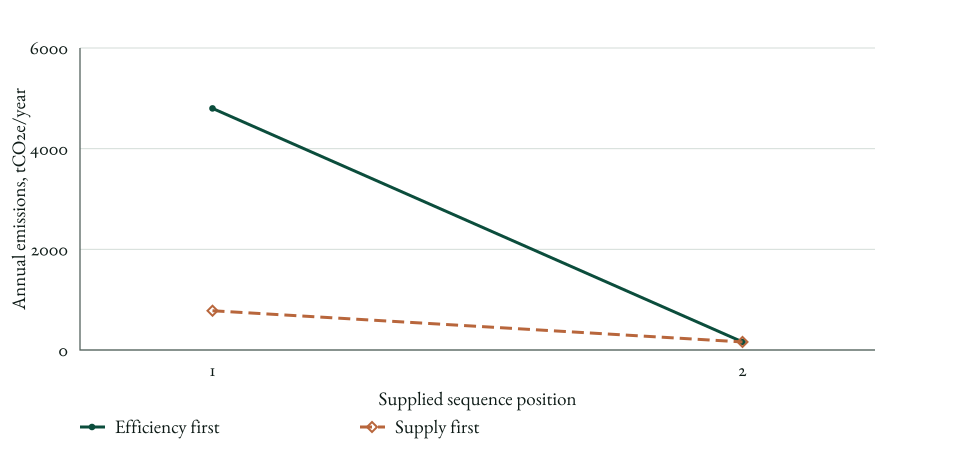
Original deterministic drawing from the paired overlap canonical output pointers. Connectors link discrete completed states; the horizontal axis is supplied sequence position, not time or a commissioning schedule. No intermediate operating trajectory or optimisation is calculated.
Added demand provides a counterexample to universal order invariance. In the sequence-interaction study, demand is added before a percentage reduction is applied. Reversing the order applies efficiency to the original demand and then adds the new load. The final demand therefore differs under the engine's supplied interpretation. The study exposes a physical assumption: whether the efficiency measure can affect the added load. The appropriate engineering response is to examine that scope, not assume that whichever numerical order yields the larger benefit is the correct implementation plan.
A load-specific model could represent those relationships differently. If the new load is unaffected by the efficiency measure, applying the facility-wide percentage after addition would overstate the saving. If the efficiency intervention genuinely controls the enlarged system, the later percentage can be a reasonable abstraction. If the measures affect separate loads, a different decomposition may be preferable. The annual engine uses the supplied remaining-demand convention because it is transparent. The engineering record must establish whether that convention is adequate for the actual package under consideration.
Shared infrastructure introduces another kind of interaction. Connection work, controls, supporting equipment or operating capability may enable several measures. Counting their full cost against each standalone measure can overstate package expenditure; omitting them because no individual measure owns the interface can understate it. The screen sums listed upfront capital and constant operating costs without a dependency architecture. The analyst should allocate or represent shared terms coherently in an expanded case. The committee needs to understand both the cost of the complete operating state and the consequence of excluding a measure.
The same issue applies to avoided costs. A package may eliminate a system only when all required measures are implemented. A standalone measure cannot claim the entire removal saving if the old system remains necessary. Conversely, a package that changes supporting demand should retain the resulting expenditure even if it sits outside the principal equipment contract. The review should trace every claimed shared benefit to the condition that makes it available. A package calculation with coherent scope is stronger than a collection of attractive component business cases that cannot coexist.
Selection should therefore follow dependency and package analysis. An abatement-cost curve that sorts supplied increments by price can be a useful communication device, but it can suggest independent selection when increments overlap. The Transition lab retains the supplied sequence for its incremental display. It does not solve a constrained measure portfolio or search all feasible packages. The committee should treat the increments as an explanation of a defined package and develop the relevant alternatives separately. A sorted visual should never be allowed to create feasibility or independence that the underlying model lacks.
A different permutation changes the final physical state
The sequence-interaction case adds electrical demand and applies an efficiency percentage. The reverse result changes which demand the percentage can affect under the supplied model convention.
Scroll for all columns. With the table focused, use the left and right arrow keys.
| A different permutation changes the final physical state | ||
|---|---|---|
| Final field | Supplied order | Reversed order |
| Demand, MWh/year | 9,000.00 | 9,500.00 |
| Attributed emissions, tCO2e/year | 5,400.00 | 5,700.00 |
| Package NPV, USD | -208,711.81 | -660,876.49 |
Canonical sequence-interaction output and reverse pointers. The comparison tests scope; it is not a construction schedule.
Completed Aster Works package-scope review
The record distinguishes an attribution-only permutation from a permutation that changes the physical state. It identifies the evidence needed to interpret either result.
Scroll for all columns. With the table focused, use the left and right arrow keys.
| Completed Aster Works package-scope review | ||
|---|---|---|
| Interaction question | Completed finding | Decision consequence |
| Does order change the overlap package? | Final state and financial result are invariant in the paired overlap studies | Retain different step attribution without claiming a different final benefit. |
| Does order change added-demand interaction? | Final demand differs in the supplied and reverse outputs | Verify whether efficiency affects the added load. |
| Are shared interfaces represented? | No connection or enabling-system dependency architecture is supplied | Develop complete package costs and feasibility before selection. |
| Can increments be selected independently? | No independent-selection or optimisation claim is supported | Compare defined feasible packages rather than sum unrelated marginal promises. |
| Is the reverse order executable? | No commissioning or schedule evidence is supplied | Treat reversal as a numerical challenge until operations validates it. |
| Accountable evidence | Mara Sene owns EW-SCOPE; numerical overlap is checked, but actual affected-load and commissioning relations are absent | Prepare a load-interface matrix before engineering-sequence acceptance. |
| Authorised use | Use overlap invariance and reverse-demand difference to identify scope questions | No permutation is accepted as a construction schedule. |
| Stop authority | Mara Sene stops a sequence that applies efficiency to an unsupported added load or removes required service | Return an executable scope at the maintenance-plan freeze. |
Original completed package review. The named studies remain supplied illustrative cases.
Classify the interaction before comparing the package
The reviewer maps each measure to its affected load and preceding state. The analyst distinguishes a change in incremental attribution from a change in final physical output. Shared costs, supporting loads and enabling conditions are recorded for the complete package. The operating owner identifies feasible sequences and service constraints. A numerical permutation can reveal a missing scope assumption but cannot choose the engineering sequence. The committee compares coherent executable alternatives, retaining package totals and conditional increments rather than treating every displayed measure as an autonomous investment.
The interaction record can prevent a negotiation error. A buyer may ask each supplier to guarantee a standalone saving, then discover that the combined installation removes the same waste more than once on paper. A stronger procurement record identifies the shared state and the basis for package acceptance. Suppliers can still be held accountable for their defined mechanism, but the total claim is reconciled at the relevant perimeter. This avoids asking separate contracts to prove additive benefits that the physical system cannot deliver.
Staging can be diagnosed by separating the state needed for a later measure from the benefit claimed for the first stage. An interface may make conversion possible while delivering little immediate reduction itself. Removing that interface from the pathway should prevent the later state; if another credible route still permits conversion, the particular design is an option rather than a necessary enabler. The annual screen cannot value that strategic choice or enforce its dependency. Keep the enabling condition explicit instead of reallocating later reductions to make every stage look attractive. This preserves the difference between a weak standalone ratio and a coherent implementation sequence.
The ultimate test is whether the package description and its numerical state tell the same story. If the narrative says the efficiency measure affects only existing equipment while the arithmetic applies it to a newly added load, the result requires repair. If the narrative says surplus energy will be sold while the model curtails it without revenue, the commercial case requires expansion. The interaction review uses such discrepancies to direct development work. It improves the recommendation by identifying which relation must be supported, rather than by making the package appear uniformly favourable.
Standalone screens can organise early options
Individual measure screens can be efficient before a final package is designed. They help identify plausible mechanisms and allocate engineering effort. The counterargument is valid when the screens remain provisional and their benefits are not summed without an interaction review. Package development can then combine, exclude or redesign measures with appropriate affected-load evidence. Requiring a final dependency model before any concept is considered would be excessive. Treating independent preliminary promises as a final combined guarantee would be equally weak. The appropriate transition is from isolated mechanism screens to a reconciled package state.
The engine does not optimise or schedule measures
Reversal is a numerical scope challenge, not an executable schedule. An efficiency measure unable to affect the added load would invalidate the corresponding sequence interpretation. Shared interfaces and avoided costs also need package reconciliation before component increments can support a combined commitment.