
Mechanisms and worked studies
An abatement-cost interpretation framework
Read the numerator and denominator before the quotient
Cost per tonne condenses an economic numerator and an emissions denominator. That compression is useful when the terms are coherent and the decision concerns the price of a specified reduction. It becomes misleading when the reader treats the ratio as a complete investment ranking. A project can have a favourable ratio and a small absolute contribution, a large reduction and an unattractive cash outcome, or a financial benefit with no positive abatement. The analyst should preserve the underlying quantities so the committee can identify which objective the ratio actually informs.
The annual electricity engine uses annualised net package cost in the numerator. It converts supplied upfront capital into an equivalent annual charge under the supplied horizon and discount convention, then subtracts net annual cash savings. The denominator is the annual attributed reduction from the supplied baseline to the final package state. This aligns annual bases within the simplified constant-flow model. It does not mean that the equivalent annual capital charge is an actual financing payment or that the project has a recognised emissions credit. Annualisation is an analytical comparison convention.
A negative ratio has a specific conditional meaning when abatement is positive: the represented annualised cost is negative, so the supplied energy-related cash savings exceed the equivalent annual capital charge. It does not establish that the project requires no upfront money, has no implementation risk or will achieve the supplied performance. It also does not imply that every project with a more negative ratio is preferable. A ratio can become more negative because its positive denominator becomes smaller while the same financial saving remains. That change can weaken absolute climate contribution while apparently improving the ratio.
The foundation and low-factor studies expose this denominator effect. The low-factor case retains the same physical demand, renewable quantity, capital, operating costs, prices and financial convention. Only the supplied grid factor changes. The net annual saving and NPV therefore remain identical in the canonical output, while attributed annual abatement falls. The package cost per tonne becomes more negative. Interpreting that movement as an unqualified improvement would reward a smaller emissions denominator rather than a stronger investment. The paired study makes the source of the movement inspectable.
A positive ratio also needs the underlying terms. It can indicate an annualised cost for achieving positive attributed abatement under the supplied assumptions. Whether that cost is acceptable depends on the objective, alternatives, resource constraint and authorised willingness to pay. A ratio alone does not identify the amount of capital required or the liquidity exposure. It does not show whether the facility can execute the measure, whether the reduction is recognised or whether another package offers a better service combination. The committee must connect the ratio to a defined decision rather than allow it to choose its own objective.
The denominator condition is part of the definition
Canonical metric expressed symbolically. Negative net cost with positive abatement is distinct from a nonpositive emissions denominator.
A zero abatement denominator requires a different disposition. Dividing a financial cost by a nonexistent reduction cannot produce a meaningful cost for reducing emissions. The canonical screen returns an unavailable metric rather than fabricating a value. That behaviour should survive tables, exports and narrative. An unavailable ratio is not the same as a zero cost per tonne, and it should not be placed at the favourable end of a ranking. The underlying physical and financial results can still be assessed on their own terms.
The zero-abatement study uses equal supplied factors for grid and additional renewable energy. Its supply change reduces the represented energy expenditure because the supplied prices differ, but it produces no attributed reduction under that common factor basis. The financial saving is therefore compatible with an unavailable abatement-cost metric. This is not a mathematical anomaly. It demonstrates why financial value and climate contribution should remain distinct. The proposal could deserve commercial investigation while its emissions benefit remains unsupported within the retained case.
A smaller denominator can make the negative ratio look better
The paired cases hold all physical and financial inputs constant except the supplied grid factor. Their different ratios must be read with the unchanged financial outcome and different absolute abatement.
Scroll for all columns. With the table focused, use the left and right arrow keys.
| A smaller denominator can make the negative ratio look better | ||
|---|---|---|
| Comparison field | Foundation | Low-factor case |
| Grid factor, tCO2e/MWh | 0.60 | 0.03 |
| Final demand, MWh/year | 8,000.00 | 8,000.00 |
| Annual abatement, tCO2e/year | 3,810.00 | 105.00 |
| Net annual saving, USD/year | 380,000.00 | 380,000.00 |
| Net annualised cost, USD/year | -34,992.96 | -34,992.96 |
| Package NPV, USD | 263,709.65 | 263,709.65 |
| Abatement cost, USD per tCO2e | -9.18 | -333.27 |
Canonical foundation and low-factor pointers. Every value is illustrative; the factor change is a diagnostic, not a regional forecast.
A negative abatement denominator also makes the metric unavailable in the engine. The added-demand study increases attributed electricity emissions within its boundary. Reporting a signed quotient as though it were an attractive negative abatement cost would confuse an emissions increase with a saving opportunity. The appropriate record states the direction of the emissions change and the financial result separately. If a broader carrier-switch appraisal could reverse the complete emissions conclusion, that appraisal needs the missing carriers and service relation. The unavailable ratio cannot repair the incomplete boundary.
Uncertainty near a small denominator calls for particular care. A modest change in factors, operating scope or counterfactual can move the result toward no reduction or an increase. The ratio can become very large in magnitude while the decision-relevant physical change becomes small. A confidence range for the ratio may be difficult to interpret when the sign of the denominator is unresolved. The analyst should report the underlying abatement alternatives and the conditions that determine the sign, rather than present a single precise quotient as though its basis were stable.
Factor tests change the denominator while prices remain fixed
The selected illustrative tests vary only the supplied grid factor within each retained package. Lower attributed abatement does not change the supplied physical energy or cash terms. The negative cost-per-tonne comparison must therefore retain its denominator.
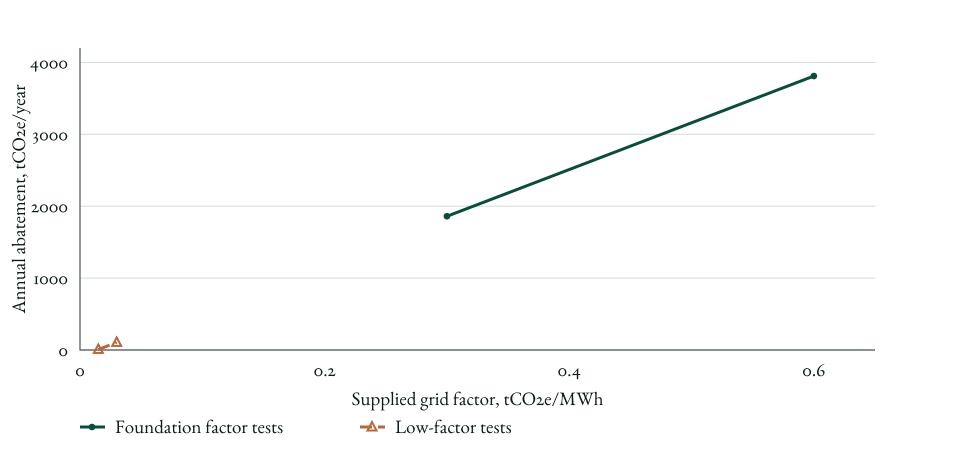
Original deterministic drawing from foundation and low-factor canonical sensitivity pointers. Connectors pair selected discrete tests only; they are not an unperformed continuous response curve, a regional factor estimate or a probability distribution. The table retains the cash and ratio quantities.
The package and incremental ratios should not be mixed. An incremental measure cost is associated with the change from the preceding sequential state, while the package ratio compares the baseline with the final state. Reordering measures can alter incremental attribution even when final package results remain unchanged. The user should therefore avoid presenting a sequence of marginal blocks as independent opportunities that can be selected without interactions. The displayed increments are conditional on the supplied execution order and assumptions. They are not a solved portfolio of autonomous abatement measures.
Financial benefit with no attributed abatement
The case holds the supplied grid and renewable factors equal. The model can report a positive financial screening result while withholding the abatement-cost ratio.
Scroll for all columns. With the table focused, use the left and right arrow keys.
| Financial benefit with no attributed abatement | ||
|---|---|---|
| Case field | Frozen quantity | Interpretation |
| Grid factor | 0.02 tCO2e/MWh | The supplied attribution factor. |
| Additional-renewable factor | 0.02 tCO2e/MWh | Equal to the grid factor in this diagnostic. |
| Annual attributed abatement | 0.00 tCO2e/year | No reduction under the declared factor comparison. |
| Net annual saving | 220,000.00 USD/year | The supplied price difference still creates cash savings. |
| Package NPV | 1,557,937.16 USD | A simplified financial screening result, without a climate reduction. |
| Package abatement cost | not defined | No positive abatement denominator is available. |
Canonical zero-abatement input and output pointers. An unavailable metric is preserved, rather than replaced by a favourable numeric cell.
Use the ratio only after its terms survive challenge
The reviewer confirms a positive, decision-relevant abatement denominator and a coherent annualised cost numerator. The dossier then reports absolute abatement, capital, net saving and the ratio together. A factor or counterfactual challenge is traced to the term it changes. Nonpositive abatement removes the ratio from a reduction-cost comparison while leaving physical and financial findings available. If interactions matter, incremental figures retain their sequence and package totals. The committee chooses an action against its authorised objective and constraints; it does not infer universal preference from the smallest displayed quotient.
A committee with a climate objective may care about total achievable reduction within a capital or delivery constraint. A committee with an operating-cost objective may care about cash release and implementation exposure. A committee balancing both needs a transparent tradeoff rather than a metric that silently substitutes one for the other. The ratio can support that discussion by showing an economic condition per positive reduction. It cannot impose a funding limit or resolve the value of service, resilience or enabling capacity. The appraisal should identify the objective the ratio informs and retain the other decision terms.
An attractive negative ratio can justify closer examination of why the opportunity remains unimplemented. The missing explanation could concern capital availability, production disruption, evidence confidence, operating incentives or contractual charges that the screen omits. It would be premature to conclude that management has ignored a guaranteed saving. The diagnostic should prompt a search for the binding condition. If that condition is resolved, the opportunity may become executable. If it changes the cash or physical terms, the model should be revised before the committee relies on the original quotient.
The strongest use of cost per tonne is therefore explanatory. The analyst shows how a defined package's economics and reduction combine, identifies which assumptions govern the quotient and tests a consequential alternative. The reader can then distinguish a change in engineering, a change in price and a change in attribution. This preserves the compact metric while preventing it from obscuring the mechanism. A ratio becomes a useful decision aid when it is accompanied by enough context to reveal why it moved and what that movement means for the proposed action.
A compact metric can improve comparability
A standardised abatement-cost metric can help a committee compare a large set of defined opportunities and identify promising areas for investigation. Requiring a full dossier beside every entry would make the screen cumbersome. The compact metric is useful when the entries use coherent boundaries and annualisation, retain material interactions and link to their underlying records. The objection does not justify ranking unavailable ratios as favourable, ignoring absolute abatement or treating negative cost as guaranteed cash. A concise register can preserve these distinctions without abandoning the efficiency of a common comparison field.
The metric does not create a carbon value or financing plan
The quotient excludes carbon income, repayment and implementation constraints. Its main falsifier is a nonpositive or unstable reduction denominator, which removes it from reduction-cost comparison. Even a defined negative ratio cannot settle the reference climate mandate or the unsecured-surplus condition.