
Mechanisms and worked studies
A flat energy-price sensitivity study and missing tariff-component record
Connect the physical change to the charge that responds
Physical energy savings become cash savings through a tariff or contract. That relation should be examined rather than assumed. A bill can contain variable energy charges, capacity-related charges, fixed payments, minimum commitments and other terms. Reducing annual consumption may affect some terms while leaving others unchanged. A proposal that substitutes supplied energy can introduce a new obligation or preserve a payment for unused quantities. The analyst needs to identify which expenditure responds to the intervention and which expenditure remains. Multiplying saved annual energy by an average bill rate can obscure that distinction.
A flat variable price is a useful first abstraction when it fits the relevant charge. It lets the screen isolate how a physical change affects expenditure under a supplied unit price. It is less useful when the intervention changes load timing or peak demand, or when contractual terms constrain the cash released. The annual Transition lab uses supplied grid and renewable energy prices in this narrow way. It has no demand charge, time-of-use schedule, fixed fee or minimum purchase obligation. A user should therefore treat its annual saving as a conditional energy-charge calculation, not an automatic forecast of the total bill.
Duty connects physical operation to the commercial basis. A measure that runs during expensive periods can have a different cash effect from the same annual energy change during inexpensive periods. A peak reduction can matter even when annual consumption moves little. A new process can add electrical demand at a time when connection or tariff constraints are binding. Annual totals do not identify these effects. The operating record should state when the relevant load occurs, whether it can move and what service or production consequences a different schedule would create.
A contractual supply arrangement can also change the relation between energy used and energy paid for. The screen charges only the annual renewable energy admitted within remaining demand. It does not charge curtailed supplied energy as a separate purchase obligation, earn export revenue or model storage. A real contract may allocate those costs and rights differently. The commercial reviewer should identify the relevant arrangement rather than infer it from the physical cap. A package can pass the annual balance while its assumed cash benefit fails under an obligation to pay for energy the facility cannot use.
Maintenance and supporting expenditure should be retained independently of energy charges. A technology may require service contracts, consumables, periodic replacement or additional operating capability. A saving can depend on a continuing expense that the sponsor initially leaves outside the energy comparison. The canonical measure operating-expenditure field captures a supplied constant annual amount but cannot assess its completeness. The record should explain what it includes and whether a changed duty affects it. Net cash savings should reflect the operating arrangement needed to sustain the physical benefit.
The foundation and adverse-price studies keep the same demand-reduction and renewable-supply package. Their physical electricity and attributed emissions outcomes are identical because prices do not enter the physical balance. The adverse case instead supplies a lower grid price and a higher renewable price. That change removes the financial benefit under the retained capital and operating terms while preserving positive attributed abatement. The paired study isolates a commercial condition. It does not demonstrate that the technology performs worse or that a future tariff will follow the adverse assumptions.
The comparison is useful because it avoids changing every assumption at once. A financial outcome can reverse while the engineering proposition remains unchanged. The committee should then ask whether the commercial terms can be supported or secured, rather than request a different physical model to explain the cash movement. If the investment is justified partly by a climate objective, the adverse result can reveal the cost of pursuing that objective under the supplied prices. If the investment depends entirely on cash savings, the same result identifies a condition that must be resolved before implementation.
The physical package survives while the price case reverses its economics
Only the supplied grid and renewable prices differ between these paired authored studies. Physical demand, factors, package, capital, operating costs, horizon and discount convention are retained.
Scroll for all columns. With the table focused, use the left and right arrow keys.
| The physical package survives while the price case reverses its economics | ||
|---|---|---|
| Comparison field | Foundation | Adverse-price case |
| Grid price, USD/MWh | 120.00 | 70.00 |
| Renewable price, USD/MWh | 80.00 | 140.00 |
| Final demand, MWh/year | 8,000.00 | 8,000.00 |
| Annual abatement, tCO2e/year | 3,810.00 | 3,810.00 |
| Net annual saving, USD/year | 380,000.00 | -215,000.00 |
| Package NPV, USD | 263,709.65 | -4,220,256.77 |
| Abatement cost, USD per tCO2e | -9.18 | 146.98 |
Canonical foundation and adverse-prices pointers. These illustrative prices are not forecasts or executed terms.
The app's built-in price challenges answer a different question. They apply a common multiplier to both supplied energy prices while retaining the factor and physical package. This tests a movement in the overall price level under a fixed relative relationship. It does not test every change in the relative grid and renewable prices, nor does it simulate a time-of-use tariff. The adverse-price study is a separately authored case that changes the relative terms. These tests should not be pooled into a statistical forecast. Their role is to reveal which commercial mechanism affects the recommendation.
A tariff review should distinguish a market assumption from an enforceable term. A current quoted price might support a concept comparison but remain unavailable at the intended volume, duration or service condition. A contracted price may still have adjustment clauses, indexation, taxes or delivery conditions. A historical bill rate may reflect a load pattern that the project changes. The reviewer should record the price's status and applicability, together with the conditions under which it can be used in the investment case. A number copied from a commercial document is not automatically the marginal charge avoided.
The cash effect also needs a timing convention. A measure may achieve steady-state savings only after commissioning, ramp-up or operating correction. A contract may begin payments before the full benefit is available. The constant annual screen has no representation of those timing mismatches. A fuller case should model them when material to liquidity or value. The tariff record helps identify which cash terms need a schedule rather than a yearly average. An attractive annual total can coexist with an unacceptable period of cash exposure.
Common price scaling is a different challenge from relative prices
The canonical built-in tests scale both supplied energy prices together while retaining the physical package and measure operating expenditure. They show a price-level condition; the separate adverse-price study changes the relative terms.
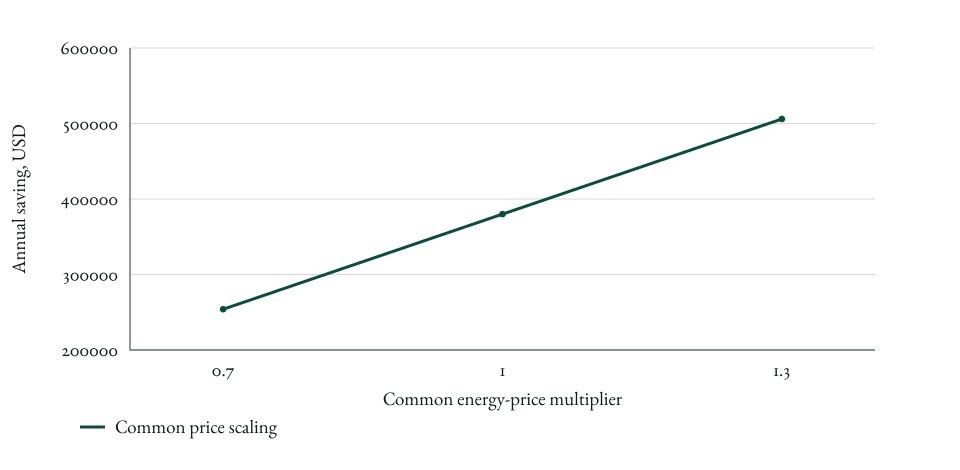
Original deterministic drawing from foundation canonical sensitivity pointers. Connectors organise selected tests, not a future price forecast. No time-of-use charge, demand charge, probability or continuous tariff optimisation is represented.
Completed Aster Works tariff and surplus disposition
The record accepts the supplied flat prices for an educational screen while making the missing tariff propositions explicit. It does not substitute a guessed charge for an unresolved contract term.
Scroll for all columns. With the table focused, use the left and right arrow keys.
| Completed Aster Works tariff and surplus disposition | ||
|---|---|---|
| Commercial term | Completed screening status | Decision-directed evidence |
| Variable energy charge | Supplied flat grid and renewable prices applied to energy used | Confirm the relevant marginal charges and delivery basis. |
| Demand or capacity charge | Not represented | Determine whether the load or peak changes the charge. |
| Time-of-use schedule | Not represented | Map the affected load timing to applicable periods. |
| Fixed or minimum payment | Not represented | Identify charges that persist when physical demand falls. |
| Unused supplied energy | Annual excess receives no bill, export or storage treatment | Review purchase obligation, curtailment rights and permitted export. |
| Measure operating expenditure | Supplied constant annual amount | Confirm sustaining costs, maintenance and duty dependence. |
| Accountable evidence | Owen Diallo owns EW-PRICE and EW-SURPLUS; enforceable rates and unused-supply obligations are absent | Prepare nonbinding bill-component and surplus-term records before supply-term selection. |
| Authorised commitment | Commercial clarification record only; current adverse prices are rejected under the cash rule | No new supply contract or support revenue is approved. |
| Stop authority | Leila Chen stops a saving based on fixed payments assumed to disappear; Idris Ko stops a binding arrangement | Return revised terms and canonical recomputation before commercial release. |
Original completed commercial record. Items outside the engine require a fuller applied tariff and cash model.
Trace each saving to a charge that can actually change
The commercial reviewer maps the physical load change to the relevant tariff or contract term. Each term is classified as avoided, introduced, unchanged or unresolved under the proposed operation. The analyst uses an appropriate temporal basis where timing or peaks matter. The operating owner confirms that any flexibility used in the case is achievable without an omitted service cost. If a decisive term is unresolved, the next action is targeted contract clarification or a wider cash model. The committee treats a flat-price screen as complete only for the terms it actually represents.
The sensitivity record should identify which commercial condition can be controlled. A sponsor may be able to negotiate a fixed term, redesign the package, reduce surplus supply or adjust operating practice. Other conditions may remain exposures that the committee must accept or avoid. The screen cannot choose among those responses without the relevant terms and constraints. It can show why the question matters. A recommendation that names the decisive tariff condition is more useful than one that simply asks for a more conservative price.
A price challenge should not be used to disguise a physical evidence problem. If the efficiency percentage lacks support, testing many tariffs does not validate the saving. If the supply quantity is unavailable during production, a favourable flat price does not make it usable. Commercial and engineering reviews should remain connected through the same operating state, but their missing propositions need distinct remedies. The committee should allocate investigation to the field that can change the decision, rather than let a detailed tariff model lend credibility to an unsupported physical assumption.
The result register should preserve gross energy expenditure, sustaining costs and the net cash term used in valuation. This helps the reader distinguish a supply-price disadvantage from additional maintenance or capital exposure. It also makes later contract changes interpretable. If a new tariff changes only the cash result, the physical proposition can remain intact while the recommendation is reopened. If a new operating schedule changes both load and charges, the study needs a revised physical state as well. The record should follow the mechanism rather than preserve the original headline at all costs.
An average unit rate can be an efficient preliminary screen
A concept assessment can use a flat rate when the affected expenditure is predominantly variable or when tariff detail is unlikely to change the next action. The objection to early commercial complexity is reasonable if the record states what the rate represents and retains material omissions. A total-bill average is less defensible when fixed charges, peaks or minimum payments drive the result. The analyst can test a bounded assumption and request the decisive terms before commitment. Proportionality permits a simple model; it does not make every omitted charge responsive to energy savings.
No complete tariff, forecast or financing cash schedule is modelled
Flat energy prices cannot test fixed payments, peaks, time periods or paid unused supply. A contractual term that prevents cash release invalidates the applied saving even if the energy balance stands. Owen Diallo must return that term and a suitable recomputation before commercial release.