
Governance and application
A staged transformation roadmap
Sequence the commitment as well as the capability
A capability sequence and an authorised commitment are different objects. The Transformation map can produce a conditional selected set from declared dependencies and resource envelopes. The enterprise must decide what it may commit to doing with that set. A production service may require tested identity, legitimate authority, operating support and an accepted continuity route. A bounded discovery stage may require a narrower commitment to obtain evidence. The synthesis proposed in this study joins the calculated candidate to those distinct commitment conditions.
Established appraisal, evaluation, quality-assurance and risk guidance supplies the scoped principles. The authored synthesis connects an operating capability to declared dependencies, a reproduced resource choice, its absent acceptance evidence and a bounded decision branch. Its cases show where this chain changes the act compared with treating a ranking as permission. The contribution is that demonstrated distinction; no replacement of the guidance or empirical superiority in a real enterprise is claimed.
The fictional sponsor considers the reference programme and a constrained alternative. In the reference, the app selects data, ownership, exception service and planning, with cost 370.00 USD thousands, effort 34.00 person-months and adjusted assumed annual benefit 251.65 USD thousands. The nominal available effort is 40.00 person-months. That is a coherent calculation under its declared input, but the sponsor must verify whether that envelope actually represents the relevant operating and delivery capacity.
Original diagram: calculation to authorised commitment
Inspect the original relationships within the captioned scope.
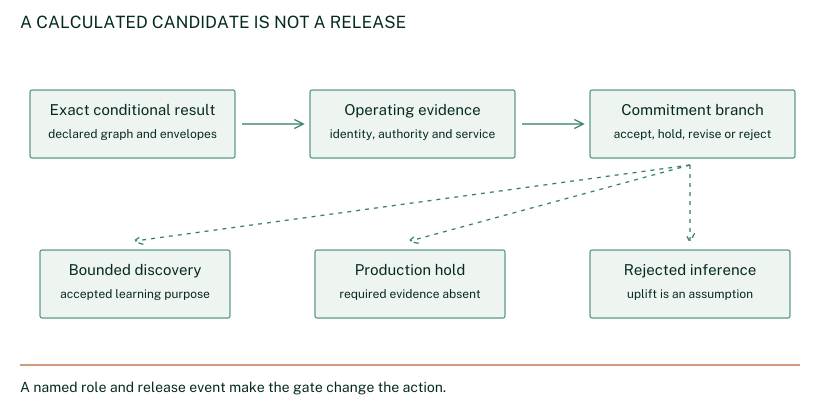
Original synthesis of the completed illustrative decision branches. Computation is actual for authored inputs; the enterprise roles and operating evidence obligations are fictional. The gate changes the commitment rather than decorating a numerical recommendation.
The effort-constrained case changes only the available aggregate effort to 24.00 person-months. The engine selects data, ownership and exception service. It reports cost 270.00 USD thousands, effort 24.00 person-months and adjusted assumed annual benefit 149.65 USD thousands. Remaining budget is 230.00 USD thousands while remaining effort is 0.00 person-months. The unused budget is not evidence that planning can proceed. The explicit effort constraint directs a different intervention than a generic request for more capital.
The comparison identifies the binding declared resource, so the sponsor cannot treat the full reference sequence as executable within a smaller effort envelope. It also leaves operating questions open: whether ownership is actually delegated, data fits the included use and the exception owner can run the service. Selected capability names establish none of those propositions. Assign each as an evidence obligation for the next commitment.
Calculation-to-commitment synthesis
Accept the conditional analytical result, then choose an authorised commitment branch with a named role, bounded use, evidence identity and status, release event and stop authority. Public guidance supplies principles; the original case chain shows why the branch can differ from the numerical selection.
Walk the intervention through the exact cases
The sponsor's proposed intervention is a bounded exception-service discovery supported by identity and ownership work. The purpose is to test the controlling meaning and authority route before production automation. The analytical basis is the effort-constrained input and exact output, not a claim that its benefit is measured. The selected data, ownership and exception capabilities form the candidate scope. The sponsor limits the approved action to investigating and demonstrating their operating mechanism; the model's annual benefit remains a conditional assumption.
The operations-ready alternative changes only the operations readiness judgment within the full reference envelope. It selects data, ownership, exception service and operations, costing 450.00 USD thousands and consuming 40.00 person-months, with adjusted assumed annual benefit 309.25 USD thousands. That attractive quantity does not fit the constrained case's available aggregate effort. It also rests on an assumed operations readiness uplift rather than on evidence that the uplift has occurred. The sponsor should not import the higher result while ignoring those changed conditions.
Illustrative. The budget-constrained case supplies a useful contrast. It selects the same data, ownership and exception set as the effort-constrained case, but retains 16.00 person-months of effort and only 30.00 USD thousands of budget. Identical selected names do not mean identical diagnosis. In one case effort blocks expansion; in the other cost does. The remedy should address the declared binding condition and still preserve operating gates. A broad statement that the organisation is not ready loses this distinction.
The intervention therefore has a concrete next event: before any pilot release that permits an automatic operating or commercial decision, the sponsor requires accepted identity meaning, documented real authority and a funded exception route. Discovery may proceed to obtain those records. Production remains held while they are absent. The event boundary is more useful than an arbitrary calendar deadline unsupported by an actual project schedule. It tells the service owner which action is prohibited and which evidence can release it.
If discovery establishes that the required authority cannot be secured, the sponsor must revise or stop the intended capability. If data acceptance supports only a narrower population, the next approval can remain bounded to that population. If effort becomes genuinely available, a new declared input can test the resource sequence, but that change does not erase the evidence gates. The synthesis preserves both conditional calculation and authorised work through the intervention rather than collapsing them into a single readiness score.
Complete the decision branches
The fictional investment chair accepts the analytical candidate and bounded learning purpose supported by the frozen effort-constrained input/output pair and its exact common-engine reproduction. That evidence establishes the declared resource choice, with production testing unestablished. The chair assigns the operating service owner to obtain the missing service evidence before seeking release. Neither the model's implementation amount nor an unestimated discovery budget is authorised; each resource commitment requires its own approval.
Hold production while E-ID-MEANING, E-AUTHORITY and E-EXCEPTION-SERVICE are required but absent. They identify use-specific identity acceptance, actual delegation with coverage and a funded usable exception service. The worksheet records missing requirements, with no fabricated documents. The sponsor's stop authority prohibits dependent production use until those conditions are met. This defined hold is a completed decision; it leaves the evidence question unresolved.
Completed illustrative sponsor branch record
Filled decision record for the exact cases. Actual computational evidence is separate from explicitly absent operating evidence. No real committee approval is asserted.
Scroll for all columns. With the table focused, use the left and right arrow keys.
| Completed illustrative sponsor branch record | ||
|---|---|---|
| Branch and role | Evidence identity/status | Bounded action and stop event |
| Accepted: fictional investment chair | effort-constrained.input/output; exact canonical reproduction | Accept analytical shortlist and bounded discovery of identity, authority and exception mechanism. |
| Held: operating service owner | E-ID-MEANING; required, not supplied | No production decision use before accepted identity evidence for the included population. |
| Held: operating sponsor | E-AUTHORITY; required, not supplied | No automatic approval before real delegation and coverage are documented. |
| Held: service funding owner | E-EXCEPTION-SERVICE; required, not supplied | No production release before funded case ownership and continuity are accepted. |
| Rejected basis: investment chair | operations-ready sensitivity; reproducible assumption, no acceptance evidence | Do not treat readiness uplift as proof of production acceptance. |
| Revision authority: investment chair | New bounded operating records and revised declared input | Reassess or stop before widening use; service owner retains the hold until explicit release. |
The unsupported-readiness branch is rejected as an approval basis. The operations-ready numerical result is reproducible, but the readiness change is a declared sensitivity assumption. No operating record establishes that change in the fictional enterprise. The investment chair refuses to use the uplift alone as proof of implementation acceptance. This does not reject the operations capability permanently. It rejects a specific argument for commitment whose necessary evidence is absent.
The final branch is revision. If discovery produces bounded usable evidence, the service owner may propose a narrower production population with actual authority and support. The sponsor then assesses that scope and its resource input as a new controlled decision. If evidence contradicts the benefit mechanism, the proposition changes or stops. The record preserves the event, role, evidence identity and permitted action for each branch, making the next step executable within the fictional governance design.
Test whether the operating gates change commitment: the same calculated set supports discovery and leaves production held. If the record merely adds cautions without changing a branch, the synthesis has supplied no decision distinction. Its use also depends on the authorised owner maintaining that boundary. The completed fictional branches demonstrate the design, with no guarantee of real organisational behaviour.
Gates can become bureaucratic labels
They can if no action changes when evidence is absent. The demonstration holds production and rejects the unsupported uplift while permitting bounded discovery. A gate should govern a specific commitment through a usable authority, not merely add a warning to a recommendation.
Preserve the conditions under changed pressure
The fictional sponsor then faces pressure to accelerate because a broader platform procurement is already planned. The decision record does not require delaying every technical action. It allows preparatory work that does not imply production acceptance, subject to its own resource and continuity approval. It retains the prohibition on automatic operating decisions while identity and authority evidence remain absent. This separates a legitimate delivery option from an unsupported claim that the operating capability is complete.
The fictional sponsor tests the supplier's proposed shortcuts against their exact mechanism. A configured workflow can block an unauthorised role, but it cannot establish which real delegation grants that role a power. A mandatory identity field can prevent an empty submission, but it can force an unsupported selection if qualified unknowns are unavailable. The remedy therefore depends on the failure: establish and implement the authority route, or preserve unresolved identity and its resolution service. Buying another workflow feature would not necessarily repair either object. This comparison converts platform pressure into specific design questions while retaining the held production branches from the completed record.
The accepted shortlist also receives a delivery challenge by prerequisite. Identity work needs access to the relevant operating records and qualified interpretation. Authority work needs an available decision sponsor. Exception design needs receiving and finance participants in the same case exercise. Aggregate person-months can cover their declared total while those specialised contributions never coincide in a useful window. The fictional chair therefore requests a dependency delivery account before converting the shortlist into an execution promise. If an existing funded team can supply the contributions within the relevant sequence, the account can reuse that commitment; if it cannot, the selected capability remains an analytical candidate. No new calendar or resource quantity is invented.
The completed transfer from shortlist to commitment has a specific outcome: preserve the canonical resource candidate, use bounded discovery to resolve the case relationships, and retain production holds attached to the absent records. New discovery evidence is classified by consequence. Accepted identity changes the permissible population; an actual delegation changes the route; funded exception coverage changes service continuity; a revised assumption changes only the analytical input until its operating meaning is established. This prevents a general progress report from crediting all forms of advancement as release readiness. The contribution is a trace from each new evidence object to the exact branch it can change, without adding a score or pretending that the fictional enterprise has implemented the capability.
A fictional branch is not an actual delegation
The computation is actual and reproducible for authored inputs. The sponsor, commitments and operating evidence IDs are illustrative. No real production approval, resource availability or service acceptance is established.