
Decision architecture
A value-stream evidence map
Follow the case through the work
A value stream becomes useful when it follows a real type of case from initiation to an operating outcome. It should reveal who receives the case, what they need to decide, what they produce and what happens when the usual route fails. A diagram that connects departments with uninterrupted arrows can conceal queues, informal reconstruction and repeated entry. The digital investment then improves the diagram's apparent route while leaving the actual work largely unchanged.
Consider a fictional industrial shipment whose release depends on an order, a recognised load, a confirmed destination and an authorised movement instruction. Sales enters a requested delivery; planning tests feasibility; dispatch prepares the load; an operating team releases it; finance later reconciles the result. The same shipment may appear under several identifiers. A routine successful case can traverse the service quietly. A changed destination or short load may force staff to telephone several teams and reconstruct which instruction remains authoritative. The exception reveals the operating model more clearly than the happy path.
The evidence map should begin with the initiating event rather than with whichever application is most prominent. It should identify how a case becomes accepted work and what makes it complete. A request received is not necessarily an accepted promise. A vehicle departure is not necessarily a completed delivery. An invoice posted is not necessarily a resolved commercial record. These distinctions prevent a programme from reporting throughput at a convenient intermediate point while presenting it as the terminal outcome.
Original diagram: owned exception work
Inspect the original relationships within the captioned scope.
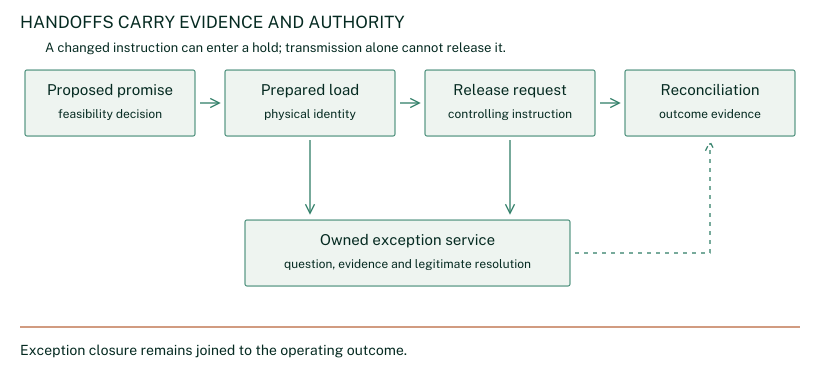
Original qualitative map for the authored shipment case. Arrows identify routine handoffs and a joined exception route, not measured flows or universal process stages. A changed instruction requires an accountable resolution before the operating outcome can be reconciled.
Each handoff has an information obligation and a decision obligation. Planning may hand dispatch a feasible instruction, while dispatch must confirm that the physical load matches its identity and permitted destination. If planning changes the instruction after preparation, the service needs a way to determine which version controls release. An integration that transmits both records successfully may increase the ambiguity unless the operating rule distinguishes superseded from authoritative instructions. Connectivity should therefore be tested with a changed case, not merely an unambiguous original transaction.
A useful map also records work performed outside the formal route. A dispatcher may keep a personal list of unresolved loads because the central system treats instruction creation as completion. That list is evidence of a missing case state or ownership rule. It should be examined before being eliminated. The goal is to bring necessary coordination into an accountable service, while removing avoidable duplication where the new design genuinely supplies the information and decisions previously carried by the informal record.
Handoff evidence acceptance
For each material handoff, identify the case state, information obligation, decision authority, reversible action and exception route. Test at least a changed case before treating successful data transmission as an integrated operating capability.
Queues and re-entry are mechanisms, not decorations
A queue exists when a case waits for a resource, a decision or information. The reason matters because each can require a different intervention. A case waiting for an authorised release role will not necessarily move faster through a better integration. A case waiting for a missing destination identifier may not benefit from additional staff. A case waiting for a scarce physical loading position may not be solved by either. The evidence map should state what would have to change for the case to advance.
Re-entry occurs when a case returns to earlier work after a failure, change or discovery. It may be legitimate. A revised destination can require renewed feasibility assessment. A defective instruction can require correction. The design problem is uncontrolled re-entry: the service cannot tell whether the returned case replaces prior work, creates a new version or remains an unresolved exception. Without that distinction, a digital workflow can duplicate obligations or allow a superseded instruction to remain apparently executable.
Illustrative shipment handoff evidence
Original event-to-obligation map for a changed instruction. It contains no observed frequency or assumed waiting time.
Scroll for all columns. With the table focused, use the left and right arrow keys.
| Illustrative shipment handoff evidence | |||
|---|---|---|---|
| Event | Required evidence | Operating decision | Unresolved route |
| Promise proposed | Recognised demand and destination | Accept or decline feasibility | Commercial clarification |
| Load prepared | Recognised physical load and controlling instruction | Confirm preparation status | Identity or short-load case |
| Instruction changed | Authorised new version and affected preparation | Supersede, hold or re-plan | Change-authority decision |
| Release requested | Current instruction, physical identity and release conditions | Release or retain hold | Authorised coverage route |
| Commercial record reconciled | Delivery evidence joined to instruction history | Approve adjustment or retain dispute | Exception service closure |
The programme should distinguish useful inspection from avoidable repetition. If dispatch verifies physical identity at release, that check may remain necessary even when planning has a clean record. Physical conditions can change or the wrong load can be prepared. Removing the check because the data already exists confuses a record with the physical object it describes. Conversely, retyping the same identifier into several products may add no useful assurance if it introduces transcription risk without an independent check. Work design should evaluate the purpose of the activity rather than assume every repeated action is waste.
The map should identify which state transitions are reversible. A prepared instruction can usually be amended within a controlled process. A physically released shipment may require a different response. An invoiced case may require an adjustment rather than deletion. These distinctions are important for automation because a workflow that treats every state as an editable field can obscure an irreversible operating event. The product should reflect the event's consequence, but the enterprise must define the consequence first.
No invented waiting-time distribution is needed to begin this analysis. The initial map can identify the observed categories that should later be measured and the decision each measurement will inform. For example, the programme can distinguish missing-information holds from resource holds and authority holds. Once real records exist, it can assess their incidence and duration. Before that evidence exists, the map supports a mechanism-level hypothesis, not a numerical claim that a new platform will remove a stated proportion of delay.
Evidence and scope
Systems engineering distinguishes defined requirements from verification of their implementation.
Evidence: NASA Systems Engineering Handbook
Design an exception service alongside the routine route
An exception service should define how a case remains visible when routine processing cannot complete it. It needs an owner, a question requiring resolution, enough context to act and a legitimate terminal state. A generic failed status is insufficient. The fictional shipment might fail because the destination is unknown, the load is physically short, the instruction is superseded or the receiving party disputes the record. Each condition requires a different decision and may involve different authority.
The service should keep the case attached to the operating outcome. If an exception is moved to a separate support ticket and the shipment record is marked complete, the enterprise can lose visibility of the unresolved obligation. Linking records is helpful, but the operating owner must still know who is responsible for closure. A technical support team may fix an interface while the commercial dispute remains unresolved. Technical resolution and operating resolution should have distinct evidence and states.
The exception route should be proportionate. A simple missing field that a permitted user can supply need not become a senior escalation. A contested release instruction may require an authorised hold. The design should state what can be corrected by the originating user, what requires verification and what requires a managerial decision. Automation can then route cases under those rules. It should not infer authority from the convenience of allowing a user to overwrite a field.
An exception record should preserve relevant versions and reasons. In the changed-destination case, the enterprise needs to know which instruction was active when the load was prepared and which was active when release occurred. A current-state-only database may make both actions appear to have used the final destination even if they did not. The information architecture should preserve the evidence necessary to explain the event without treating indefinite retention of every detail as automatically justified.
A service can also close an exception through an explicit refusal or a narrowed outcome. The operator may decline a changed destination after a load has passed an irreversible release point. That refusal should be communicated and linked to the case. A dashboard that counts only approved changes as successful closure can create pressure to conceal legitimate refusals or perform unsafe workarounds. The exception design should be evaluated on accountable resolution, not merely on the disappearance of cases from a queue.
Mapping can delay an urgent delivery
A compact map around the disputed handoff can be enough for an initial decision. Exhaustive enterprise mapping is unnecessary. Urgency does not remove the need to identify the controlling instruction and the release authority.
A changed instruction as the acceptance test
The fictional operator tests its proposed shipment service by changing a destination after preparation but before physical release. The test begins with a valid original instruction, a prepared load and an acknowledged dispatcher. It then introduces the changed instruction through the legitimate commercial route. The team examines whether the old instruction is visibly superseded, whether dispatch receives the change and whether the release role can determine what is now permitted. A successful transmission log is one piece of evidence, not the entire test.
The test also introduces an unavailable release role. This reveals whether the authorised coverage route exists and whether the system preserves a hold while coverage is obtained. A team that resolves the test by asking a programme manager to intervene has demonstrated an available senior person, not necessarily a sustainable service. The test should use the declared operating arrangement or record the arrangement's failure. Otherwise the pilot can conceal dependence on exceptional attention.
The review then follows the case into commercial reconciliation. If the final delivery record and original order disagree, the service must retain an intelligible account of the authorised change. Finance should not be forced to choose a plausible version through informal conversations. The investment proposition can now identify a concrete improvement: a controlled instruction history joins planning, release and reconciliation. Whether that improvement saves money or time remains a separate empirical question.
The value-stream map should be revised after this test. It may reveal a new hold state, a missing authority obligation or an information version that the original diagram omitted. Revision is evidence of learning. The sponsor should preserve the earlier map and the reason for change, so a later reviewer can distinguish an improved model from a retrospectively simplified story. The map becomes an operating design when it can explain a difficult case and direct its resolution, not when every arrow has been drawn neatly.
Mechanism mapping supplies no delay estimate
The shipment case is invented for analytical use. Queue categories identify what to investigate. They do not establish actual delay incidence, staffing need, reliability or savings, and no such quantities are computed by the companion app.