
Mechanisms and worked studies
A canonical-data and interoperability design
An identifier joins records only if meaning agrees
An identifier is useful when participating services agree what it identifies and how its relationship to an object changes. Copying the same string through interfaces does not establish that agreement. A customer identifier might refer to a legal entity in finance, a delivery location in operations and an account grouping in sales. A load identifier might refer to a planned movement, a physical batch or a commercial shipment. Integration can transmit those identifiers flawlessly while joining unlike objects.
Consider a fictional bulk-material service. Planning creates a movement reference before a physical load is assembled. Dispatch assigns a load identity during preparation. Commercial reconciliation groups several physical loads under a customer shipment reference. The enterprise needs relationships among these objects, not an assumption that they are interchangeable. If a system uses the shipment reference as physical identity, it may make a short-load event impossible to explain when several loads share the reference. The semantic model should preserve the object boundaries that the work requires.
An identity design should state who creates an identifier, what event makes it valid, whether it can be reused and what happens when the identified object splits, merges or is corrected. These questions have operating consequences. A split load may retain a relationship to an original preparation instruction while requiring distinct release evidence. A corrected customer identity may need a controlled relationship to historical commercial records. Replacing a value in place can erase the reason earlier decisions were made.
Original diagram: object relationships survive a split
Inspect the original relationships within the captioned scope.
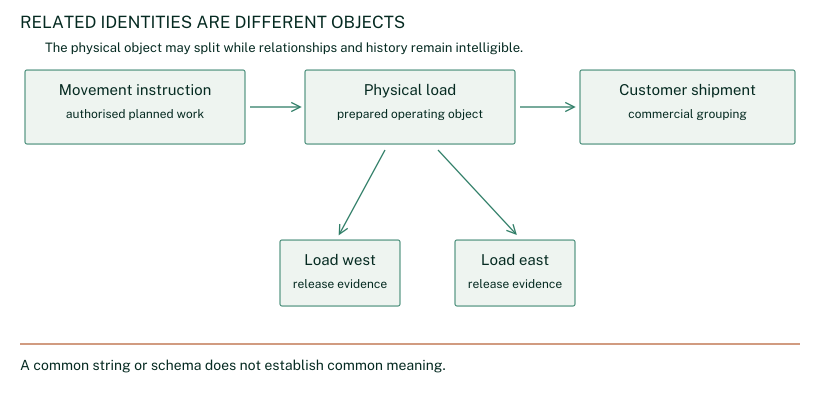
Original qualitative semantic design. The movement, physical load and commercial shipment retain distinct meanings. The split illustrates relationship preservation; the arrows assert no count, proportion, legal authority or observed event.
Names should be treated as descriptions rather than reliable identity unless the service has explicitly established otherwise. Local equipment names, item abbreviations and customer labels may be meaningful to users while remaining ambiguous across teams. The interface should support those useful descriptions without allowing them to silently replace the controlled identity. A lookup service can present both. The operating decision should know which value establishes the object and which assists human recognition.
Identity also requires a route for uncertainty. If a user cannot identify the physical object confidently, the service should allow a controlled unresolved case rather than force a plausible selection to satisfy an input requirement. A required-field rule can otherwise manufacture certainty. The technical architecture should preserve the uncertainty and its resolution history, while the operating model identifies who can establish the correct relationship. This is a joint information and authority problem.
Semantic interface acceptance
Accept an interface after a changed or split case preserves object identity, controlling versions, distinct operating events and correction history. A compatible schema and a successful transmission are necessary technical evidence within that wider contract.
Define states and events before connecting interfaces
A state describes a condition relevant to a decision. An event records a meaningful change or occurrence. The enterprise should distinguish the two before designing interfaces. A load can be prepared, held, released or delivered according to defined operating conditions. A message received by an application is a technical event that may or may not establish one of those conditions. Treating technical receipt as operating completion can create a false picture of progress across connected systems.
The bulk-material service needs to know whether release means a supervisor authorised departure, a vehicle physically departed or a record was posted. Each may matter, but they are different facts. The interface specification should identify which event it carries, whose evidence supports it and what receiving services may infer. A downstream invoice service should not infer completed delivery merely from an authorised release. If it needs delivery evidence, that dependency should remain explicit even if release data is readily available.
Illustrative object and event dictionary
Original dictionary for the split-load acceptance case. Its meanings are deliberately scoped to this authored service.
Scroll for all columns. With the table focused, use the left and right arrow keys.
| Illustrative object and event dictionary | ||
|---|---|---|
| Term | Meaning | Authority or condition |
| Movement instruction | An authorised planned movement before physical assembly | Commercial and planning authority establish its controlling version. |
| Physical load | A prepared object that may split or be held | Dispatch establishes identity and relationship to the instruction. |
| Customer shipment | Commercial grouping of intended deliveries | Commercial operations maintains its promise boundary. |
| Release event | Authorised operating release for the stated physical load | Permitted operating role and recorded conditions. |
| Delivery evidence | Evidence for the receiving outcome | Defined receiving process; not inferred from release alone. |
State changes should have permitted origins. An administrative correction to a record should not be indistinguishable from a physical operating event. The service might allow a data steward to correct an identifier while requiring an authorised operating role to record release. Keeping the distinction allows a reviewer to understand whether an apparent sequence reflects actual events or retrospective record maintenance. It also prevents an interface account with broad technical permissions from becoming an invisible operating decision maker.
Messages can arrive late, more than once or in a different order from the events they represent. A robust interface must manage those technical conditions, but their operating interpretation depends on the semantic design. A repeated release message should not create a second physical load. A late correction should not silently invalidate a completed commercial decision without a defined review. The programme should test these patterns using controlled cases rather than rely on a general claim that the integration is reliable.
The semantic record should state the authoritative source for each meaning and the conditions under which another service may retain a copy. Authority can differ by field or event. Dispatch may own physical load preparation, commercial operations may own the customer promise and finance may own the posted adjustment. A single master label applied to the entire platform can conceal these distinctions. The architecture should express ownership where the work actually requires it.
Evidence and scope
Open standards guidance addresses agreed data sources, identifiers and interoperable information use.
Evidence: Make use of open standards
Open interfaces still need operating contracts
An open format or published interface can reduce technical dependence while leaving important meaning unresolved. A receiving system still needs to know the object, event, units, version and permitted interpretation of each field. It also needs a change process. A technically conforming message can be operationally wrong if its sender and receiver interpret a status differently. The interface contract should therefore connect technical specification with service obligations and accountable meaning.
The contract should define what happens when a required record cannot be supplied. The bulk-material service may permit a qualified record for reporting while retaining a hold on release or reconciliation. If the interface simply substitutes an empty value or a default status, downstream teams may make an unsupported inference. Failure handling should preserve the decision boundary. A visible incomplete case with an owner can be safer and more useful than a successful message that conceals an unresolved fact.
Versioning should account for meaning as well as structure. Changing the definition of delivered while retaining the same field name can be more consequential than adding an optional field. The programme should state which consumers must review the change, what historical records mean and whether a transition period is required. A schema compatibility test can detect some structural problems. It cannot establish that the new meaning preserves the assumptions on which an operating decision depends.
The enterprise should test portability with a meaningful record, not only a file export. A provider may export current fields while omitting instruction history, identity relationships or correction reasons. Another system might receive the file successfully without being able to reconstruct the service's decisions. Exit capability requires a usable semantic record and a way to interpret it independently. This is why open interfaces and data export should be assessed through completed operating cases rather than broad marketing claims.
None of this requires an enterprise to settle every semantic question before delivering useful technology. It requires the programme to define the meanings that the current capability depends on and to retain qualifications where wider agreement remains incomplete. A bounded service can operate through an explicit translation or reconciliation route. The danger is presenting a provisional translation as a permanent universal identity without recording its scope and limitations.
A common platform may impose consistent semantics
A shared platform can help enforce a chosen meaning. The enterprise must still choose that meaning, resolve affected operating distinctions and govern future change. Uniform fields do not demonstrate that the imposed definition fits every required use.
A split load as the semantic acceptance case
The fictional service tests a prepared load that is split before release. The original movement instruction remains relevant, but the physical pieces require distinct release and delivery evidence. The test asks whether the information design can represent the relationship without overwriting the original object or creating an unexplained duplicate. It follows the split through dispatch, customer communication and reconciliation so each role can verify that its decision still refers to the intended object.
A second part of the test corrects a destination description after release. The service preserves the original release evidence and records the correction with its reason. It does not rewrite history to make the original event appear to have used the corrected description. Commercial operations determines whether the correction changes the intended promise or merely improves the record. The difference is an operating decision that a technical update cannot infer safely on its own.
The completed semantic record now identifies movement, physical load and customer shipment as distinct objects with controlled relationships. It defines the release event and the delivered event separately. It states which authority may correct an identity relationship and which may approve a changed operating instruction. These definitions supply a usable basis for interface work. They also make the limits of a provisional migration mapping visible, because a record that cannot preserve these distinctions should not be declared fully equivalent.
A sponsor can use the test to compare architectures. A central service, a federated arrangement and a staged translation may all be feasible. The comparison should examine whether each preserves the required meanings, authority and history with a sustainable burden. The existence of an API is evidence of a technical connection. The completed split-load case is evidence about the operating information contract that the connection must carry.
No enterprise ontology is prescribed
The dictionary is an original illustrative record. Actual identifiers, event definitions, retention obligations and correction powers require local evidence. The Transformation map validates declared dependencies without inspecting semantic compatibility among enterprise systems.