
Mechanisms and worked studies
An illustrative ranking sensitivity table
Turn ranking sensitivity into an evidence agenda
A ranking is a conditional output, not a supplier attribute. Its meaning depends on the admissible alternatives, service requirement, cost boundary and input case. A lifecycle model becomes more useful when it shows which changed premise can move the leader. That task differs from producing a long stress table. The evaluator needs an intervention with an explained mechanism and a decision consequence, so that a committee can identify the evidence or authority that determines its position on the ranking boundary.
Separate a changed requirement from a changed forecast. Extending the common service horizon changes how much service the buyer seeks to obtain. Revising annual electricity changes an operating premise for a stated requirement. Altering the discount rate changes the time-value basis. These can all move the result, but they are different kinds of intervention. If they are combined without a record, the analyst cannot explain why the leader changes or which action could resolve the uncertainty. A useful scenario preserves its category as well as its numeric fields.
Use a controlled pair before a broad combined scenario. Change one material premise while holding the alternatives and other assumptions constant, then recompute the full schedule through the canonical engine. This isolates the consequence within the implemented structure. A combined downside case can subsequently test interacting assumptions, but it should be labelled as combined. The controlled pair does not establish causality in an empirical market or operating system; it establishes the mathematical effect of a defined model intervention.
Maintain the alternative identity across the intervention. The engine sorts its output by present cost, so row position can change when the leader changes. A report comparing the first output row across cases without matching its name may accidentally compare different bids. The narrative and exhibits should retain stable alternative names while explaining that each displayed output list is ranked inside its own case. This is a practical reproducibility control: a technically correct result can still be misread if identity is inferred from a spreadsheet position.
The cost decomposition provides the explanatory bridge. Acquisition, replacement, operation, energy, downtime and terminal credit should reconcile to the modelled present total under the case's conventions. A changed leader can then be traced to the component altered by the intervention. If the explanation cannot reconcile to the component ledger, the evaluator should investigate the input changes or display transformation before presenting a conclusion. A plausible story beside an accurate total is insufficient when the story describes a mechanism the engine did not implement.
Evidence and scope
The AQuA Book advocates proportionate analytical assurance, with verification and validation serving distinct purposes.
Evidence: The AQuA Book
The fictional service-horizon pair compares a lower-acquisition alternative with a higher-acquisition alternative that has lower recurring expense and a longer supplied life. Both are assumed to meet the same authorised service within each case. The short and long cases retain all bid fields and change the common horizon. The long case therefore includes more recurring expense and a replacement for the shorter-life alternative under the published convention. No actual supplier or asset evidence is used; the pair exposes the interaction between the service requirement and the cost structure.
The shorter requirement favours the acquisition-led alternative in this fixture. The longer requirement favours the service-led alternative as recurring expenses and the modelled replacement change the balance. The result is conditional on the particular common-basis costs, interruption allowances, tariff and life assumptions. It does not show that a longer horizon always rewards an expensive offer. Another admissible cost structure could preserve the same leader. The decision question is whether the intended service duration and replacement premise are supported, not which duration makes the preferred alternative lead.
A required replacement is a discrete cash event
The fictional short-life case adds a replacement at the supplied life multiple because required service continues beyond it. The other curve retains uniform operating expense. Acquisition at the base date is excluded from both annual curves and remains in the total-cost comparison.
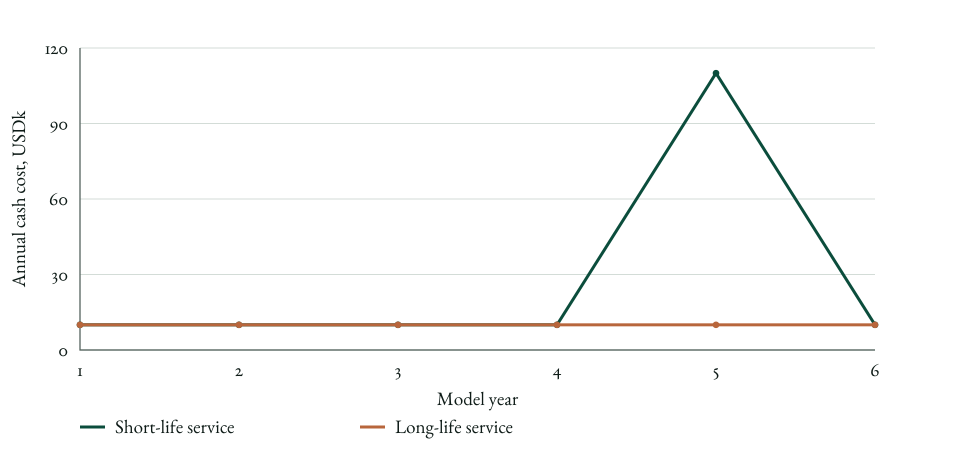
Original deterministic plot of exact frozen schedule points. The spike is the model convention for a replacement purchase, not a forecast probability of failure. Lines connect annual points without claiming intermediate cash events.
The fictional service requirement changes the ranking
Exact canonical computations, rounded for display. Each case compares the same two assumed service-capable alternatives over its common horizon. USDk is fictional.
Scroll for all columns. With the table focused, use the left and right arrow keys.
| The fictional service requirement changes the ranking | |||
|---|---|---|---|
| Horizon, years | Alternative | Replacement present cost, USDk | Total present cost, USDk |
| 3 | Acquisition-led | 0.00 | 203.58 |
| 3 | Service-led | 0.00 | 214.41 |
| 10 | Service-led | 0.00 | 304.19 |
| 10 | Acquisition-led | 68.06 | 441.92 |
The separate replacement pair makes a discontinuity visible. It holds both bid structures constant and extends the requirement from the shorter asset's life boundary into the following service period. At the life boundary, the engine does not purchase another asset solely to end the requirement. Once the horizon extends beyond that boundary, the same convention purchases a replacement at the life multiple. This discrete commitment can change the leader abruptly. A smooth annual cost display can obscure the underlying event if the replacement ledger is not retained.
The replacement study uses a zero rate to make its nominal component structure directly inspectable. It has equal annual operating expense, no energy, no downtime and no residual credit. Its only differing mechanisms are acquisition and supplied life. The pair therefore shows the effect of a service extension that requires another purchase. It is not a claim about actual failure at a precise age. The supplied lifetime is a deterministic convention, and the replacement price is the unchanged acquisition input, not an independently evidenced future quote.
Crossing the replacement boundary creates a discrete commitment
These fictional canonical outputs isolate the service-life boundary. The terminal treatment is held at no credit, so the table should not be interpreted as a complete valuation of remaining useful service.
Scroll for all columns. With the table focused, use the left and right arrow keys.
| Crossing the replacement boundary creates a discrete commitment | |||
|---|---|---|---|
| Horizon, years | Alternative | Replacement present cost, USDk | Total present cost, USDk |
| 5 | Short-life | 0.00 | 150.00 |
| 5 | Long-life | 0.00 | 210.00 |
| 6 | Long-life | 0.00 | 220.00 |
| 6 | Short-life | 100.00 | 260.00 |
A ranking boundary can be continuous, discrete or partly outside the engine. A uniform tariff intervention changes the energy present cost continuously within the implemented formula. A supplied service-life boundary can add a discrete replacement. A changed installation feasibility condition can remove an alternative before cost ranking and is not represented by the engine. The evaluator should classify the boundary before searching for it. A numerical interpolation between endpoints is inappropriate when a discrete event or admissibility change occurs between them.
Locate a numerical threshold only through a retained method. Specify the varied input, allowed domain, unchanged fields and tolerance. Recompute the canonical model at the tested points and preserve output identity and gap. The additional tariff, loss and residual studies use analytic equalities and retained canonical confirmations at and on both sides of each boundary. Their interval reading relies on a fixed linear cost structure. The original replacement cases remain discrete event comparisons rather than an interpolated continuous threshold.
An automatic stress display is a diagnostic convenience, not evidence that the selected cases are likely. The workbench applies defined energy and downtime multipliers and reports the resulting ranking. Those interventions help a reader inspect exposure to the supplied cost structure. They do not give probabilities, correlated downside conditions or an authorised risk tolerance. A case labelled stress remains an illustrative computation. The buyer must explain why a proposed actual scenario is relevant and whether its combined premises can occur together.
Robustness needs a defensible domain. A leader unchanged by tiny perturbations may still be unstable under the evidence range that matters. Conversely, a leader that changes under an extreme mechanism probe may remain adequate within the authorised and supported decision range. Retain the basis for the interval and report which conditions are excluded. The conclusion should be that the decision is stable within a named domain, rather than universally robust. The model cannot select that domain merely by supplying a convenient default.
Rank stability and decision adequacy are separate. A preferred alternative can remain the cheapest while exceeding the budget, failing a required service condition or relying on an unrepresented exit obligation. A ranking dashboard should therefore link to admissibility, affordability and model-scope records. The committee should not read a stable first row as proof that commitment is safe or executable. Cost sensitivity identifies comparative consequences; the release decision requires the other conditions to remain satisfied.
Use an adversarial case to challenge the mechanism the decision relies upon. If the advantage comes from service life, test a supported shorter-life convention and the replacement event. If it comes from energy, examine a credible duty or tariff change. If it comes from terminal credit, retain a no-credit and exit-obligation enquiry. This is different from constructing an arbitrary catastrophic case to make every option look bad. The purpose is to find the premise whose failure would invalidate the recommendation and the evidence or action that can address it.
Locate the disagreement on the correct kind of boundary. A hypothetical tariff range that crosses the existing continuous equality calls for better price incidence or an explicit judgement about that uncertainty. A required service period that crosses a replacement event calls for a horizon and transition decision; interpolating between the neighbouring totals can conceal the event. A failed duty condition calls for exclusion or redesign even if no scalar threshold has been crossed. These are different committee actions. The controlled pair, event case and admissibility record should each retain their own identity, so a smooth sensitivity chart cannot substitute for the discontinuous or noncompensable question that actually determines commitment.
A completed illustrative ranking-boundary register
The original record links each controlled fictional intervention to a decision question. It makes no claim about actual parameter ranges or probabilities.
Scroll for all columns. With the table focused, use the left and right arrow keys.
| A completed illustrative ranking-boundary register | ||
|---|---|---|
| Intervention | Published mechanism | Decision enquiry |
| Service horizon | Longer common service changes recurring cost and replacement exposure. | Confirm the authorised service requirement and terminal treatment. |
| Energy price | The same annual MWh has another uniform cash weight. | Obtain the applicable price basis and material tariff structure. |
| Downtime incidence | The same interruptions receive another loss-per-hour convention. | Establish lost, deferred and recoverable service. |
| Replacement boundary | Another purchase enters when required service extends beyond supplied life. | Support life and the executable replacement arrangement. |
| Terminal credit | A future credit changes present cost while other components remain equal. | Support transfer and retain exit obligations. |
| Discount basis | Future recurring savings receive another present weight. | Apply an authorised coherent rate and price treatment. |
Publish the conditional leader and its reopening conditions
Release a ranking only with the common service, decomposition, changed premises and tested domain. Preserve alternative identity across sorted outputs and distinguish an endpoint reversal from a located threshold.
- Separate requirement changes, forecast changes and appraisal conventions.
- Use controlled interventions before combined scenarios.
- Explain the result through the reconciled component ledger.
- Classify continuous, discrete and admissibility boundaries.
- State the evidence or condition that would reverse or reopen the recommendation.
Too much sensitivity can make a clear decision appear indecisive
An extensive matrix can obscure the few material premises. A proportionate report should prioritise interventions with a decision consequence and an evidence basis. If the same admissible leader persists throughout a defensible domain, state that clearly and retain the reproduction files. The purpose is disciplined conditional confidence, not an obligation to display every possible input combination.
Endpoint studies are narrower than a complete decision surface
The published fixtures establish controlled deterministic mechanisms and the three stated continuous equalities under unchanged fields. They do not estimate a probability distribution, optimise a multidimensional procurement strategy or resolve feasibility and affordability. Interval conclusions apply only to the retained monotone structure; a changed service, cost perimeter or replacement event requires a new complete computation.
Continuous boundaries and completed evidence branches
The interruption pair varies net unrecovered contribution per interruption hour while keeping the interruption hours supplied for each offer unchanged. Recoverable service has a larger initial acquisition, a smaller electricity stream and fewer interruption hours. Its lifecycle difference against Lean purchase is the additional acquisition less the present energy saving less the discounted difference in interruption hours multiplied by the common loss rate. With zero escalation and no replacements or residual differences, all recurring differentials use the same annuity factor. Let ΔC be the added acquisition, Δe the annual electricity-cost saving at the fixed tariff and Δd the annual interruption-hours reduction. Equality occurs at ℓ* = (ΔC / A − Δe) / Δd.
The restricted formula has useful refusal cases. If Δd is zero, a loss-rate change cannot create the claimed difference and division by zero is impermissible. If the acquisition and energy terms already favour the same offer at a zero nonnegative loss rate, a negative calculated equality lies outside the admitted nonnegative loss domain. If one offer's interruption causes deferred rather than lost service, the common loss-rate convention is wrong. The current fictional pair deliberately supplies a common net unrecovered contribution and different interruption hours so that its positive equality is well defined. The next evidence task concerns that causal incidence, not gross hourly revenue.
Locate interruption-loss sensitivity before asking for evidence
Exact unchanged-workbench confirmations. USDk per interruption hour is the common loss input. All price, energy, duty and interruption-hour fields are retained from the restricted pair.
Scroll for all columns. With the table focused, use the left and right arrow keys.
| Locate interruption-loss sensitivity before asking for evidence | |||
|---|---|---|---|
| Retained case | Common loss, USDk per hour | Conditional cost leader | Gap, USDk |
| Below | 0.2 | Lean purchase | 6.32 |
| Equality | 0.22690769490927215 | Lean purchase | 0.00 |
| Above | 0.25 | Recoverable service | 5.42 |
A fictional causal-accounting packet supporting 0.100 to 0.200 USDk per hour is wholly below the equality and preserves Lean purchase's conditional cost lead. A packet supporting 0.250 to 0.350 USDk per hour is wholly above and preserves Recoverable service's lead. A 0.200 to 0.250 USDk per hour interval crosses the equality. Finance cannot close that interval by replacing net contribution with larger gross revenue, and Operations cannot close it by counting the same deferred production as permanently lost. The specific enquiry is whether the supported unrecovered contribution and recovery pattern place the common loss interval on one side. Those declared intervals are scenario assumptions, not measured loss estimates.
The three continuous studies illustrate a consistent decision procedure. State the varied scalar and its valid domain; derive the equality from the implemented cost perimeter; confirm the equality and both sides using actual frozen computations; retain raw values and display conventions; compare the supported evidence interval with the boundary; then apply the independent mandatory-service and authority gates. A crossing interval yields a held cost preference or a deliberately authorised choice under uncertainty. An interval entirely on one side can close that one financial ambiguity while leaving a service or scope condition unresolved. It cannot certify the other inputs simply because the selected scalar is now decisive.
The interval verdict is conditional on its fixed coefficients. Combining a tariff range with a separately uncertain acquisition premium does not inherit either one-dimensional conclusion. In the tariff family, Efficient is no dearer only where the additional acquisition is no greater than common tariff times annual electricity saved times the annuity factor. If both price and premium are uncertain, the owner must assess that inequality over the supported joint set. For independently bounded quantities in this restricted monotone structure, the adverse corner uses the largest admissible premium and smallest admissible tariff. Passing only a favourable corner proves no robustness. If the evidence links price to included scope or energy to a changed duty, the rectangular convention is itself false; retain paired admissible cases and stop the independent-range claim. This rule turns a located equality into a refusal-capable evidence test rather than a versatile-looking sensitivity chart.
Replacement remains a discrete event test. A supplied life that moves a replacement exactly onto the common horizon changes whether the event enters the published convention. A continuous tariff equality can be analysed within either fixed event structure, but should not be interpolated across the life change as if the structure were smooth. The original before/at-horizon pair remains separate and unchanged. The additional studies strengthen the continuous analysis without erasing the reason to inspect the discrete calendar directly.
Completed fictional interval-to-action record
Each interval is an explicit original scenario assumption. The Commercial manager retains price evidence, Finance retains loss/credit incidence and Operations retains common service. These records permit analytical routing, not an award.
Scroll for all columns. With the table focused, use the left and right arrow keys.
| Completed fictional interval-to-action record | ||
|---|---|---|
| Evidence branch | Completed fictional disposition | Next permitted action / stop |
| Tariff 0.030 to 0.040 USDk per MWh | Conventional preference survives this tariff interval. | Commercial manager records the common charge basis; Operations must still support duty. |
| Tariff 0.040 to 0.060 USDk per MWh | HOLD unique tariff-led cost preference. | Commercial manager clarifies the applicable interval; no favourable point chosen silently. |
| Loss 0.250 to 0.350 USDk per hour | Recoverable service preference survives this causal loss interval. | Finance signs net unrecovered incidence; Operations confirms interruption and recovery compatibility. |
| Residual 60.00 to 70.00 USDk | HOLD unique residual-led cost preference. | Asset manager and Finance resolve transfer condition, net receipt and date, or retain no-credit case. |
| Mandatory service fails | Reject the affected offer from this requirement. | Operations director stops progression even if the conditional cost total is favourable. |