
Mechanisms and worked studies
A residual-value break-even study
Give terminal value a route and a boundary
Residual value can be the least evidenced input in a lifecycle comparison while remaining decisive for the award. It appears at the end of the horizon, after acquisition and operating costs have been incurred. A buyer may associate it with remaining service, an accounting balance or expected resale proceeds. Those are different quantities. A cost model using a terminal cash credit needs an explanation of the proceeds that can be realised and the conditions attached to them. Remaining useful capacity does not by itself establish an executable payment.
Begin by defining what happens at the end of the service requirement. The buyer might retain the asset for another authorised service, transfer it to another operating unit, sell it, return it under a contractual arrangement or dispose of it. Each route has a different boundary. Retained service can have opportunity value without a sale receipt. An internal transfer can create a resource allocation question without cash received from outside the organisation. A sale requires a transferable asset and a transaction. A disposal can create an obligation rather than a credit.
The terminal convention should match the decision question. A buyer comparing the cost of service over a bounded horizon should explain how remaining service is treated and why the alternatives are comparable at that boundary. Ignoring all remaining value can penalise an alternative whose useful capacity extends beyond the requirement. Assuming full recoverability can overreward an asset that cannot readily be transferred or reused. Neither treatment is universally conservative. The relevant assumption depends on the service counterfactual and the buyer's actual terminal options.
Transferability needs a practical path. The asset's condition, ownership rights, location, access, documentation and compatibility can affect whether another party can use it. Removal and transport may be required before any sale proceeds arrive. A specialised installation may have value in place while having little portable value. The evaluator should identify the intended recipient or market basis and the obligations needed to deliver the transfer, without inferring recoverability from an accounting label or a supplier's general resale statement.
The timing of proceeds should remain explicit. A terminal credit at the horizon is a simplifying convention. If removal, acceptance or sale occurs later, the cash date differs. A buyer may also incur an exit expense before receiving proceeds. Combining them into a single net amount can be useful only when their boundary and timing are adequately represented. The companion engine applies a nonnegative credit at the horizon and has no separate negative disposal amount. A material dated exit obligation requires an appropriate verified extension.
Evidence and scope
NIST treats capital replacement and residual value as future investment-related lifecycle amounts.
Evidence: Life Cycle Costing Manual for the Federal Energy Management Program
The fictional residual pair isolates the terminal-credit mechanism. The alternatives have equal annual operating expense, service lives extending beyond the common horizon, no energy and no downtime allowance. One alternative has a higher acquisition input. In the no-credit case neither receives terminal proceeds. In the transfer-credit case, only the higher-acquisition alternative receives the supplied credit. Other inputs remain fixed, including the rate and horizon. The case asks whether the present weight of that fictional credit can offset the acquisition difference.
This design deliberately does not assert that a more expensive asset is more transferable. The names identify the fictional scenario roles. They do not constitute evidence about a product, supplier or secondary market. The lower terminal-credit base case can help expose what the comparison would conclude without reliance on a sale. The alternative credit case shows the cost consequence if the stated proceeds were admissible. A real decision would need independent support for the transaction and its associated obligations before using the credit as more than sensitivity.
The credit occurs at the terminal boundary
The fictional credited alternative receives its supplied proceeds only at the horizon. Earlier annual operating expense remains the same. The net terminal point combines that year's operating expense and the assumed credit; it is not an earlier source of funding.
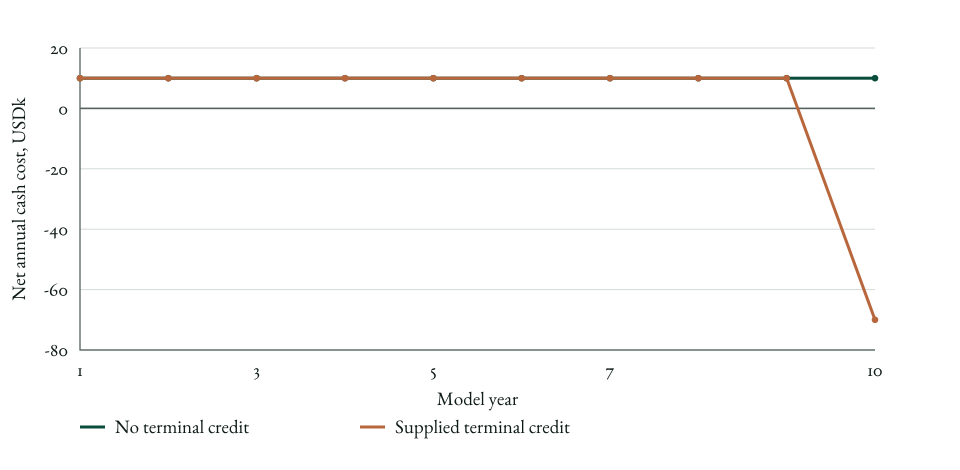
Original deterministic plot of exact frozen schedule points. A negative net cost represents the supplied fictional terminal receipt. The chart establishes neither sale eligibility nor recoverability, and it includes no separate disposal obligation.
The controlled fictional terminal-credit intervention
Illustrative inputs only. Equal recurring expenses and the same service horizon isolate the acquisition-versus-terminal-credit mechanism. USDk is the fictional monetary unit.
Scroll for all columns. With the table focused, use the left and right arrow keys.
| The controlled fictional terminal-credit intervention | |||
|---|---|---|---|
| Alternative | Acquisition, USDk | Annual operation, USDk | Credit in changed case, USDk |
| Non-transferable | 100.00 | 10.00 | 0.00 |
| Transferable | 130.00 | 10.00 | 80.00 |
A terminal credit changes the fictional cost leader
Exact canonical computations, rounded for display. Rows follow the cost order within each case. A computed credit consequence does not validate the transfer premise.
Scroll for all columns. With the table focused, use the left and right arrow keys.
| A terminal credit changes the fictional cost leader | |||
|---|---|---|---|
| Credit treatment | Alternative | Residual present credit, USDk | Total present cost, USDk |
| No credit | Non-transferable | 0.00 | 167.10 |
| No credit | Transferable | 0.00 | 197.10 |
| Supplied transfer credit | Transferable | 37.06 | 160.05 |
| Supplied transfer credit | Non-transferable | 0.00 | 167.10 |
The lower acquisition alternative leads without the terminal credit. Applying the supplied credit changes the leader because its present value exceeds the additional acquisition commitment under the common rate and horizon. Equal recurring expense makes that mechanism especially clear in this fixture. The result does not imply that a terminal credit will usually dominate a purchase, nor does it validate the selected amount. It identifies the premise on which the changed award would rely and the evidence that therefore needs scrutiny.
The break-even condition in this restricted pair is a present-value equality. The additional terminal credit must have the same present weight as the additional base-date acquisition commitment because every other differential component is held equal. Above that boundary the credited alternative has lower modelled present cost; below it the lower-acquisition alternative does. The original endpoint studies reveal the reversal. The additional analytic expression and three retained canonical confirmations below now locate its nominal equality and make the interval decision usable.
Do not confuse the undiscounted sale amount with the acquisition gap. The terminal date and common rate determine how much present weight the amount receives. A distant credit may need a larger nominal amount to offset the same base-date acquisition difference. If the intended sale date moves, the current horizon convention may cease to represent it. The evaluator should show the timing basis before comparing the amounts. The model's residual-present-credit component is useful precisely because it separates the supplied future amount from its present-cost effect.
Future market evidence needs a scope and date boundary. A current indication for a comparable asset can inform a scenario without establishing the price obtainable at the end of the buyer's requirement. Condition, remaining useful life, location and buyer access can differ. A supplier repurchase offer can have its own eligibility, exercise and performance conditions. The source should support the particular transfer proposition being used. Broad claims about demand for used equipment cannot replace evidence about the intended asset and executable route.
Residual uncertainty can be asymmetric. A buyer might receive less than expected while remaining responsible for removal or disposal. Treating that entire boundary as a nonnegative credit range may omit a material downside. The workbench's input restriction prevents a negative residual from masquerading as proceeds; it does not establish that no exit obligation exists. The analyst should retain the omitted obligation explicitly and use a dated extension when it matters. Hiding disposal expense inside a uniform annual amount would change the time structure and weaken the comparison.
Condition management links the terminal assumption to operating behaviour. If recoverability depends on records, maintenance or a transferable configuration, the buyer needs to preserve those conditions during the service period. A residual credit should not be treated as an isolated finance input whose requirements disappear after award. The handover should identify the operating obligations that keep the proposed terminal route available. If a later decision alters those conditions, the lifecycle estimate and award rationale need a distinguishable revised case.
Terminal value may also create an incentive conflict. A service owner can prefer a configuration that maximises current output while another decision owner expects future transfer value. Neither objective is automatically wrong, but the trade-off needs authority. A lifecycle cost model can show the consequence of supplied terminal and operating assumptions; it cannot decide whose service objectives govern. The committee should state the terminal route it has authorised and the operating constraints required to support it, rather than infer an organisational mandate from the cost leader.
A no-credit sensitivity is useful when the decision relies heavily on future proceeds. If the preferred option remains admissible and attractive without the credit, the transfer assumption may be less consequential to ranking while still affecting the budget. If the leader changes, the committee should understand that a weak terminal premise can be award-determining. That finding can justify stronger evidence, an enforceable arrangement or a different decision. It does not mean the credit must always be excluded; it means its use should match the evidence and decision consequence.
A terminal promise can be challenged by separating eligibility to transfer from willingness to purchase. In a hypothetical exit, title is transferable and the asset is technically reusable, but no recipient has accepted its condition or removal responsibility. Those facts establish a possible route, not assured net proceeds. In another branch, a recipient commits to purchase but the buyer remains liable for disconnection, remediation or transport; the gross amount is still not the net credit. Trace each obligation to the proposed payer and payment event. This gives the terminal equality a concrete evidence target and prevents technical transferability from silently carrying an unsupported sale and exit assumption.
A completed illustrative terminal-value record
The fictional example keeps a proposed credit conditional. It demonstrates evidence and ownership questions rather than supplying resale or disposal estimates.
Scroll for all columns. With the table focused, use the left and right arrow keys.
| A completed illustrative terminal-value record | ||
|---|---|---|
| Terminal question | Illustrative record | Effect on release |
| Intended route | A transfer is proposed after the defined service horizon. | Keep the credited case as sensitivity until the route is supported. |
| Rights and condition | Ownership and usable documentation are assumed but not confirmed. | Confirm eligibility and the condition that transfer requires. |
| Recipient or market | No actual recipient or market quote is supplied. | Do not label the fictional credit a market value. |
| Timing | The workbench receives proceeds at the horizon. | Extend the model if the transfer or payment occurs later. |
| Exit obligation | Removal and disposal consequences remain to be assessed. | A material negative dated amount cannot fit the residual-credit field. |
| Operating preservation | Required condition and records would need an accountable owner. | Transfer the obligation into the operating handover. |
An original terminal-route distinction
These analytical categories distinguish what the terminal amount would need to represent. They do not establish a valuation for any actual asset.
Scroll for all columns. With the table focused, use the left and right arrow keys.
| An original terminal-route distinction | ||
|---|---|---|
| Route | Relevant value question | Evidence boundary |
| Retain | What additional authorised service can the buyer obtain? | Remaining useful capacity differs from a sale receipt. |
| Internal transfer | What resource opportunity changes within the organisation? | A transfer price need not create external cash. |
| External sale | What executable proceeds can be obtained net of dated obligations? | Condition, rights, location and transaction timing matter. |
| Contractual return | What payment or liability follows the agreed return conditions? | Eligibility and remedy retain their actual contractual scope. |
| Dispose | What obligation is created by safe and authorised exit? | A negative dated cost needs a compatible extended model. |
Release a terminal credit with an executable premise
Treat terminal value as an explicit route and evidence question. A future credit that can change the leader needs support proportionate to that decision consequence, with exit obligations retained.
- Distinguish retained service, accounting balance and external proceeds.
- Describe the terminal route, condition, rights and payment date.
- Reconcile removal or disposal obligations rather than assume a nonnegative boundary.
- Compare the no-credit case with the supported credit case.
- Assign the operating conditions that preserve the intended terminal option.
Excluding residual value can bias a short-horizon comparison
This objection is valid where alternatives retain materially different usable service and a common short horizon ignores it. The remedy is a defensible terminal treatment or a better service-period comparison, rather than either automatic exclusion or an unverified sale credit. Explain the future service or transaction basis and keep uncertainty visible. A conservative label cannot substitute for an appropriate economic boundary.
A terminal-credit computation is not an asset valuation
The engine does not forecast secondary-market prices, inspect condition, interpret transfer rights, value retained service or encode negative disposal costs. The located equality is a deterministic requirement for the supplied restricted pair. It does not establish recoverability, exit authority or the likelihood of reaching that credit.
Locate the credit required by the terminal proposition
The residual pair admits a similarly direct equality. Transferable and Non-transferable have equal recurring costs and no inside-horizon replacement. Transferable adds an initial acquisition amount and receives the only terminal credit. The additional initial commitment is ΔC, the common rate is r and the terminal horizon is h. The discounted credit equals the acquisition difference when R* / (unity + r)^h = ΔC, so R* = ΔC × (unity + r)^h. The equality is nominal at the stated terminal boundary. An earlier credit, an exit charge or a different recurring burden would require its own dated comparison.
A located nominal residual threshold
Retained computed confirmations at the stated year-ten boundary, in USDk. All recurring quantities remain equal. A printed zero gap can reflect rounding of a nonzero raw difference; the engine warns only for exactly equal computed Number costs. This numerical comparison does not establish a market appraisal or executable recovery.
Scroll for all columns. With the table focused, use the left and right arrow keys.
| A located nominal residual threshold | |||
|---|---|---|---|
| Retained case | Transferable nominal residual, USDk | Conditional cost leader | Gap, USDk |
| Below | 60.0 | Non-transferable | 2.21 |
| Equality | 64.7677499181836 | Non-transferable | 0.00 |
| Above | 70.0 | Transferable | 2.42 |
A fictional terminal-evidence interval of 55.00 to 60.00 USDk is wholly below the equality. Under the unchanged model, Non-transferable remains the cost leader throughout it. An interval of 70.00 to 75.00 USDk is wholly above, giving Transferable the conditional lead. A 60.00 to 70.00 USDk interval crosses the boundary and does not support a unique preference. The first and second cases need no artificial point estimate to establish their direction. The crossing case deserves a targeted enquiry into transfer eligibility, net receipts and the terminal date, rather than a favourable average selected because it lies on the preferred side.
These interval branches remain narrower than acceptance of the terminal premise. A quoted possible sale amount without a feasible route does not provide a supported interval. Gross proceeds with omitted exit expense do not answer the net-credit question. A right to retain service does not become cash simply because the buyer expects to use the asset after the horizon. The fictional Asset manager owns transfer condition and eligibility; Finance owns net incidence and timing. Where either object is missing, the committee retains a no-credit case or a held preference. The exact equality identifies how strong an admissible terminal claim would have to be; it cannot make an inadmissible claim recoverable.