
Mechanisms and worked studies
A lifecycle cash-flow timeline
Preserve the time structure of each cost
Discounting preserves a distinction that an undiscounted total loses: the date at which a cost is incurred. An acquisition expense paid at the base date has a different time profile from an operating expense paid over the service period. A replacement can create a discrete future commitment. A residual credit can arrive only at the terminal date assumed by the model. Present value brings those dated amounts to one reference basis using a stated rate. It does not establish the rate, remove uncertainty or show whether the buyer can meet the actual payment schedule.
The workbench's convention is deliberately simple. Acquisition is placed at the common base date. Recurring operating, energy and downtime costs are paid at the end of each model year. Replacement purchases occur at supplied service-life multiples that fall inside the common horizon. A supplied residual credit appears at the horizon. These conventions are inspectable in the exported schedule. If an actual decision has advances, milestone payments, uneven operation or a material expense between those dates, the convention needs an appropriate verified extension. Relabelling an annual cost cannot implement a different payment calendar.
The discount rate expresses the chosen time-value basis of the comparison. A buyer might have an authorised appraisal convention or a transaction-specific financing and opportunity-cost question; the analyst should identify which basis is being used. A rate cannot be selected solely because it preserves the preferred bid. Equally, a published rate from another jurisdiction or programme does not automatically govern the buyer's purchase. This study uses fictional rates to expose the mechanism. It supplies no current recommendation about an actual buyer's cost of capital or authorised appraisal rate.
Nominal and real treatment must be internally consistent. A stream expressed in future nominal money includes whatever price changes have been assumed; its discounting basis should correspond to that treatment. A stream expressed in constant purchasing-power terms has another basis. A model can produce a numerical result even if the analyst mixes them, because the arithmetic does not know what the money represents. The input record should therefore state price date, escalation treatment and rate basis together. The workbench has no automatic inflation conversion or assurance that a user-supplied rate matches the input stream.
Escalation in the companion engine is restricted to the supplied energy-price convention. Annual operating expense and downtime incidence remain uniform in the implemented schedule, and replacement uses the unchanged acquisition input. This is an important boundary for interpreting a result. A reader should not describe the output as a complete nominal forecast with labour, spare-parts and replacement inflation when those mechanisms are absent. Holding a category constant can be a useful controlled assumption, but its meaning must remain explicit and a material omitted price mechanism requires additional analysis.
Evidence and scope
NIST explains discounting and the consistency of constant-dollar and current-dollar lifecycle calculations.
Evidence: Life Cycle Costing Manual for the Federal Energy Management Program
A common positive rate puts less present weight on a distant cost than on the same cost paid sooner. That treatment can favour a lower initial commitment with higher future expense over a more expensive purchase that reduces recurring costs. It can also reduce the present weight of a terminal credit. Those effects follow the timing structure; they are not empirical evidence that a particular service model is preferable. The analyst should describe which component drives a changed ranking instead of treating discounting as an unexplained adjustment to a total.
The zero-rate case provides a useful diagnostic boundary. The present-value schedule then equals the model's nominal amounts under its stated price assumptions. This makes it easier to inspect whether acquisition, recurring expense, replacement and residual have been included with the intended sign. A diagnostic zero rate is not a recommendation to ignore time value in an actual award. It can reveal a component error or show the undiscounted trade-off before the committee applies its authorised basis. The same fixture should be recomputed rather than edited through a separate unofficial spreadsheet.
The rate changes present weight, not the operating expense
The fictional annual present-cost points retain uniform annual operating amounts within each alternative. The positive-rate curves fall because the same annual expense is discounted from later dates. Base-date acquisition is excluded from this annual figure and remains in the total-cost table.
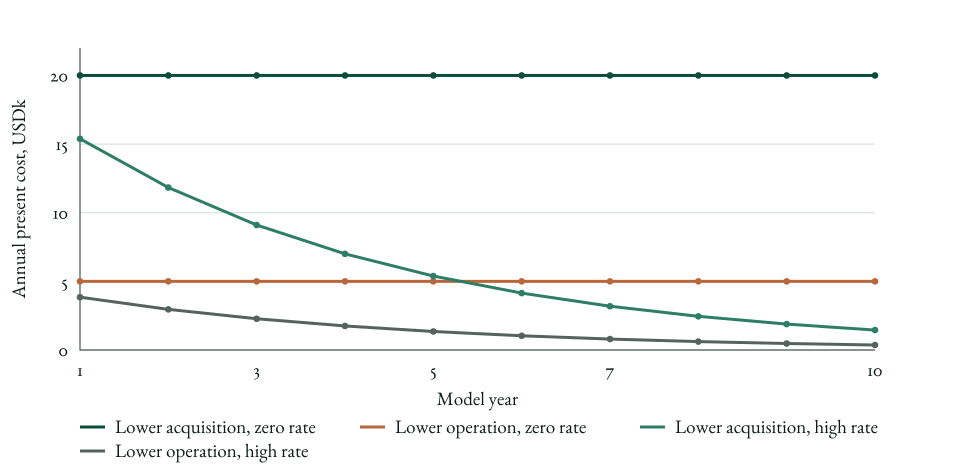
Original deterministic plot of exact frozen schedule points. Connectors support reading of the annual points; the chart does not represent payments between years or recommend the illustrative rate.
An unusually high illustrative rate can reveal the other side of the trade-off. It puts much more relative weight on the base-date commitment than on savings realised later. That can be useful for understanding ranking sensitivity even when the rate would be inappropriate for the actual decision. The label matters: an exploration of a mechanism is different from a defensible appraisal convention. The decision record should state why a tested range is relevant before calling the leader robust or financially preferable within that range.
The fictional discounting pair holds the service horizon and all bid inputs constant while changing only the common rate. Both alternatives have service lives extending beyond the model horizon, no energy or downtime allowance and no terminal credit. The acquisition difference is therefore compared against a difference in uniform annual operating expense. This narrow design isolates the time-value mechanism. It does not assert equal technical performance for any real equipment, nor does it estimate the frequency with which a buyer would face the selected cost structure.
The controlled fictional timing trade-off
Illustrative input values only. The common service horizon and all bid fields remain fixed across the rate intervention. USDk is a fictional display unit.
Scroll for all columns. With the table focused, use the left and right arrow keys.
| The controlled fictional timing trade-off | |||
|---|---|---|---|
| Alternative | Acquisition, USDk | Annual operation, USDk | Service life, years |
| Lower acquisition | 100.00 | 20.00 | 20 |
| Lower recurring cost | 160.00 | 5.00 | 20 |
A changed rate changes the fictional leader
These are exact canonical computations, rounded only for display. Rows are in the engine output order, from the lowest present cost within each case. The tested high rate is an illustrative mechanism probe, not a recommended buyer appraisal rate.
Scroll for all columns. With the table focused, use the left and right arrow keys.
| A changed rate changes the fictional leader | |||
|---|---|---|---|
| Case rate, % | Alternative | Present cost, USDk | Annual equivalent, USDk |
| 0.00 | Lower recurring cost | 210.00 | 21.00 |
| 0.00 | Lower acquisition | 300.00 | 30.00 |
| 30.00 | Lower acquisition | 161.83 | 52.35 |
| 30.00 | Lower recurring cost | 175.46 | 56.75 |
Read the reversal through the component ledger. At the zero rate, the alternative with lower recurring expense benefits from the full undiscounted difference over the common service period. Under the higher rate, those future savings receive less present weight, while the additional acquisition commitment remains at the base date. The lower acquisition then becomes the cost leader in this fixture. The change is a consequence of the selected payment pattern and intervention. It is not evidence that discounting should be used to favour inexpensive assets or that recurring savings are operationally unimportant.
Equivalent annual cost changes the display basis, rather than adding an independent source of value. It converts the present cost over the supplied common horizon into an equal annual amount using the same rate. Within one case, the common positive conversion factor preserves the present-cost ranking. The annual display can help a reader compare the scale of a lifecycle commitment with annual service budgets, but it is not the actual sequence of invoices. A buyer cannot fund a large advance by pointing to a smaller annual equivalent.
Comparing annual equivalents across different service periods requires care. An alternative that supplies a shorter requirement is not automatically comparable with one that supplies a longer requirement, even if each result has an annual label. The buyer needs a common service question and a defensible repeatability or extension assumption. The study's principal paired cases use a shared horizon inside each comparison so that the ranking has an explicit service perimeter. Horizon changes across cases are interventions on the decision requirement; they should not be collapsed into a single universal winner.
Discounting is also different from risk adjustment. A higher common rate changes the weight on all future costs according to their dates. It does not identify which supplier might fail, how correlated interruption could occur or what the buyer can recover. Adding a broad rate premium may obscure the mechanism that actually creates an exposure. A scenario on the relevant cost or operating condition can be clearer, while retaining the authorised discount basis. This deterministic workbench does not estimate a risk-adjusted capital rate or a probability distribution for costs.
Inspect liquidity separately from present value. A lower lifecycle cost can require a higher initial payment that the buyer cannot fund. A replacement obligation can occur before receipts are available to support it. An apparently favourable residual is received only after the buyer has incurred the operating costs. None of these cash-calendar constraints disappears when the total is discounted. The acquisition and annual schedule provide an analytical starting point, but actual payment milestones and funding commitments need their own dated assessment before the cost leader can become an executable award.
The rate pair can also distinguish a timing dispute from an operating dispute. In a hypothetical review, Finance accepts the recurring-cost estimates but disputes the rate convention. Operations accepts the rate yet disputes whether the premium offer can sustain the lower recurring burden. Recomputing the common rate addresses Finance's question while leaving Operations' question unresolved. Changing the burden addresses the latter question while leaving the valuation convention intact. Retain separate contrasts before constructing a combined case. Otherwise a reversal can be attributed to financing policy even though a corrected operating premise caused it. This diagnosis makes the existing pair useful beyond a display of totals without adding a new numerical example.
A component-sign check should precede interpretation of a rate reversal. Where the premium is paid now and its compensating savings occur later, increasing a common positive discount rate reduces the present weight of those savings relative to the premium. A later replacement or terminal credit can alter the net timing pattern, so inspect those components before applying the shorthand. If a displayed reversal appears to contradict the dated ledger, investigate changed fields or cost placement rather than explain it with a vague claim that higher rates favour one supplier. The pair identifies a valuation mechanism; an actual award still requires the rate mandate, cash calendar and operating evidence appropriate to its own scope.
A completed illustrative timing-basis check
The record defines the implemented calendar and the questions that would require an extension. It is an original method illustration, not a forecast of actual payments.
Scroll for all columns. With the table focused, use the left and right arrow keys.
| A completed illustrative timing-basis check | ||
|---|---|---|
| Element | Current convention | Extension trigger |
| Acquisition | Comparable amount at the common base date. | Advance, staged payment or delayed handover is material. |
| Recurring operation | Uniform amount at each year end. | Seasonal, ramped or uneven operating costs can change the conclusion. |
| Energy | Supplied annual consumption with the stated uniform tariff and energy escalation. | Load-based or time-specific tariffs matter. |
| Replacement | Unchanged acquisition at supplied-life multiples inside the horizon. | Replacement price, refurbishment or timing differs materially. |
| Terminal credit | Supplied nonnegative amount at the horizon. | Transfer or disposal has another payment date or obligation. |
| Rate and price basis | Explicit fictional rate with declared constant category assumptions. | Actual appraisal authority or nominal treatment requires another basis. |
Approve timing and rate together
Release a lifecycle present-cost comparison only when payment dates, price treatment and rate basis form a coherent declared case. Preserve undiscounted amounts and the cash-calendar question alongside the discounted total.
- Identify the common service horizon and reference date.
- Retain the implemented payment convention and material exceptions.
- State rate authority or explicitly label the rate as illustrative.
- Reconcile escalation treatment with the rate and money basis.
- Explain a changed leader through the component ledger and controlled intervention.
A discount-rate debate can distract from weak operating evidence
This objection is strong when a comparison varies the rate extensively while treating unsupported annual costs as certain. A perfectly chosen rate cannot repair an incorrect duty profile or omitted replacement. Prioritise the uncertainty that can change the decision, retain the authorised timing basis and obtain operating evidence where it has material value. Rate sensitivity should illuminate a trade-off rather than conceal a weak technical baseline.
The timing model is restricted and deterministic
The workbench has no staged acquisition payments, general category escalation, tax timing, financing schedule or stochastic discount-rate process. Its annual-equivalent output is a mathematical display transformation, not an actual invoice plan. All numeric examples in this chapter are fictional controlled cases and do not establish an appropriate rate for a transaction.