
Governance and application
Which obstacle and accountable evidence task remain under the same preparation mandate?
A growth option is a package of changed assumptions
Growth options should be compared as actions with complete changed and held assumptions. A higher price, a larger acquisition budget, lower churn, faster collection and longer supplier terms affect different parts of the resource path. They cannot be ranked responsibly by one attractive endpoint while their obligations and evidence are omitted. The committee needs a comparable reference, a literal intervention specification and the constraint that can prevent each option from being used.
The published slate provides that reference. Each fixture states its exogenous change and retains all other fields unless the package explicitly changes more than one. None of the cases estimates intervention efficacy. The price case does not estimate demand response; the volume case does not estimate conversion or saturation; the retention case does not estimate a programme effect; the collection case does not estimate recovery performance; the supplier case does not establish contractual eligibility. Their exact outputs are conditional mechanism evidence.
The comparison should first test the recurring offer perimeter. A nonpositive starting contribution is rejected under Meridian’s declared recurring-service policy, unless a separately approved strategic exception is proposed. That policy is a normative choice outside compute. It prevents an attractive longer-horizon story from bypassing the initial duty the operator must accept. The adverse-margin fixture shows the rejection branch without claiming that every possible strategic use of a loss-making offer is irrational.
The next test is funding under the supplied business path. A positive required additional opening-cash amount holds a fully self-funded implementation claim. It can still justify an evidence task or a revised funded proposal. The test does not say that finance can never be obtained; it says that the current supplied resources do not support the stated nonnegative path. A later positive balance cannot remove an earlier unresolved obligation. The funding source must be available before the commitment it supports.
After the mechanical funding test, readiness and applicable terms remain independent evidence questions. The cash-funded fixture removes the modelled financial gap by changing opening cash only. The record then retains the same favourable output while identifying absent service acceptance or missing terms evidence. Those states direct distinct owner tasks and preserve reasons to hold an implementation request. They do not alter the preparation mandate: existing staff may assemble offer, service, funding and terms evidence in each branch. This diagnostic record prevents an economic improvement from being described as delivered capability or an available contractual premise.
Existing staff may assemble offer, service, funding and terms evidence in every branch of the worked mandate. An all-present state closes the declared questions; it does not create this preparation permission or release implementation. A later request must seek the new act. No purchase, external campaign, customer start date or financing transaction follows here. The comparison changes the diagnosed obstacle under unchanged economics, while a real committee can authorise another bounded act on its own evidence and authority.
The diagnostic rule connects each declared result and evidence state to an implementation obstacle and accountable preparation task. It neither optimises enterprise value nor exhausts the option menu. Judge the comparison by whether it changes the fact the owner investigates next. When the same missing fact and task persist across relevant cases, report that result without claiming a new permission consequence.
Evidence and scope
Retention modelling research motivates a stated churn process and model diagnostics beyond a fitted time trend.
Evidence: How to Project Customer Retention
Compare funding paths before celebrating endpoints
Exact illustrative option comparison
The endpoints and trough requirements are canonical. Higher ending cash does not clear an earlier resource gate, and improved unit value does not establish programme efficacy.
Scroll for all columns. With the table focused, use the left and right arrow keys.
| Exact illustrative option comparison | ||||
|---|---|---|---|---|
| Exogenous case | Contribution value, USD | Additional opening cash, USD | Ending cash, USD | Implementation dependency |
| Foundation | 971.94 | 58,025.46 | 218,526.01 | Funding and service evidence |
| Price | 1,284.93 | 6,566.68 | 553,831.13 | Offer response, funding and service |
| Volume | 971.94 | 66,208.85 | 609,543.35 | Acquisition premise, funding and admissions |
| Retention | 1,134.50 | 50,533.63 | 328,613.57 | Programme costs and efficacy unestimated |
| Collection | 971.94 | 14,906.53 | 302,858.74 | Payment efficacy and funding |
| Supplier credit | 971.94 | 24,254.62 | 282,568.36 | Applicable terms and funding |
| Opening cash only | 971.94 | 0.00 | 408,526.01 | Unrestricted funding evidence and service |
| Adverse margin | -162.53 | 1,068,789.70 | -1,068,789.70 | Starting recurring perimeter rejected |
The volume case is a useful adversary to endpoint ranking. It can show a greater final cash balance than the opening-cash case while retaining a positive additional funding requirement. The latter has a different supplied resource base and clears the mechanical trough test. Ranking the two by ending cash alone would answer neither affordability nor commercial superiority. The committee must state whether it is choosing an intervention, a funding arrangement or a next evidence task.
The price case presents a different challenge. It improves customer contribution and reduces the funding need under held customer assumptions, yet its remaining gap keeps the implementation claim on hold. This does not make the price idea useless. It can be the most promising internal offer review, provided the customer response and service scope are investigated. The protocol distinguishes a worthwhile evidence task from an approved rollout, preserving both the favourable mechanism and its unresolved dependencies.
Different resource mechanisms preserve different obligations
Illustrative comparisons of isolated collection, payable and opening-cash changes. The opening-cash case preserves every operating flow and removes the modelled trough deficit. Service and applicable terms remain independent gates in the decision record.
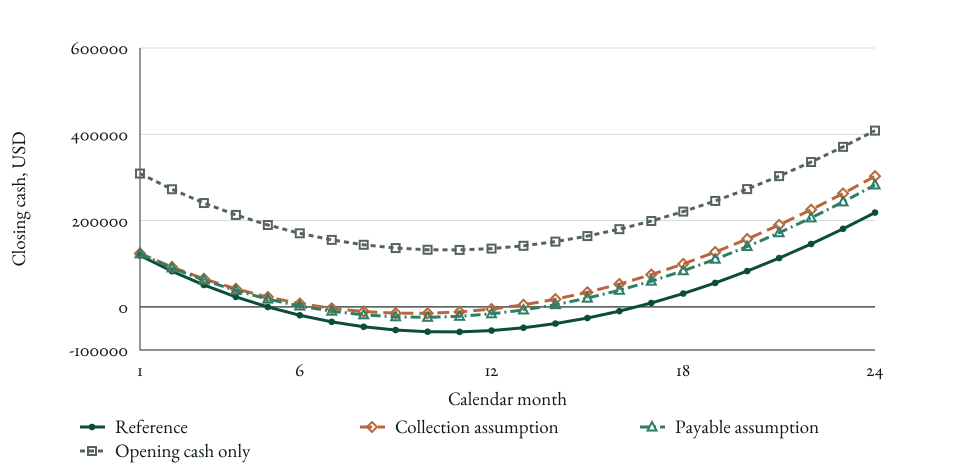
Original deterministic drawing from exact monthly cash pointers of four named canonical cases. Curves connect monthly closing balances; no financing offer, payment efficacy, term eligibility or intramonth liquidity is established. Distinct line styles and markers supplement colour.
The retention case reminds the reader that a parameter change is not a programme. Lower supplied churn increases survival contribution under the engine convention. The cost of producing that change, the affected customer universe and the measurement window are absent. The source literature offers reasons to examine the churn process and cohort diagnostics; it does not provide Meridian’s input. A complete intervention comparison must include programme obligations and evidence before the retention output can support spending.
The supplier-credit case demonstrates an evidence gate on a favourable cash premise. Its extended terms reduce the modelled resource burden, but TERM-A is absent. Treasury therefore cannot use the improvement as a funding fact. Even if other funding resolved the remaining numerical gap, the terms condition would still be required if the case relied on that arrangement. This is a genuinely separate constraint: the result can be favourable while the assumed source of value is not available for use.
The higher-envelope and adverse-margin cases prevent a selective success slate. They retain unfavourable resource consequences and an unavailable break-even result. Their purpose is to test the decision architecture, not to provide a collection of attractive examples. A robust comparison should preserve cases that challenge the thesis or the proposed action. Suppressing them would make the method appear more decisive while reducing its practical usefulness.
The comparison also needs a rule against mixing results. A committee cannot combine the price case’s customer value, the collection case’s cash benefit and the reference case’s costs without a new joint input and canonical recomputation. The mechanisms interact through revenue, contribution and working-capital levels. Separate sensitivities identify dependencies; they are not additive savings claims. A proposed combined action should publish its own changed and held assumptions before numerical conclusions are written.
The decision protocol is demonstrated, not merely proposed
Diagnostic evidence states under a common preparation mandate
The case and declared evidence state identify the implementation obstacle and owner task. Existing-staff preparation is permitted in every row. No row authorizes a new purchase, external campaign, dated customer offer or financial transaction.
Scroll for all columns. With the table focused, use the left and right arrow keys.
| Diagnostic evidence states under a common preparation mandate | ||||
|---|---|---|---|---|
| Canonical case | Funding reading | Service evidence | Terms evidence | Diagnostic disposition |
| Foundation | Additional opening cash needed | Declared present for branch test | Declared present for branch test | Hold funding |
| Price | Additional opening cash still needed | Declared present for branch test | Declared present for branch test | Hold funding |
| Opening cash only | No additional modelled opening cash | Absent | Present | Hold service |
| Opening cash only | No additional modelled opening cash | Present | Absent | Hold terms |
| Opening cash only | No additional modelled opening cash | Present | Present | No named evidence hold; later request still required |
| Adverse margin | Starting recurring contribution nonpositive | Does not override perimeter | Does not override perimeter | Reject recurring perimeter |
| No acquisition | Positive hypothetical unit, no acquired base | Does not create customers | Does not create funding | Hold funding |
The branch tests use the exact frozen outputs and explicit Boolean evidence declarations. They contain no alternative economic calculation. The recurring-perimeter test examines one-customer starting contribution, so a business with no acquisitions is not incorrectly classified as having an adverse unit. The funding test reads the canonical gap. Service and terms tests read the declared evidence states. The resulting disposition is a transparent rule that another reader can reproduce and challenge.
The comparison packet receives a composition check before the committee applies it. A proposed presentation combines the price fixture's unit value with the collection fixture's funding improvement and the reference cost envelope. Tomas records that these outputs come from different complete inputs and therefore do not describe a single retained case. The packet returns the combined claim for an appropriate typed joint comparison if it is pursued; it keeps each separate sensitivity available for mechanism learning. The committee record then works from the actual named cases and declared evidence states. This adds a concrete falsifier to the protocol: a plausible collection of favourable quantities is unusable when its input lineage does not represent the proposed action.
Decision and consequence
Compare the recurring perimeter, modelled funding path, service evidence and applicable terms separately. Preserve exogenous status and exact changed and held fields. Use the cash-funded case to isolate service or terms obstacles under the same numerical result. Existing-staff evidence preparation remains permitted in held and all-present branches; another implementation act needs its own decision. A combined economic intervention requires a new typed fixture and complete recomputation.
A serious alternative
A committee can rationally prioritize an option before every implementation dependency is resolved. Waiting for complete evidence may be expensive and slow. This alternative is compatible with the protocol when the selected action is a bounded evidence task rather than a rollout. It challenges the protocol only if gates prevent useful learning despite an affordable and truthful action boundary. The solution is to change the permitted action and evidence standard explicitly, not to treat a favourable endpoint as if missing funding or service conditions had disappeared. The comparison should remain open to better options outside the current slate.
Where this argument stops
The protocol is an original normative rule over illustrative outputs and declared fictional evidence states. It is not a causal intervention estimator, optimal strategy solver or guarantee of future cash. The slate contains selected mechanism cases rather than an empirical universe. All real funding, service, contractual and legal conditions require independent evidence. Mechanical reproduction verifies the declared branches, not the wisdom of the policy for every organisation.