
Mechanisms and worked studies
What value, horizon and clock does the customer ratio describe, and what recovery claim is unavailable?
Name the value before dividing it by CAC
Customer lifetime value is often used as a shorthand for the economic value of a relationship. The shorthand can conceal timing, cost and horizon choices. A prospective customer, a just-acquired customer and an established customer with future renewals are different valuation objects. A finite contribution window and an infinite expected cash-flow valuation are different quantities. Before using a ratio to acquisition cost, the analyst should name the object, the included flows and the clock.
The Growth engine computes a finite-horizon contribution value for one expected new customer. It sums discounted recurring contribution over the supplied age window. Acquisition cost and the fixed operating envelope are outside that sum. Working-capital timing is also outside the one-customer curve; it is represented separately in the business cash path. The label contribution value is therefore more precise than an unqualified claim of customer cash value or enterprise value. The field name in the app remains available for reproduction, while the paper states its perimeter.
The monthly discount input applies to contribution by customer age. The acquisition-month contribution is undiscounted under the engine convention, and later ages are discounted by successive monthly factors. This is not an annual rate silently converted into a monthly input. A reader who supplies an annual rate directly would change the economics dramatically while entering a syntactically valid number. The method dictionary prints the period basis, and the evidence record requires finance to own any real discount assumption.
The customer-value literature explains why formula timing matters. Including the first payment and booking periodic flows at the beginning or end of a period lead to different calculations. This paper does not choose a universal timing convention from that literature. It states the convention implemented in the canonical engine and asks whether it fits the commercial obligation. If onboarding precedes revenue or payment occurs later, the working and cash representation must be escalated rather than relabelled.
The finite window is equally consequential. Contribution after the supplied horizon is not included, and surviving customers receive no residual value. The result can be useful for a bounded recovery or operating comparison. It should not be described as the entire remaining value of a durable relationship. Conversely, adding a terminal value without a stated survival, price and cost basis would make the result look more complete while introducing unsupported economics. The paper leaves the omitted continuation explicit.
CAC is a separate supplied amount per acquired customer. Its numerator and activation denominator must match the relationship represented in the curve. If the spending covers leads rather than activated accounts, or if onboarding costs are omitted, the ratio changes meaning. A favourable ratio does not repair the mismatch. The acquisition metric record should identify the spending scope, attribution window, activation event and any cost that is outside CAC but required to begin the service.
The ratio is also not a business funding test. It compares a finite expected contribution quantity with the acquisition cost per customer. The business spends acquisition cash repeatedly, carries a fixed envelope and establishes working-capital balances before later cohorts accumulate. Those obligations are absent from the ratio numerator. The reference case shows why the ratio can be attractive while the business path needs additional opening cash. This logical counterexample is central to the thesis, rather than a footnote attached to a preferred metric.
Evidence and scope
Customer-value timing depends on first-payment inclusion and whether periodic flows begin or end the period.
Evidence: Reconciling and Clarifying CLV Formulas
Evidence and scope
A finite expected contribution window needs an explicit truncated-value interpretation and a stated customer relationship.
Evidence: What’s Wrong With This CLV Formula?
Contribution payback is a first crossing
Finite value and recovery in declared windows
All amounts are illustrative canonical scalars. The shorter window omits later ages; the total-churn case preserves only acquisition-month contribution.
Scroll for all columns. With the table focused, use the left and right arrow keys.
| Finite value and recovery in declared windows | ||||
|---|---|---|---|---|
| Case | Horizon, months | Contribution value, USD | Value divided by CAC | Contribution payback, months |
| Foundation | 24 | 971.94 | 4.05 | 5 |
| Shorter window | 12 | 597.02 | 2.49 | 5 |
| Complete churn | 24 | 61.00 | 0.25 | not defined |
| Contracting retained price | 24 | 799.28 | 3.33 | 5 |
| No acquired customers | 24 | 971.94 | 4.05 | 5 |
The payback output uses cumulative undiscounted expected recurring contribution. It reports the first age row at which that cumulative quantity reaches supplied CAC. It is not discounted payback and does not include the fixed operating envelope or working-capital cash. This distinction matters because customers may pay later than the service month, and the organisation may incur other commitments while it acquires them. Customer contribution recovery cannot establish when the organisation’s opening cash is recovered.
The word first also matters. The engine identifies a crossing, not a guarantee that every later cumulative value remains above CAC. Under a sufficiently adverse future contribution path, later losses could reduce cumulative recovery. The paper does not present a numeric reversal case outside its published slate, but the algorithmic interpretation remains important: the output is a first-attainment metric under the supplied age path. A durable recovery claim would require a separate condition on the later path.
Logo survival does not determine the whole contribution path
Illustrative cumulative undiscounted contribution under common supplied logo churn, with expansion changed to contraction in the second case. The adjacent table reports the separately discounted finite contribution value and first CAC crossing.
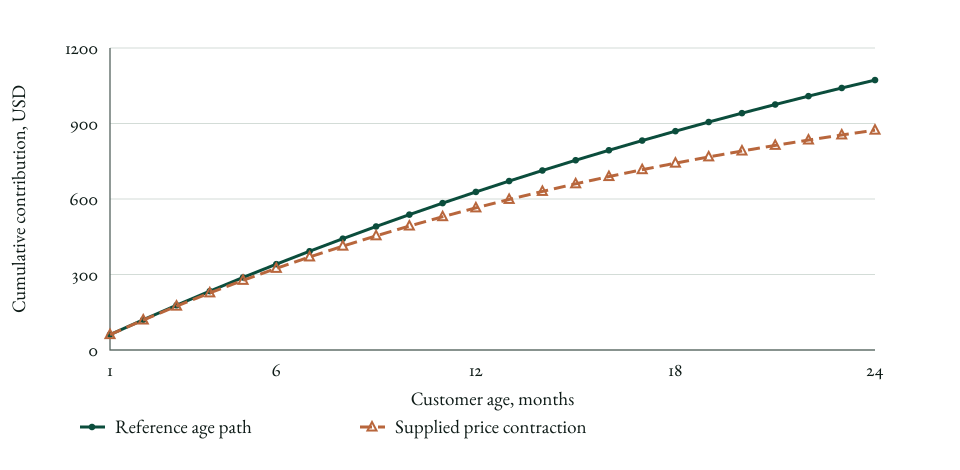
Original deterministic drawing from exact foundation and contracting-price unit-curve pointers. Customer age differs from calendar month. The curve excludes fixed costs, acquisition expenditure and working-capital timing; it is not a business cash recovery curve.
Expected payback is not an individual customer promise. The curve uses a homogeneous survival expectation and can have fractional expected contribution across accounts. One customer can terminate before recovery while another remains longer. The engine does not produce the distribution of those outcomes. A decision about concentration, credit exposure or a small customer pool may require a probabilistic or account-level analysis. The deterministic expected curve provides a mechanism comparison, not a confidence level.
The no-acquisition case makes the valuation object unmistakable. The hypothetical new-customer curve is unchanged by a zero acquisition budget because the unit curve depends on the supplied customer assumptions, not on whether a business campaign actually acquires customers. The monthly business path contains none. A dashboard that displays positive customer value beside that path should explain the difference. The unit opportunity can be attractive while the operating action is absent or unaffordable.
The retained-price contraction case illustrates another perimeter. Logo survival is unchanged, but each surviving account’s supplied price declines with age. The customer-value result responds to that price path. This is different from an account leaving the base, and different from a refund or bad-debt process. A customer metric protocol should keep these mechanisms distinct. Otherwise a lower contribution value can be diagnosed as a retention problem when the actual supplied change is price.
The acceptance test for a ratio is therefore a short reconstruction. State the customer object, age window, contribution components, discount period, CAC boundary and payback definition. Then identify which business obligations remain outside it. A ratio that passes this reconstruction can be useful for screening an acquisition idea. A ratio that cannot be reconstructed should not become a target, even if it resembles a familiar industry rule. This paper supplies no universal target multiple.
A value metric should not become an unrestricted budget
Tomas completes an acquisition-cost boundary note before the customer-value ratio is used. Campaign spending, qualification work and any cost necessary to activate the recurring duty must be assigned deliberately to CAC, recurring cost or an explicitly separate obligation. If onboarding is excluded from both CAC and service cost, the ratio omits a relationship requirement. If the same onboarding is counted in both, the comparison duplicates it. The note identifies the responsible ledger and event for each proposed component; it does not supply new amounts. Meridian retains the finite contribution metric for explanation while directing a cost-classification task, which is more specific than treating the favourable ratio as an unrestricted acquisition budget.
The evidence burden changes if management wants to use value for acquisition allocation. The homogeneous constant-churn illustration cannot compare the expected value of different channels or customers. An allocation rule would need evidence for segment-specific contribution, acquisition response and constraints. The published customer-value research offers modelling approaches for some of those problems, but this paper does not implement them. Its original protocol requires escalation before the simple ratio is used to make a decision it does not represent.
A useful falsifier is a mismatch between the acquisition event and the start of service. If marketing counts a contract before the customer can be served, the canonical immediate contribution convention overstates early recovery. The controller should hold the ratio’s use as a recovery measure until the activation timing is reconciled. Another falsifier is a required cost outside both CAC and recurring contribution. The apparent recovery then omits an obligation needed to begin the relationship.
The fictional ratio-use record compares screening with allocation. Screening asks whether a supplied standard relationship has a promising contribution mechanism; the retained homogeneous curve can explain that mechanism. Allocation asks which channel or customer should receive scarce spending; the same curve cannot discriminate when all supplied customer assumptions are common. A difference in marketing labels would create no analytical distinction. The record therefore accepts the first use and refers the second to evidence and a suitable representation of heterogeneous response and obligations. This is a change in decision object, not a demand for more decimal precision. The contribution is an operational refusal of a specific inference that the current ratio cannot support.
Decision and consequence
Accept Meridian’s finite-horizon contribution value and undiscounted CAC first-crossing metric only with their printed perimeter and timing. Tomas Reed owns the discount-period and CAC-event reconciliation. Do not convert the ratio into an acquisition budget or launch permission. If onboarding delay, segment allocation or omitted relationship cost controls the action, escalate the representation before committing.
A serious alternative
A simple customer-value ratio can be an efficient screening heuristic when the business model is uniform and acquisition is a small reversible action. Detailed estimation may consume more resources than the decision warrants. That alternative is credible if management already understands the horizon, timing and excluded obligations and retains a separate affordability boundary. It is weaker when the ratio is used to allocate substantial spending or compare different segments. A familiar heuristic should be treated as a coarse screen with a named escalation rule, not as a universal law that positive contribution always finances growth.
Where this argument stops
Finite contribution value is not an infinite cash-flow valuation, enterprise value or individual customer outcome. The monthly discount input is not an annual rate. CAC payback uses undiscounted recurring contribution and reports first attainment only. No distribution, empirical retention model, terminal contribution or working-capital recovery enters the one-customer curve. Those exclusions are structural, not optional footnotes.