
Mechanisms and worked studies
Which price mechanism is computed, and what response and contract evidence is needed before rollout?
A price input is not a price-response model
A higher price can increase recurring contribution if the same customers buy the same service at the higher amount. That conditional statement is straightforward. The commercial decision is harder because customers may change whether they buy, how much they use, when they pay or what service they expect. A model that changes price while holding all of those relationships constant answers the conditional statement. It does not estimate the response needed to choose an actual price.
Meridian’s price case changes the supplied starting monthly price and nothing else. Expected acquisitions remain governed by the same acquisition budget and CAC. Logo churn remains the same supplied rate. Recurring variable cost, retained-price expansion, operating envelope and payment days remain unchanged. The comparison is intentionally useful for understanding the price mechanism. Its usefulness depends on the reader being told that the unchanged customer path is an assumption, not a prediction.
A common analytical error is to give a conditional improvement the language of an intervention effect. The analyst sees a better cash curve after changing price and writes that a price increase will improve cash. The missing step is evidence that the price can be realised under the retained acquisition, service and payment assumptions. The correct statement identifies the changed input, the held inputs and the conditional outcome, then specifies what customer or contractual evidence is needed before committing to the intervention.
The service promise is part of the price intervention. A higher price can be accompanied by better response coverage, a new feature or additional account management. That changes the obligation being sold. Holding variable cost constant would then represent a different package from the one proposed. The first evidence task is to compare the old and new offers, including service tiers and eligibility, rather than to ask whether customers generally prefer a higher-value product. A defined offer can be costed; an aspiration cannot.
Customer selection can also change. A higher price may be acceptable to a different set of customers from those represented in the reference. They may have different service intensity or payment terms. Conversely, a narrower offer may exclude demanding customers and improve contribution even with a lower price. These are possible mechanisms, not empirical claims about Meridian. The point is that a single supplied customer path cannot estimate composition changes. The proposed evidence design should look for the mechanism that could reverse the decision.
Retained-customer price expansion is distinct from a new-customer price change. In the engine, every surviving customer’s price follows the supplied age-related expansion assumption. Raising the starting price changes the entire cohort price path under that convention. A real business might grandfather existing accounts, introduce a new tariff only at renewal or apply different rules by contract. Such a policy needs an explicit customer-age or contract schedule. The homogeneous price comparison should not be presented as implementing grandfathering.
Payment can react to an offer as well. Customers may require longer credit to accept a higher amount, choose a different payment channel or dispute charges when the service definition is unclear. A higher invoice is not a higher deposit until the payment event occurs. The model’s price-only comparison retains receivable days, so the related change in its working-capital level is mechanical. It contains no credit negotiation, delinquency response or collection-cost estimate.
Evidence and scope
Business guidance connects marketing budgets and performance review with financial planning and bookkeeping.
Separate the mechanism result from permission
The illustrative price case supplies a starting monthly amount of 105.00 USD per active customer instead of 85.00 USD. Its finite-horizon contribution value is 1,284.93 USD, ending cash is 553,831.13 USD and required additional opening cash is 6,566.68 USD. The customer path is held constant. The lower positive funding requirement is a favourable conditional result, while the remaining gap still holds a fully self-funded launch under the declared policy.
Completed price-intervention specification
Meridian’s price comparison is a supplied mechanism test. The record identifies what evidence would be required to turn it into a commercial intervention.
Scroll for all columns. With the table focused, use the left and right arrow keys.
| Completed price-intervention specification | ||
|---|---|---|
| Element | Recorded state | Evidence task and stop event |
| Changed assumption | Starting price only; all other canonical fields retained | Tomas Reed verifies frozen fixture before committee use |
| Offer scope | Same recurring support duty in PRICE-A | Amira Sato holds comparison if added duties are requested |
| Customer response | Acquisition and churn unchanged by assumption | Lena Okafor obtains offer-specific activation and renewal evidence before rollout |
| Payment response | Receivable days unchanged by assumption | Nadia Chen requires applicable credit and collection terms |
| Permitted action | Internal offer review; no dated customer launch or campaign booking | Marta Velez withholds rollout pending funding and readiness evidence |
The useful next step is a controlled offer-evidence task, not an automatic rollout. Meridian can compare a clearly specified offer with the existing one, define which prospective or renewing customers are eligible and record activation, service demand and payment events. Such a task must respect the organisation’s customer, legal and data obligations. The paper specifies the decision logic, not an experiment approval or a legal entitlement to vary customer terms.
A credible evidence design states what would falsify the unchanged-path assumption. If qualified prospects accept the price but require a more expensive service tier, the recurring cost assumption fails. If activated accounts are fewer for the same acquisition spend, the CAC assumption fails. If renewal changes materially for existing customers, the common churn assumption fails. If payment terms change, the collection assumption fails. Each failure points to an input or a model structure that must be reconsidered.
A price mechanism improves the path but retains a trough
Illustrative price-only comparison with customer acquisitions, churn, recurring cost, operating envelope and payment days held constant. The zero line is a balance reference; crossing it is not evidence of available funding.
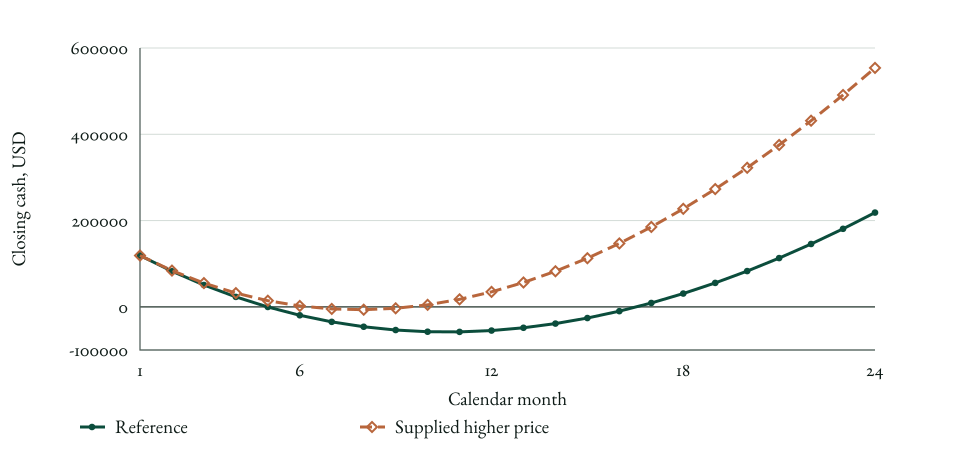
Original deterministic drawing from exact foundation and price monthly cash pointers. Lines connect monthly modelled closing balances only; no intramonth path, price elasticity, probability or customer response is estimated.
It is possible for the price case to remain directionally useful even when those relationships change. The analyst can use it as one point in a broader scenario set, with independently supplied acquisition, cost or payment alternatives. But the resulting cases are still exogenous joint assumptions unless a response model is estimated. The exhibit should not label them an elasticity curve or a forecast simply because several input combinations have been plotted. Their role is to locate decision dependence, not to invent causal evidence.
The choice of what to hold constant should itself be challenged. Holding acquisition budget fixed asks how a different offer performs under the same planned spending. Holding expected acquisitions fixed would require changing budget or CAC to preserve that path. Those answer different questions. The canonical price-only case keeps both budget and CAC unchanged, which preserves acquisitions mechanically. Meridian’s committee must decide whether that is a useful mechanism comparison before asking whether it is a plausible commercial path.
The favourable result can support a narrower action. It may justify spending existing staff time on a price and service review because the mechanism has potential value. It does not justify making binding offers while the cash and service dependencies remain unresolved. This distinction preserves commercial initiative: the team can learn about a promising intervention without claiming that the intervention has already been proven. The bounded evidence task has an owner, a scope and a decision event.
The additional funding gap is especially useful in this chapter because it prevents a simple success narrative. The price-only scenario improves several outputs, yet it does not cross the declared cash feasibility condition. Meridian therefore holds the launch for funding even before service readiness is considered. Later, the cash-funded case removes that financial obstruction while retaining a service gate. Together the branches show why a good output and a complete commercial permission are different objects.
A contract boundary can invalidate a price comparison
Existing contractual rights can constrain how and when a price changes. A customer may have a fixed tariff, a renewal notice requirement or an agreed package scope. The model does not interpret those terms. The offer record must therefore distinguish a new-customer proposal, an optional upgrade and a change to an existing obligation. A higher-price fixture cannot create a contractual right to impose that price. The appropriate legal or contract owner must establish the permitted action from the actual facts.
A commercially attractive exception might be to offer a new premium tier to willing customers while preserving the existing service. That can be a valid strategy, but it is not the uniform price-only case. The new tier can change customer selection, service cost and fixed capability. It deserves its own scoped comparison. The original fixture remains a reference demonstrating the price mechanism, while the real decision depends on the changed package and the evidence that supports it.
The practical falsifier is a refusal to accept the unchanged offer at the changed price within the relevant customer universe. That evidence would invalidate the proposed comparison as a forecast, without invalidating the arithmetic. Another falsifier is a service obligation that raises cost before customers pay. The committee should ask for both because a price increase can fail through demand or delivery. A complete intervention proposal needs a reason why the retained input relationships remain credible.
This chapter’s original framework is a disciplined translation from a supplied price scenario to an evidence task. It distinguishes the mechanism, the response assumptions, the contractual permission and the resource gate. The framework is useful if it directs scarce attention to the assumption that can reverse the next commitment. It is excessive if applied to a trivial price correction already permitted by established terms. The scope should follow the action, not the sophistication of the chart.
Decision and consequence
Use Meridian’s higher-price fixture as an exogenous mechanism comparison. Lena Okafor may conduct the recorded internal offer review, with Amira Sato confirming unchanged service scope and Nadia Chen reviewing payment terms. Hold rollout because the canonical funding gap remains positive and the evidence does not establish customer response or contractual permission.
A serious alternative
An operator may already know that a small price correction is accepted under established terms, especially when the same customers have repeatedly renewed a uniform service. In that circumstance an elaborate response study can add little. A short conditional comparison and contract check may be sufficient. The alternative is strongest when the intervention is small in its operational consequences and the next commitment is reversible. It is weak when the proposed price also changes the offer, customer universe, payment method or renewal rights. Historical familiarity should not be used to declare those changed relationships constant without examining them.
Where this argument stops
The engine estimates no price elasticity, customer selection, campaign conversion, service-intensity response or contractual permission. Its retained-price expansion is a supplied homogeneous age path, not a realised tariff schedule. The price case retains acquisition and churn by construction. A favourable result establishes a conditional mechanism and can motivate an evidence task; it cannot establish the effect or legality of a real intervention.