
Governance and application
An end-to-end commissioning worksheet
Acceptance must follow the service architecture
Commissioning should demonstrate the service that justified the investment. A component test can establish that equipment performs under specified local conditions. A system test can establish that connected components and interfaces work together. An operational service test can establish that eligible cargo reaches the chosen acceptance boundary under the declared envelope. These are complementary kinds of evidence. Treating a successful local test as full corridor acceptance leaves the dependencies that matter to the customer unexamined.
The test plan should trace each requirement to evidence and an accountable decision. A loader-rate requirement needs compatible material, measurement basis and test conditions. An end-to-end delivery requirement needs cargo release, transport, receipt, eligibility and destination acceptance events. A recovery requirement needs reserve activation and restoration. The plan should identify which requirement each test establishes, what it excludes and who can accept the result. A single commissioning percentage cannot preserve those distinctions.
The system boundary should include institutional and informational handoffs. A physical movement can succeed through manual intervention while the intended dispatch or release interface remains unready. That may be an acceptable temporary arrangement if it is safe, authorised and documented. It is not proof that the normal operating model works. The commissioning record should distinguish temporary workarounds from the commissioned service, with owners and conditions for removing or retaining them.
The relevant authorities retain their scope. A supplier can accept an equipment test; an operator can confirm readiness; a public actor can grant a permission; a customer can accept delivery. The sponsor should coordinate these decisions without pretending that one signature covers them all. An explicit acceptance matrix protects the project from both overclaiming and an unmanageable demand that a component supplier guarantee every external dependency.
Exhibit: evidence gates for the accepted service
Read the relationships as declared service conditions, with the limits stated in the caption.
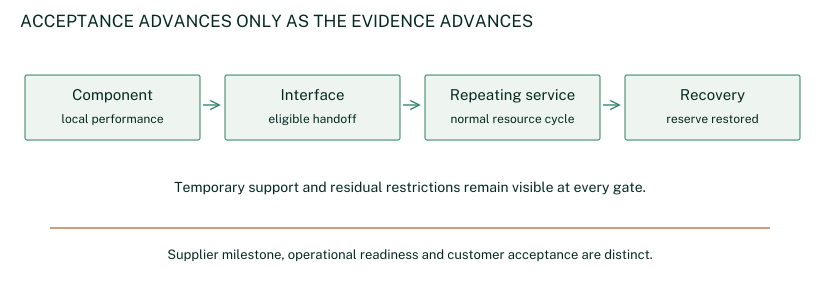
Original commissioning architecture. A component test, eligible interface, repeating resource cycle and restored reserve establish different properties. Temporary support and residual restrictions remain visible throughout. The drawing contains no completed test and no acceptance claim for an actual corridor.
Test interfaces before celebrating the first movement
The first movement is a useful milestone, but it can be specially prepared. Extra staff, prepositioned stock and exceptional priority may remove the ordinary constraints. The commissioning report should state those conditions rather than imply that the event demonstrates a sustained service. A repeatable operating test should use the declared resource and governance basis, with deviations recorded. The difference between a successful demonstration and an accepted recurring service is an important status boundary.
Interface tests should follow the actual handoff. Cargo identity and quantity should reconcile between release and receipt. Readiness messages should reach the right actor in time to support dispatch. The receiving stage should confirm that it can accept the cargo and preserve eligibility. The resource should return to its next duty when the service cycle requires it. Each test should expose the evidence gap that could prevent repeating the movement, instead of measuring only the most visible productive interval.
The programme should include adverse but admissible conditions. A changed priority, delayed upstream release or temporary restriction can reveal whether the operating plan remains coherent. Tests must remain safe and authorised; they should not manufacture a dangerous event for presentation value. A tabletop exercise can test authority and communication, while a controlled physical exercise can test compatibility or substitution. The report should identify which property each exercise establishes and which still depends on evidence not yet available.
Failures should be classified by requirement and mechanism. A missed handoff can arise from physical capability, missing information, unconfirmed permission or unclear decision authority. The corrective action should address that mechanism and the subsequent test should show whether it was resolved. Retesting an unrelated local rate does not close an interface defect. The challenge log should retain the failed test, corrective action and evidence of closure rather than replace the record with the final favourable result.
Ramp-up needs a provisional service basis
A ramp-up plan can deliberately begin within a narrower envelope. The team may use a restricted cargo mix, temporary resource allocation or conservative dispatch sequence while it verifies interfaces. Those conditions should be labelled provisional and connected to the next acceptance gate. A lower initial rate does not necessarily show design failure, just as a high isolated rate does not prove full readiness. The review should compare the evidence with the staged service requirement.
The plan should state how it advances. Each release should require relevant evidence such as stable receipt, reconciled quantity, valid permissions or restored reserves. An elapsed date alone is a weak readiness criterion when the unresolved dependency remains. Conversely, excessive ceremony can delay service after the necessary evidence is established. The gate should be specific enough that operators and reviewers can recognise when the condition has been met.
Temporary support needs a sunset or adoption decision. Additional commissioning personnel, manual interfaces or dedicated equipment can become permanent without their costs and authority being reviewed. The service basis should identify what normal operation assumes and what ramp-up support supplies. If the project chooses to retain a workaround, revise the operating and commercial basis explicitly. A silent continuation can leave the accepted annual capacity dependent on resources absent from the approved plan.
Sustained operation should also test restoration of readiness. A chain that delivers a staged campaign while depleting buffers or consuming exceptional fleet reserve may not be able to repeat it. The commissioning record should show whether the intended stock, equipment and operating positions are restored. This links the acceptance test to the maintenance and buffer chapters: delivery, recovery and readiness for the next cycle are separate properties that the service promise may require.
A repeated cycle challenges a staged demonstration
A fictional first delivery is prepared with fully released cargo, a dedicated path, extra staff and empty receiving space. It succeeds and provides valuable evidence of compatibility. The next service has to share resources, form cargo through normal release and return equipment through the ordinary terminal process. It may reveal a circulation or readiness problem absent from the demonstration. The commissioning record should therefore state the exceptional support and identify the repeating-cycle test that remains.
The test should trace the resource back to its next eligible assignment. A delivery that immobilises equipment at destination can succeed at the cargo boundary and fail the fleet-circulation requirement. A campaign that consumes the protective yard reserve can succeed for the current vessel and leave the next commitment exposed. These are distinct outcomes. The acceptance matrix should preserve both rather than force a single success label across the whole programme.
If the repeat test fails, the corrective action should address the limiting state. A delayed return may require terminal release or resource allocation changes rather than a higher loading rate. An exhausted reserve may require a restoration sequence rather than more isolated peak capability. The evidence should identify whether the original annual assumptions remain defensible and whether the approved intervention addressed the right mechanism. The project should not close a service defect through an unrelated component test.
A provisional operating state can be appropriate while these issues are resolved. The sponsor should state the permitted duty, temporary support, unresolved requirement and evidence needed to advance. That allows useful service to begin within a controlled envelope without claiming a full capability that has not been demonstrated. It also protects the local equipment acceptance from being confused with wider readiness, giving each actor a clear and feasible evidential responsibility.
Close acceptance with residual conditions visible
A residual defect can be minor for one duty and blocking for another. The acceptance decision should state which service is permitted, under which restrictions and with which open actions. It should not use a generic accepted status that obscures a consequential limitation. An unresolved data defect may prevent a performance claim even when safe movement is possible. An unresolved technical restriction may prevent movement regardless of a favourable data record. The matrix should preserve the difference.
The committee should receive evidence of the delivered system, not only progress against the commissioning schedule. An integrated schedule helps identify dependencies and prepare tests, while completion of an activity does not prove that its requirement was satisfied. The acceptance review should connect the schedule, test record, defects and actual authority to release. This prevents a programme marked complete from becoming an unsupported service certificate.
A commissioning result can update only the capacity property it actually tests. A hypothetical repeated-cycle demonstration that relies on dedicated paths supports circulation under that path arrangement; it does not establish capacity under the ordinary shared timetable. A successful loading test with prepositioned eligible stock supports the loader duty but leaves replenishment untested. Preserve those test conditions in the basis bridge and mark the unresolved transition that prevents their combination into an annual guarantee. Where ordinary operation reproduces the conditions, the bridge can advance. Where it does not, the next test should challenge that difference rather than repeat the favourable demonstration.
The residual disposition should distinguish a restriction from a performance-evidence gap. A hypothetical cargo trace can be incomplete while movement remains technically permissible; acceptance of a throughput claim must then wait for lineage reconciliation. A handling restriction can remain even when every timestamp is complete; movement must stay within the permitted envelope. A temporary dedicated crew can permit provisional service while leaving the normal staffing duty unresolved. Recording these different residuals tells the operator which service can continue and tells the sponsor which claim remains unsupported. It avoids both stopping safe permitted work merely because a report is unfinished and declaring full service acceptance merely because the paperwork is complete.
Completed illustrative commissioning matrix
This proposed record contains no executed test or acceptance claim. It links each service requirement to evidence and a release decision.
Scroll for all columns. With the table focused, use the left and right arrow keys.
| Completed illustrative commissioning matrix | |||
|---|---|---|---|
| Requirement | Test or review | Evidence still needed | Acceptance role |
| Local loading capability | Specified cargo and equipment test | Rate record, conditions and technical result | Supplier and relevant technical actor |
| Eligible cargo handoff | Trace release through yard receipt and loading assignment | Identity, quantity and status reconciliation | Producing and receiving operators |
| Recurring transport cycle | Repeat compatible dispatch and resource return | Path, terminal and circulation records | Transport and terminal actors |
| Restriction response | Safe authorised exercise of stop and restart process | State messages, authority and permitted actions | Relevant stop authority and coordinator |
| Reserve restoration | Verify depletion, deployment and recovery sequence | Eligible reserve and repeated-service evidence | Service and reserve owners |
| Whole-chain service | Accepted delivery under declared operating basis | Customer boundary record and residual defects | Sponsor, operator and receiving acceptance roles |
Service acceptance gate
Accept only the service state demonstrated by relevant tests and authorised reviews. Keep component, interface and recurring-service evidence separate. Record temporary support and residual restrictions. Revise the model basis when observed operation contradicts its assumptions, and close each defect through evidence tied to the original requirement.
- Trace requirements to tests and acceptance authority.
- Distinguish demonstration from normal repeating operation.
- Test safe adverse states and reserve restoration.
- Publish the permitted envelope and open conditions at handover.
Full recurring-service proof may delay contractual acceptance
Contractual component acceptance and sponsor service acceptance can be separate decisions with different evidence. The paper does not recommend withholding a supplier’s agreed milestone because of an unrelated external dependency. It recommends preserving what that milestone establishes and testing the corridor service through the appropriate programme. The sponsor should allocate those duties in advance so that a technical test does not become an improvised dispute over wider responsibility.
The matrix records a proposed test plan
Before accepting performance, legal readiness or customer delivery, obtain the executed test and scoped acceptance evidence from the relevant actors. No commissioning event has been executed for this fictional corridor. The matrix supplies a structure for documenting those properties when suitable evidence exists; its entries alone cannot certify them. Retain any property whose evidence remains absent as an open condition in the permitted service state.
Evidence and scope
NASA’s systems engineering guidance connects requirements, technical management and decision rationale. Its reference architecture requires adaptation; it does not accept this corridor.
Evidence: NASA Systems Engineering Handbook
Evidence and scope
GAO’s schedule guide treats schedules as integrated dependency models. Schedule completion alone is not evidence that an operational service requirement has passed its test.
Evidence: Schedule Assessment Guide: Best Practices for Project Schedules