
Governance and application
A corridor governance charter
The corridor needs coordination across legitimate authorities
Start the governance design with the interfaces that no single asset manager controls, from eligible release to accepted delivery. Their actors retain different ownership, duties and incentives. Assign the coordination function a clear service purpose and limited powers, then preserve the distinct authority of operators, technical functions, commercial parties and public institutions. Where a proposed corridor-manager diagram implies a power, identify the agreement or law that would provide it. If that basis is absent, route the decision to the actor that holds it instead of placing the actor beneath an unsupported hierarchy.
The charter should begin with the approved service definition. It should name the participating boundaries, cargo eligibility, operating envelope and customer commitments. That gives the coordination function an object to manage. Without it, meetings can become general discussions of logistics performance in which every actor uses a different success measure. The charter should also state exclusions and unresolved external dependencies so that the coordinator's accountability matches its actual authority.
Participation should follow decisive interfaces, not prestige. A release desk can matter as much as a major equipment owner when its decision governs eligibility. A receiving customer can matter when its acceptance window constrains the service. A maintenance or infrastructure actor can matter when its calendar shapes usable capacity. The charter should identify who must attend which decision and who can provide confirmation asynchronously, avoiding a permanent committee that includes everyone but resolves nothing.
The sponsor should distinguish coordination from contracting. A governance charter can establish a process for shared planning, evidence and escalation. It cannot silently amend an access right, equipment warranty or public duty. Those changes need their relevant authority and agreement. The charter should name that boundary rather than imply that collaboration creates consent. This protects the participants and makes the service promise more credible.
Exhibit: coordination within scoped authority
Read the relationships as declared service conditions, with the limits stated in the caption.
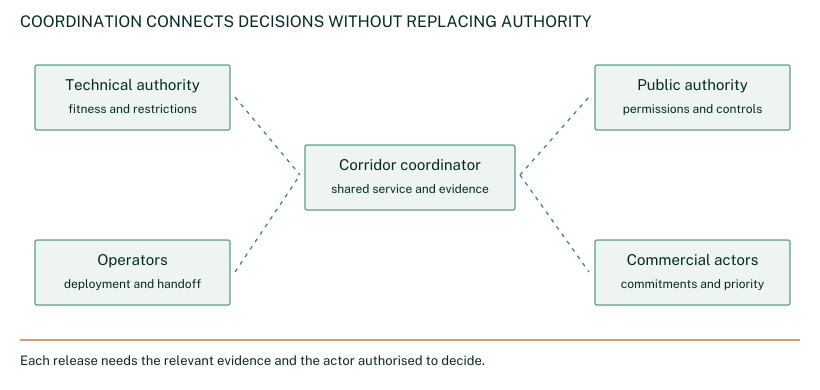
Original proposed governance diagram. Connections represent coordination rather than hierarchy or an executed agreement. Technical fitness, public permission, operator deployment and commercial priority retain their relevant decision owners. The coordinator connects evidence and service consequences; it does not acquire those authorities by appearing at the centre.
Assign decisions and evidence, not only responsibilities
A responsibility matrix is useful only when it identifies an actual decision and the evidence needed to make it. The charter should state who can confirm eligible cargo, allocate a shared operating slot, suspend dispatch, approve restart and close recovery. It should distinguish recommendation, approval and execution. An actor may advise on a decision while another holds authority, and a third records the resulting event. Collapsing these roles into responsible can leave a critical handoff unresolved.
Normal planning should use a common readiness vocabulary. Forecast, committed, ready, restricted and completed states should retain their meaning across actors. The data dictionary should identify the source, update duty and correction route for each state. The coordinator should not overwrite a technical restriction with a commercial green status. When the states disagree, the charter should define which condition governs movement and how the conflict is escalated.
An incident protocol should begin with the service impact and immediate constraints. It should identify the actor that observed the event, the technical or public stop authority, the relevant users and the current buffer or reserve state. The coordinator then aligns permitted responses. This is a different duty from determining legal liability or assigning blame. Keeping those processes separate can improve both operational candour and later evidence review.
The evidence repository should retain decisions, assumptions and revisions. A meeting minute that records only action items may lose why an alternative was rejected or which condition made approval valid. The record should include the service edition, evidence references, unresolved challenge and accountable release. It should be concise enough for operators to use but sufficiently complete for a later reviewer to trace the decision. A longer archive without decision lineage is not stronger governance.
Design escalation that can actually resolve a conflict
Escalation should follow the nature of the conflict. A missing readiness confirmation may be resolved by the interface owner. A priority conflict may need the agreed commercial decision process. A technical restriction may need qualified review. A public permission may remain with the relevant authority. The charter should route each category to an actor capable of deciding it, rather than send every issue to the most senior person and assume hierarchy supplies expertise or legal power.
The escalation record should state the feasible options and their service consequences. If a yard is full, the choices might include revised upstream release, alternate eligible storage or changed vessel allocation, each subject to its own conditions. The coordinator should preserve the effects on other users and the authority required. A decision to prioritise one commitment should be transparent within the applicable information rules, especially when it creates delay elsewhere.
Unresolved conflict should have a safe operating state. If the actors cannot agree that a movement is eligible, the charter should specify how it is held and who protects cargo and resources. Commercial urgency should not erase uncertainty about a noncompensable condition. The record should identify the next evidence action and escalation route. This makes the hold a governed state rather than an unmanaged queue whose costs and responsibilities are later disputed.
The charter should also limit recurring exceptions. A temporary priority or recovery rule can become normal practice unless it has an expiry and review trigger. Repeated exceptions may indicate that the base service design no longer fits demand or operating conditions. The coordinator should bring that pattern into a service-basis review, not continue to resolve each episode informally. Governance then supports redesign rather than merely sustaining a fragile arrangement through individual intervention.
Review governance through service evidence
Evaluate the charter against the service decisions it is intended to resolve. Proposed evidence includes timely readiness confirmation, clear incident ownership, fewer unresolved handoff states and a traceable response to changed conditions. Define a baseline for those categories and record concurrent operational changes before interpreting any movement as governance improvement. This paper reports no measured outcomes for them. Counting meetings or participants cannot answer the service question; the review needs evidence of the relevant decision and its consequence.
The charter should include a challenge route for participants. An operator should be able to dispute a metric, capacity basis or attributed cause with evidence. A source owner should be able to correct an erroneous readiness status. A customer should be able to show that a reported delivery did not meet the agreed acceptance event. The process should record the challenge and resolution, preserving adverse findings instead of treating disagreement as obstruction.
Test the charter with a hypothetical disputed readiness message. The yard records ready space, the railway records an unreleased formation and the customer records a missed delivery. The coordinator should reconstruct which transition failed and convene the actor able to change it. If the formation lacked cargo release, the yard cannot cure the problem by accepting a queue. If the formation was eligible but the yard's readiness omitted compatible handling, the receiving definition needs correction. If both were ready but no admissible path remained, escalate the scheduling conflict. A functioning charter routes each branch to a decision; a meeting that merely repeats the competing statuses has not resolved the service interruption.
To distinguish decision latency from operating latency, record when the conflict became actionable, when the responsible actor received a complete request, when a disposition was issued and when the operating transition occurred. Delay before a complete request points to a definition or information gap; delay afterward calls for review of authority or resources. A prompt decision followed by slow execution directs the diagnosis elsewhere. These proposed qualitative diagnostics need actual observations before becoming performance findings. They give charter review a specific agenda and keep missed delivery from being attributed to bureaucracy or equipment without a traceable mechanism.
Completed proposed corridor governance charter
This is an original fictional charter structure, not an executed agreement. Each clause defines an operational purpose and identifies the approval still needed.
Scroll for all columns. With the table focused, use the left and right arrow keys.
| Completed proposed corridor governance charter | |||
|---|---|---|---|
| Clause | Proposed rule | Accountable role | Required confirmation |
| Service purpose | Coordinate eligible producer release to accepted vessel transfer | Sponsor and service coordinator | Participating actors agree boundary and exclusions |
| Readiness data | Keep forecast, commitment and actual event separate | Each originating interface owner | Data definitions and permitted recipients agreed |
| Dispatch decision | Move only when required eligibility and downstream conditions hold | Operator within its authority | Release and access confirmations recorded |
| Incident coordination | Preserve stop authority and align feasible responses | Coordinator and affected owners | Technical, public and commercial powers retained |
| Recovery closure | Close after agreed service and reserves are restored | Incident governance roles | Evidence of stable handoffs and residual restrictions |
| Challenge and change | Record disputed basis and revise on decisive service changes | Model and charter owners | Challenge resolution and service edition approved |
Governance operating test
Before adopting the charter, walk a normal handoff, an incident and a priority conflict through its rules. Confirm that each decision reaches an actor with actual authority and that the required evidence exists. Revise clauses that depend on assumed data access or consent. Set a trigger for service-basis review when recurring exceptions or new interfaces appear.
- Name service boundaries and exclusions.
- Assign forecast, approval, execution and recording separately.
- Route conflicts by technical, commercial or public authority.
- Retain decisions, challenges and the conditions attached to approval.
Coordination can become an expensive administrative layer
A charter should remove unresolved decisions rather than add reporting for its own sake. Limit shared data to the service purpose and convene the actors needed for the current issue. If an existing operating arrangement already resolves the relevant interfaces, document and test it instead of creating another committee. Governance quality depends on authority and usable evidence, not institutional complexity.
The charter is proposed and unexecuted
Adopt this fictional role allocation only after the relevant agreements, jurisdictional review and operational tests establish the proposed powers and data access. No actor has accepted it, and the paper creates no legal authority or data right. The charter can organise those confirmations and route an absent one to its owner; it cannot replace the acceptance needed for actual coordination.
Evidence and scope
The World Bank port-governance module describes port authorities as actors that reconcile stakeholder interests, build port communities and cooperate beyond local boundaries. It also retains the importance of legal setting and the relationship with government. This supports coordination with scoped authority; it does not establish an executed arrangement for the fictional service.
Evidence: Port Reform Toolkit: Port Governance