
Decision architecture
An end-to-end scope and service definition
Begin with the delivery promise
A corridor investment should begin with a precise statement of the service that its users will receive. A line drawn between a production area and a port is a geography. A schedule of locomotives, yards and loading equipment is an asset inventory. A promise to deliver eligible cargo at an agreed custody point within an agreed operating window is a service. These descriptions overlap, but they answer different questions. Confusing them allows an investment committee to approve a technically impressive component without establishing whether the intended customer can use the resulting chain.
Consider an expressly fictional bulk export corridor. The producer releases cargo, a railway moves it to a coastal stockyard, and a loading operation transfers it to a vessel. The committee sees a loading machine operating intensely during vessel calls and concludes that this visible asset needs expansion. The service manager instead asks whether cargo arrives in the correct grade, with cleared documentation and a compatible vessel ready to receive it. If the railway cannot replenish the yard quickly enough, a faster loader may spend more time waiting. If vessel access is unavailable, inland production may create stock without delivering accepted cargo.
The relevant output therefore needs both a physical and an acceptance definition. Physical movement records the quantity crossing a boundary. Accepted delivery records whether that movement meets the customer's specification and the terms governing custody. Cargo transferred with an unresolved quality dispute is not interchangeable with cargo accepted without reservation. Similarly, a departure from the mine is an upstream event rather than proof of vessel delivery. A throughput report should state which boundary it measures and whether rejected, reworked or diverted material enters its numerator.
This distinction changes accountability. An equipment owner can reasonably warrant performance within a defined envelope without controlling the whole service. A corridor coordinator may be responsible for resolving incompatible schedules while lacking authority to waive customs or safety requirements. The sponsor should preserve these distinctions in the project design. A broad ambition such as improving logistics does not allocate control, establish a measurement boundary or resolve a conflict between productive movement and lawful release. The opening service statement must make those unresolved matters visible before alternatives are compared.
Exhibit: service boundaries in parallel
Read the relationships as declared service conditions, with the limits stated in the caption.
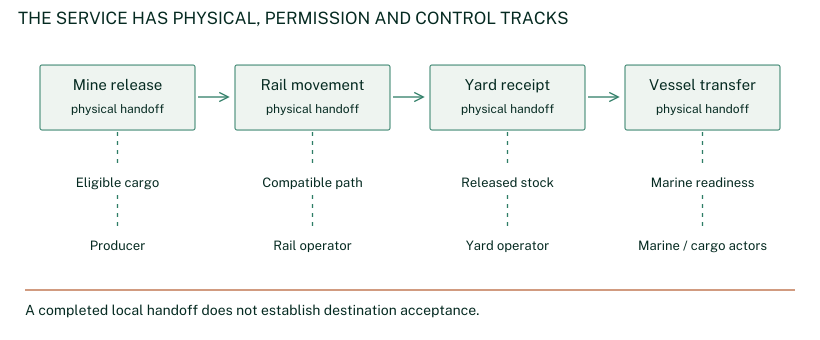
Original conceptual diagram. Solid arrows follow cargo; dotted connections identify eligibility and control. The drawing represents the declared fictional service, with no quantities or measured operating events. Its decision purpose is to expose a completed local handoff that still lacks the condition for destination acceptance.
Scope follows the cargo and its permissions
A useful corridor boundary follows the cargo from its first eligible release to the chosen destination, including transformations that can interrupt acceptance. It also follows the permissions needed for that movement. A train needs infrastructure access as well as rolling stock. A shipment needs documentary release as well as a berth. A road movement needs a compatible vehicle and driver arrangement as well as a nominal road capacity. These dependencies belong inside the service analysis even when the sponsor neither owns nor operates them.
The boundary need not include every remote supplier or institution. Scope should expand when a dependency can change the delivery decision, the operating basis or the ability to recover from disruption. A fuel supplier may belong in a continuity analysis because unavailable fuel can stop the chain. The supplier's unrelated business activities do not. A customer's downstream processing plant belongs inside the delivery boundary only if its receipt capacity or specification determines what the corridor can acceptably deliver. This decision-based boundary is more useful than either an indiscriminate map or an ownership-only diagram.
An explicit exclusion is an analytical commitment. If the study ends at vessel loading, it cannot describe cargo arrival at the final customer as a demonstrated result. If it omits maritime sailing, the estimated transit time is not a door-to-door time. If the operating scenario excludes a border closure, its apparent capacity cannot establish continuity during that closure. Exclusions should be attached to the conclusions they limit. A distant disclaimer does little to prevent a diagram or executive summary from suggesting a wider claim than its actual boundary supports.
Interfaces deserve particular attention because each side may define completion differently. A mine may record release when cargo leaves a stockpile, while the railway records acceptance when a train is formed and weighed. The interval contains loading, inspection and queuing that neither local report may own. At the coastal end, a yard may count receipt before sampling is complete while the loader accepts only material released for shipment. The system ledger must expose these intermediate states. Otherwise apparent losses or delays become arguments about whose report is correct instead of evidence about the service.
Draw the service before selecting the asset
The service map should show physical progression, documentary progression and control progression. Physical progression identifies where material is held, transferred or transformed. Documentary progression identifies the evidence that permits the next movement. Control progression identifies who can authorise, stop or restore that movement. Keeping these tracks distinct makes it possible to locate a disagreement. A train may be physically ready, administratively ineligible and operationally outside its allocated path at the same time. A single green status hides the reason it cannot depart.
A stockpile is particularly revealing. It may protect the loader from a short rail interruption, yet it may also conceal unreliable inland replenishment. It can contain cargo of several grades, cargo awaiting release and cargo reserved for another vessel. Treating the entire pile as available supply may overstate the service buffer. The initial system map should therefore describe eligibility transitions rather than only storage volumes. This is the beginning of a working definition of useful capacity: the capacity to advance eligible material through the relevant service boundary under the declared conditions.
The map should also identify the user affected by delay. A producer may care about evacuation from the mine, a charterer about vessel readiness, and a downstream buyer about received quality. Their objectives can conflict. Faster evacuation can overload the yard; a vessel priority rule can delay another cargo; tighter acceptance tests can slow release while reducing rejection risk. The committee needs an explicit service hierarchy or a process for resolving such conflicts. An average throughput objective alone cannot decide which user's commitment should prevail during a constrained operating period.
The fictional studies in this paper deliberately simplify this map to annual serial flow. They show the effect of changing annual effective capacities while holding the defined chain and operating cost assumptions fixed. They do not assign custody, simulate individual consignments or prove acceptance. The broader service map supplies the questions that the annual calculation leaves open. In practice, the sponsor should approve the map and service definition before accepting a capacity model, because the model's minimum operation can be mathematically correct for a boundary that does not answer the customer's question.
A disputed delivery exposes the boundary
Imagine a fictional disagreement after cargo has reached the port yard. The producer's report says its evacuation commitment was met. The carrier's report says the transport movement was complete. The yard's receipt record confirms physical arrival, but part of the cargo remains on hold pending an eligibility decision. The vessel-loading actor says the intended parcel is not ready. None of these statements has to be false. They refer to different events, and only the last unresolved transition determines whether the chosen vessel service can proceed.
The coordinator should not resolve the disagreement by selecting the most senior actor's tonnage report. It should reconstruct the agreed service object. Which commercial parcel was intended? Which physical receipt objects compose it? What acceptance condition remains unresolved? Who can provide the missing evidence, and what other eligible work can proceed while it is resolved? The resulting record separates completed local duties from the unmet system commitment. This can support fair responsibility allocation without pretending that the completed upstream movement has no value.
The investment implication depends on that reconstruction. A larger receipt system will not release held cargo if the missing condition is documentary or quality-related. A faster loader will not make the parcel eligible. A change in release preparation may improve the service, while additional segregation space may protect other cargo from the hold. The case directs the team toward a specific mechanism and feasible alternatives. It also prevents a service failure from becoming a general narrative that every asset is too small.
The committee should retain the disagreement as a test of the service definition. If the parties cannot identify the event that counts as successful delivery, the project's objective remains unresolved. An investment approval should then require a clarified acceptance boundary and governing record before it claims a capacity benefit. This is a practical use of the systems perspective: it makes an ambiguous operational dispute answerable through objects, events, evidence and authority instead of competing local totals.
Define an intervention that can be falsified
The claim that relieving a bottleneck improves the corridor becomes testable only after the target service and comparison basis are fixed. An intervention record should state what changes, what remains constant, which delivered outcome is expected to respond and what observation would contradict that expectation. For a loader expansion, the expectation might be a reduction in time needed to transfer released cargo during compatible vessel windows. The whole-chain throughput claim requires a further showing that another stage, customer demand or a permission does not absorb that apparent gain.
A good falsifier is specific enough to alter a decision. If eligible cargo delivery remains unchanged after a controlled operating trial while inland queues grow, the intervention has not demonstrated the promised service improvement. That observation does not automatically prove that the equipment is defective. It may show that the wrong boundary was selected or that dispatch and stockyard eligibility constrain the benefit. The response should be to revise the system explanation and investment sequence rather than redefine success as local utilisation after the fact.
The service definition should remain versioned. A sponsor may later add another product, destination or operating season. Such a change can be commercially sensible, but it alters the basis on which the earlier capacity conclusion was made. The new service should trigger a reassessment of bottlenecks and operating constraints. Otherwise a model originally intended for a homogeneous flow may be carried into a mixed operation where handling, quality segregation and scheduling matter. A service change is not merely a new label on an unchanged throughput number.
The most useful opening decision is therefore modest and binding: approve the service boundary, acceptance basis, accountable actors and test of improvement. This gives the technical team a coherent question and gives the committee a means of challenging an attractive asset proposal. It also prevents governance from arriving only after procurement, when incompatible obligations are harder to alter. The first deliverable of corridor development is a shared description of what must be delivered and under which conditions, not a larger number attached to the most visible piece of infrastructure.
Exhibit: the same cargo has different states
Original conceptual map for the fictional bulk corridor. Each row describes a boundary that needs an event record; no actual operating data are represented.
Scroll for all columns. With the table focused, use the left and right arrow keys.
| Exhibit: the same cargo has different states | |||
|---|---|---|---|
| Boundary | Physical state | Permission or acceptance | Accountable decision |
| Producer release | Cargo ready for collection | Grade and release evidence complete | Producer authorises eligible batch |
| Rail acceptance | Cargo loaded and consist ready | Access and train formation requirements satisfied | Rail operator accepts movement |
| Yard receipt | Cargo physically received | Sampling, segregation and shipment release resolved | Yard allocates usable stock |
| Vessel transfer | Cargo crosses loading boundary | Compatible vessel and cargo acceptance conditions met | Marine and cargo actors confirm transfer |
Service-definition gate
Approve the service statement only when the customer boundary and the evidence of successful delivery agree. Record the purpose of the corridor, the eligible cargo, custody transitions, operating envelope and authority to stop. Require each asset proposal to explain which part of this service it changes. Return the proposal for revision when its benefit is stated at a local equipment boundary while the approved objective sits elsewhere.
- Name the origin, destination and acceptance event.
- Describe permissions and transformations between those events.
- Agree which unmet condition prevents the service from being counted.
- Record who changes the service definition and who reviews the resulting capacity basis.
An ownership boundary is easier to manage
An owner may argue that a wider service boundary creates responsibility for events it cannot control. That concern is valid for contracts and warranties. It does not justify excluding those events from the analytical chain. The map should distinguish influence from authority and should avoid assigning an owner obligations it has not accepted. A sponsor can recognise a border agency as a decisive dependency without pretending to control it. The resulting investment decision may require a condition, an alternate service promise or a governance arrangement rather than a wider equipment guarantee.
A service map establishes a question, not feasibility
The map cannot establish that a proposed route is permitted, that cargo quality can be maintained or that each actor will accept the proposed allocation of responsibility. Those require relevant evidence and agreement. Its role is to expose dependencies and prevent a narrow capacity result from being interpreted as demonstrated end-to-end delivery.
Evidence and scope
The World Bank toolkit describes corridors through connected infrastructure, services and coordinating institutions. Its primer includes gateways within the corridor and argues for attention to total movement from origin to destination. This supports a broad service boundary, while its examples supply no operating values for the fictional chain.