
Mechanisms and worked studies
A refinancing dependency register and interest scenario comparison
Two calendars of financing risk
Interest risk changes the cost of carrying an obligation. Refinancing risk concerns the source available to repay or replace an obligation at maturity. They can interact, yet they should remain distinct in a financing decision. A loan with a stable current payment can still depend on uncertain future refinancing. A floating-rate loan can create near-term pressure even when it amortises fully within the asset's operating rights. The committee should identify the event that changes the cash claim and the event that requires new capital, rather than grouping both under a broad interest-rate sensitivity.
A rate assumption needs a convention. The applicable reference, margin, reset date, payment period and balance basis determine what cash becomes due. A projected rate path is an assumption about future conditions, while a fixed contractual component can be established from terms. The analyst should keep them separate and record where qualified treasury or legal interpretation is needed. An annual percentage alone does not fully define a debt-service schedule. This paper's capital app therefore takes debt service as an independent supplied series instead of deriving obligations from a loosely specified borrowing rate.
The balance on which interest accrues can change through drawdowns, repayments, capitalisation or other permitted claims. A cost increase during construction can require additional funding and affect later obligations even before operating revenue begins. A deferral can reduce current cash payments while increasing future claims. The model should show these pathways in a validated debt calculation where they are material. A simple service series can compare the outcome of different paths, but it cannot establish whether the path conforms to proposed terms or whether principal remains outstanding after the final supplied period.
The calculation dictionary records the annual convention. For the equity decision, test the funding mandate: is opening protection a newly contributed amount, a restricted project balance or a contingent promise? Those sources create different cost and incidence. None should be inserted as project operating cash to improve CFADS-based coverage. The bridge results identify a required amount conditionally; the completed committee record deliberately leaves its fundable source unresolved.
Refinancing dependence begins with the maturity funding source. If scheduled operating cash does not retire the full obligation, the project needs another source at the required date. A refinancing assumption can be plausible without being committed. It may depend on operating performance, lender appetite, market access, remaining rights, collateral condition or public policy. The model should distinguish a signed available source from an expectation that a source will later appear. This distinction is central to resilience because the project's willingness to refinance does not establish another party's willingness to provide capital when needed.
An expected reduction in risk after construction can support a refinancing thesis, but the path to that state must be defined. Completion, reliable operations, collections and stable rights may improve the evidence available to a future lender. Outstanding defects, unresolved interfaces or a weak commercial ramp can prevent the anticipated transition. The committee should state the milestones on which the refinancing expectation depends. Monitoring can then assess whether the project is becoming the asset the future financing case assumes. A statement that refinancing follows completion is too broad when completion itself has several meanings.
The remaining operating horizon affects future financing options. A refinancing lender needs to consider cash and rights after the new obligation begins, not merely the fact that the asset operated successfully before it. Renewal conditions, major replacements, terminal arrangements and changing demand can reduce the useful tail. A favourable historical period does not automatically support a long new tenor. The refinancing record should identify the rights and technical condition that remain at the intended date. It should also show whether a proposed payment relies on terminal value rather than continuing cash generation.
Rate sensitivity holds the cash path constant
The illustrative curves select the positive-rate region of the canonical sensitivity output for contrasting cash paths. They show valuation sensitivity and a crossing without changing the supplied operating or service schedule. The full canonical sweep remains available in the model files.
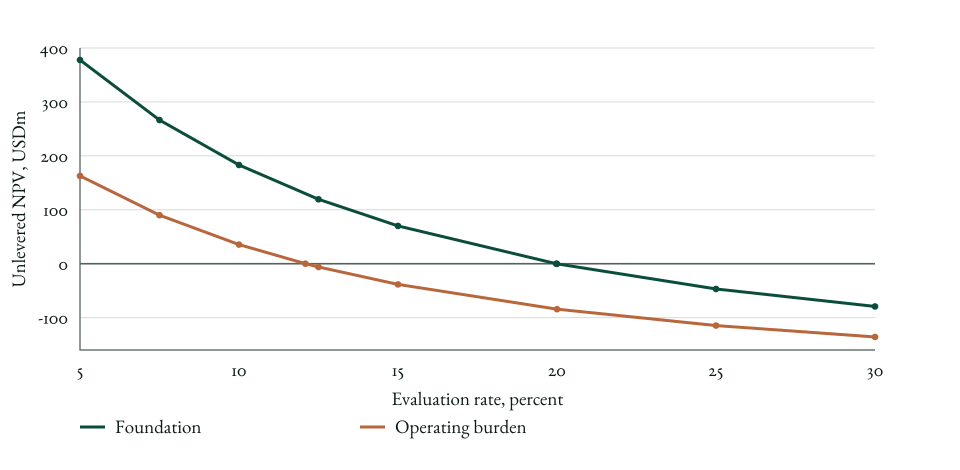
Original deterministic plot of frozen illustrative sensitivity outputs. The plotted evaluation rate is not a forecast financing rate; the chart does not simulate refinancing.
Market access can be cyclical or institution specific, but this paper assigns no probability to a future financing window. The relevant discipline is to ask what happens if expected capital is unavailable or available only on materially different terms. The response might include retaining cash, reducing distributions, staging investment, arranging support or using a different initial maturity. Each response changes current incidence or flexibility. The committee should see those changes as alternatives with costs and conditions. A refinancing assumption without a fallback can transform an operating project into a bet on future capital access.
Refinancing proceeds and gains should not be treated as ordinary operating cash. New borrowing can create a source at maturity while also creating a new obligation. A gain from revised terms may accrue to sponsors, users or public payers according to the applicable arrangement. The financing model should distinguish the transaction itself from the asset's cash generation. Counting a refinancing receipt in project value while also treating the asset's underlying cash as unlevered can mix analytical perimeters. The public capital fixtures avoid this issue by calculating unlevered values from supplied project cash and comparing independent service inputs.
The terms of an initial facility can constrain refinancing or prepayment. Charges, consent requirements, security release, intercreditor arrangements and other conditions may affect timing and cost. The analyst should obtain appropriate legal and treasury review rather than assume that a lower market rate can immediately replace the existing facility. A refinancing case should include the resources and process required to complete the change. The point is not to presume that refinancing is undesirable. It is to recognise that switching financing is a governed transaction with obligations, rather than a frictionless update to a discount-rate cell.
Interest protection can reduce a defined rate exposure while leaving refinancing dependence intact. A mechanism covering scheduled interest does not provide maturity principal. Conversely, a future refinancing expectation does not protect current service from adverse resets before maturity. The committee should separate the protected amount and period from the remaining claim. This allows the proposed structure to be judged as a set of mechanisms with different boundaries. A single description such as rate risk managed is inadequate if it hides a large obligation whose source remains contingent on a later financing transaction.
Optionality has value when it is genuinely available to the project. The ability to repay early, retain liquidity or choose among funding sources can improve response to changing conditions. Yet optionality may come with price, consent or performance conditions, and a formal option can be unusable if the project lacks cash. The analyst should identify what action the project can actually take, who authorises it and what it costs. A model that assumes management always chooses the favourable path should show the information and resources required at that decision date.
Monitoring a refinancing thesis requires leading conditions rather than only a countdown to maturity. The project should retain evidence about operations, remaining rights, technical condition, liquidity and unresolved lender concerns. The committee should identify the decision date at which a fallback must be activated if progress is inadequate. Waiting until maturity to discover that terms are unavailable can eliminate options that required earlier cash retention or negotiation. The financing record should therefore state both the intended refinancing path and the point at which continuing to rely on it becomes an explicit new decision.
The practical recommendation should state the structure's dependence on capital access in plain language. A fully amortising obligation, a maturity funded by retained cash and a maturity expected to be refinanced have different exposure. The committee can accept any of these in an appropriate context, but it should know which it is accepting. Interest sensitivities should then be applied to the actual obligation mechanism, and refinancing alternatives should be assessed for their conditions and incidence. A lower current service burden is useful only when its later consequence is understood and deliberately funded.
Evidence and scope
The World Bank risk-allocation guidance identifies interest-rate variation as a financial risk for debt-service affordability. This paper separates that recurring-payment mechanism from an original analysis of maturity funding and refinancing dependency. No current rate path, lender appetite or treasury protection price is inferred from the guidance.
Evidence: Risk Allocation
Refinancing dependency register
This conceptual completed record exposes the difference between an expected future source and an available commitment.
Scroll for all columns. With the table focused, use the left and right arrow keys.
| Refinancing dependency register | |||
|---|---|---|---|
| Dependency | Conceptual evidence status | Failure consequence | Decision or owner |
| Completion and stable operation | Future milestone in the conceptual case | The intended lower-risk asset is not established | Technical and operating owners supply milestone evidence |
| Remaining service rights | Expiry and renewal require reconciliation | A future lender may lack a sufficient cash horizon | Legal and commercial teams define the remaining perimeter |
| Maturity funding | Refinancing expected; no commitment claimed | Principal source remains contingent | Committee defines fallback and activation date |
| Transaction permissions | Terms require specialist review | A proposed refinancing can be delayed or costly | Treasury and legal owners reconcile conditions |
| Fallback resources | Cash retention or support requires an explicit choice | Options can disappear before maturity | Decision owner approves incidence and timing |
Rate exposure and maturity exposure
The table specifies distinct questions rather than claiming measured likelihood or actual financing terms.
Scroll for all columns. With the table focused, use the left and right arrow keys.
| Rate exposure and maturity exposure | |||
|---|---|---|---|
| Exposure | Cash event | Useful test | Insufficient substitute |
| Rate variation | A recurring payment changes under its convention | Dated service under coherent reset assumptions | An expected later refinancing |
| Maturity principal | A balance requires funding at a defined date | Available source and fallback conditions | Protection limited to current interest |
| Refinancing transaction | New capital replaces an existing obligation | Terms, permissions, costs and remaining cash horizon | A favourable operating history alone |
| Protection expiry | A defined arrangement ends before exposure | Uncovered tail and renewal decision | Assuming unchanged future availability |
A maturity source must have a status
A committee should identify whether maturity is funded by scheduled retirement, retained cash, committed support or expected refinancing. Where a source is expected, define the milestone evidence and the point at which a fallback must be chosen.
- Separate current rate mechanics from the final funding claim.
- State the source status and the conditions needed to make it available.
- Assess remaining rights and technical obligations at the financing date.
- Define an earlier decision trigger that preserves fallback options.
Refinancing can be a rational staged strategy
Initial financing can reasonably bridge construction or an early phase while later capital reflects improved operating evidence. Requiring the original facility to cover the entire horizon can impose unnecessary cost or constrain access. The staged strategy is strongest when transition milestones, fallback resources and remaining rights are explicit; it is weakest when lower current payments conceal an unsupported maturity source.
No interest or refinancing engine
The public app does not calculate floating-rate resets, balances, protection settlements, refinancing proceeds or prepayment charges. It compares supplied schedules. Actual financing terms and their cash consequences require a separate validated debt model and qualified treasury and legal review.