
Mechanisms and worked studies
A minimum-coverage exhibit and period-specific intervention rule
Finding the payment with least room
A coverage ratio compresses a cash-flow relationship. The compression is useful when the reader knows the perimeter, period and obligation being compared. It becomes misleading when a favourable summary conceals the period in which cash is insufficient. Resilience analysis should begin with the sequence of coverage values, identify the weakest period and explain the mechanism producing it. A minimum is not a complete financing judgment, but it directs attention toward the payment at which the project has the least room for error. The relevant remedy then follows the cause rather than the average.
Periodic debt-service coverage compares defined cash available with the service due in the same period. The ratio should retain the numerator's perimeter and the denominator's contents. If no service is due, the comparison is not an infinite demonstration of strength; the period simply does not provide an ordinary service-coverage observation. The public app excludes such periods from its minimum service-coverage calculation. This distinction matters for assets with a grace period or a debt-free operating tail. Cash in those periods can create value or liquidity, yet it should not inflate a summary of periods carrying repayment obligations.
Minimum coverage and average coverage answer different questions. The minimum identifies the narrowest periodic relationship under the specified schedule. An average can describe overall headroom but may blend a difficult ramp with a strong mature phase. If the difficult period occurs before later cash arrives, the average does not fund it. A committee should therefore resist a presentation that replaces the schedule with a favourable central value. The weak period should be named, its drivers explained and its funding source tested. The question is whether the project can meet the difficult date, not whether later prosperity makes the whole history look comfortable.
An unusually weak period can arise from distinct mechanisms. Low early receipts can indicate ramp-up timing; a major replacement can temporarily reduce cash; an increased service payment can reflect a repayment profile; a persistent margin shortfall can reveal an operating problem. The same minimum value can therefore require different responses. Delaying service may address a credible ramp, while a lifecycle reserve may address a known replacement. Neither necessarily solves a persistently inadequate operating perimeter. The coverage schedule should be accompanied by a mechanism annotation that allows the reader to distinguish these conditions before choosing a financing intervention.
Use the calculation dictionary for the common annual-boundary limitation. For coverage interpretation, the discriminating test is denominator reset: does the obligation change, or does only available cash change? The appended reprofile changes supplied service explicitly and requires recipient acceptance. The fixed stress changes CFADS before subtracting unchanged service. Mixing those mechanisms would understate the adverse payment gap and allocate an unaccepted concession to the recipient.
The illustrative foundation and delayed-ramp studies isolate this distinction. The delayed-ramp schedule preserves mature operating cash and the supplied service calendar, but reduces cash in the early operating periods. Its project valuation remains positive under the stated discount assumption while its minimum operating coverage is much weaker. That combination is not a paradox. Valuation discounts the full unlevered cash-flow series; periodic coverage examines a particular obligation relationship. The comparison provides a reason to investigate early funding and ramp credibility. It does not prove that the delayed-ramp project can raise financing or that a reserve of unspecified size would be enough.
The schedule should also reveal when a financing remedy restores alignment and when it merely shifts exposure. A deferred payment can improve the initial ratio while making a later period harder. A reduced service profile can improve coverage while implying a different financing commitment. A cash injection can meet a payment without changing the operating ratio. These effects should not be mixed into a single post-remedy measure. The committee needs to see the operating schedule, the revised obligation schedule and the funding source separately. Otherwise an intervention can appear to improve performance when it has only changed who pays.
Coverage depends on the period, not the horizon average
The illustrative curves select each positive-service period from the six canonical outputs. Their shape shows early ramp pressure and the effect of heavier supplied obligations. Later cash cannot make an earlier obligation disappear.
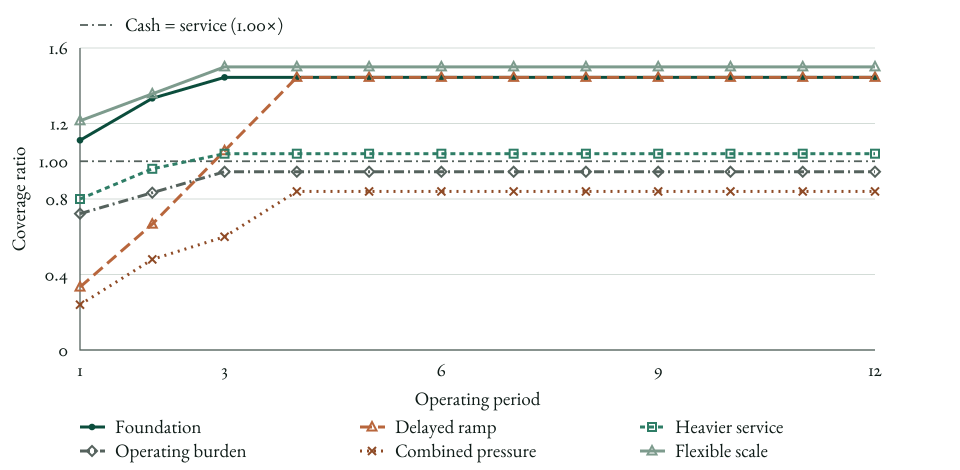
Illustrative annual CFADS/service ratios. The 1.00× line means cash equals supplied service, not a covenant. The foundation and delayed paths coincide from the mature ramp onwards; their solid-circle and dashed-triangle styles retain that overlap. Dash and marker distinctions support monochrome reading. Periods after supplied service ends are excluded.
Loan-life coverage takes a broader cash perspective, but its definition must remain precise. It compares a discounted measure of cash available over the relevant loan life with an obligation measure under the specified convention. The discount rate, included cash, treatment of reserves and balance date matter. A broad life measure can support an assessment of overall debt repayment resources while leaving a near-term cash shortage unresolved. The public app does not calculate loan-life coverage or an outstanding balance. Discussion of that concept here is therefore a boundary for specialist analysis, not a hidden additional model result.
The treatment of terminal cash deserves particular scrutiny. A disposal value or contractual end payment can contribute to an unlevered valuation even when lenders cannot rely on it for earlier service. It may also be subject to deductions, timing, condition or market uncertainty. Including terminal cash in a life-coverage calculation without explaining its availability can convert an assumption about residual value into a claim about repayment capacity. The analyst should state which obligations can actually be met by that terminal source. Where the source is material, a valuation without it is a useful challenge, provided it is presented as a deliberate scenario rather than an assertion of actual outcome.
Ratio thresholds should come from the decision context, not from the prestige of a familiar number. A selected covenant or screening boundary can reflect lender preferences, project risk, reporting periods and remedies. The analyst should distinguish a negotiated requirement from an analytical warning level and a purely illustrative benchmark. This paper does not publish a universal acceptable DSCR. The worked values compare the supplied schedules. An actual committee should identify the relevant terms and explain why the margin is adequate for the specific evidence and uncertainty, rather than treating a generic industry rule as transaction proof.
The usefulness of a coverage chart depends on stable definitions through time. If monitoring begins to exclude costs that the original forecast included, a reported improvement can be a perimeter change. If service is reprofiled, a stronger ratio can reflect reduced near-term claims rather than improved operating cash. The monitoring bridge should separate changes in numerator, denominator and definition. This allows the committee to understand whether resilience improved, support was added or the original thesis was revised. A time series without a definition bridge can reward accounting changes while failing to reveal deteriorating cash generation.
Missing values should retain their meaning. A period without defined cash availability is an evidence gap, not a zero inserted for convenience unless zero is genuinely the assumption being tested. A period without debt service is a different condition. A negative cash period can be a real cash demand requiring funding. Software should not replace these distinctions with a convenient aggregate that silently drops difficult observations. The simplified app expects finite supplied numbers, so the author must resolve the input convention before computation. The public result cannot establish that the missing operational evidence was resolved merely because the engine accepted a numeric input.
Coverage should be tested together with service continuity. A project can increase apparent cash available by postponing maintenance, cutting essential staffing or reducing service quality. Such measures may weaken future receipts or breach performance requirements. A valid operating remedy should preserve the service envelope on which the forecast relies, or explicitly revise that envelope and reappraise the asset. The committee should ask whether the proposed improvement is a genuine cash-efficiency change, a temporary deferral or a reduction in the service being financed. Coverage alone cannot distinguish these possibilities.
The practical intervention rule is period specific. Identify the weak period; state whether it is driven by cash, service or definition; identify any available funded protection; then test whether the remedy remains credible under a coherent adverse case. This avoids both complacency and automatic rejection. A weak early period can be manageable when an independently funded, timely and sufficient mechanism addresses it. A strong minimum can still be unpersuasive when the cash schedule is unsupported. The ratio is an entry point to a financing decision, not a substitute for the evidence architecture established earlier.
Evidence and scope
The World Bank financing-issues guidance distinguishes debt-service coverage for a specified period from loan-life coverage. This supports retaining periodic weakness alongside a broader resource measure. It does not supply a universal acceptance threshold or validate the illustrative inputs used in this paper.
Evidence: Key Issues in Developing Project Financed Transactions
Evidence and scope
IFC's project-finance publication defines debt-service coverage using cash available for service in the relevant period and distinguishes project economic viability from financing considerations. Its historical context is retained; it is used for conceptual definitions rather than current market terms.
Evidence: Project Finance in Developing Countries
Periodic coverage
Positive value can coexist with a weak ramp
The schedules are illustrative. Their mature operating cash and service calendar are held constant; early available cash changes. The app reports unlevered NPV and minimum periodic coverage independently.
Scroll for all columns. With the table focused, use the left and right arrow keys.
| Positive value can coexist with a weak ramp | ||||
|---|---|---|---|---|
| Schedule | Initial-period CFADS, USDm | Supplied service, USDm | Unlevered NPV, USDm | Minimum DSCR |
| Foundation | 40.00 | 36.00 | 183.05 | 1.11 |
| Delayed ramp | 12.00 | 36.00 | 127.24 | 0.33 |
Weak-period intervention rule
Select a remedy only after identifying the weak period and its causal mechanism. Review the revised calendar and any new dependencies alongside the original schedule.
- Separate operating cash weakness from a heavy obligation or a definition change.
- Identify the dated cash or support source available for the weak period.
- Test the mechanism-specific remedy while retaining service continuity.
- Show whether exposure disappears, is funded or moves to a later period.
The minimum can overstate a manageable exception
A minimum ratio can give disproportionate attention to a brief, anticipated and fully funded shortfall. A broader repayment resource measure may better explain lender recovery. This is a strong objection to using the minimum as an automatic rejection rule. It is not a reason to omit the period; the presentation should show the funded protection and its conditions.
Annual observations compress timing
The annual app verifies the supplied cash/service comparison. It does not validate a covenant definition, the right to draw protection or the recipient acceptance of a different service calendar. The calculation dictionary gives the single shared time-resolution statement; the intervention and completed committee sections retain those separate acceptance conditions.