
Decision architecture
A CFADS reconciliation worksheet and boundary challenge
Defining what lenders can receive
Cash available for debt service is a defined analytical perimeter. The phrase sounds self-explanatory, but its usefulness depends on identifying which receipts have arrived, which operating obligations have been paid and which required expenditures remain ahead of lenders. The objective is to isolate cash that can actually be applied to the specified debt obligation during the specified period. A profitability measure cannot answer that question on its own. Nor can a balance in an account if part of that balance is restricted, belongs to another party or is needed to preserve the asset's ability to operate.
Begin with the distinction between earning and collecting. Accrual revenue can be recognised before the customer pays. The asset can therefore appear profitable while cash is tied up in receivables. An increase in activity can worsen this position if the project must fund materials, staff and other inputs before collection. The financing model needs a cash conversion mechanism, including the treatment of disputes, overdue balances and write-offs. Applying a fixed collection percentage to annual revenue may be acceptable for a bounded preliminary illustration; it should not conceal the timing exposure of an actual payment mechanism.
The next boundary is between a cost recognised and a payment made. Supplier credit can temporarily improve cash availability, but extending payment does not eliminate the obligation. If the project uses overdue suppliers as an informal financing source, apparent coverage may come at the expense of service continuity or contract compliance. The analyst should distinguish agreed working-capital terms from arrears. A cash-flow statement that groups them together can make deterioration look like improved financial performance. Debt-service capacity should not be inferred from cash retained by failing to discharge obligations necessary to keep the asset functioning.
Maintenance expenditure raises a related timing problem. An asset can generate a temporary cash surplus by deferring work, yet lose reliability, useful life or contractual performance. The appropriate debt-service perimeter should reflect the maintenance required for the service and the forecast horizon. This is not an instruction to treat every proposed capital improvement as mandatory. It is a requirement to identify the technical consequence of omission. When a committee excludes a proposed item from required maintenance, it should know whether the excluded item preserves current service, expands service or merely improves optional efficiency.
Major replacements need a lifecycle view rather than an arbitrary annual average. Cash may be required in a concentrated period even when the operating margin looks stable. Reserving cash in advance can smooth funding but reduces what is distributable earlier. The model should show the distinction between expenditure, provision and restricted cash. An accounting provision does not itself make money available for the eventual replacement. A funded reserve does, subject to its access conditions. Treating both as equivalent can overstate the cash that remains available to lenders or sponsors at different points in the asset's life.
Tax and statutory payments should follow applicable obligations established by qualified advisers. A generic tax percentage on operating profit can be a useful transparent assumption in a conceptual model, but it does not establish the actual timing, deductions, incentives, withholding or transfer restrictions of a transaction. The cash perimeter must identify which tax payments precede debt service and whether refunds assumed in the model can be used when expected. The public app deliberately does not implement a tax engine. Its independently supplied cash-available schedule must be understood as an input whose construction belongs outside the simplified calculation.
Working capital is often treated as a residual line, although it can encode several mechanisms. Inventory can rise because the project is building a necessary buffer, because demand is weak or because supply is unreliable. Receivables can rise because sales are growing, customers are paying late or invoices are disputed. Payables can rise because terms are favourable or because the project lacks cash. These situations have different implications for resilience. A bridge from operating activity to cash should preserve the reason for movement, allowing the committee to judge whether a temporary cash benefit is sustainable.
Terminal cash and operating cash have different perimeters
The foundation illustration keeps the terminal residual in the unlevered valuation series while its cash-available series retains operating cash. The final divergence is an authored assumption that requires its own evidence in any transaction.
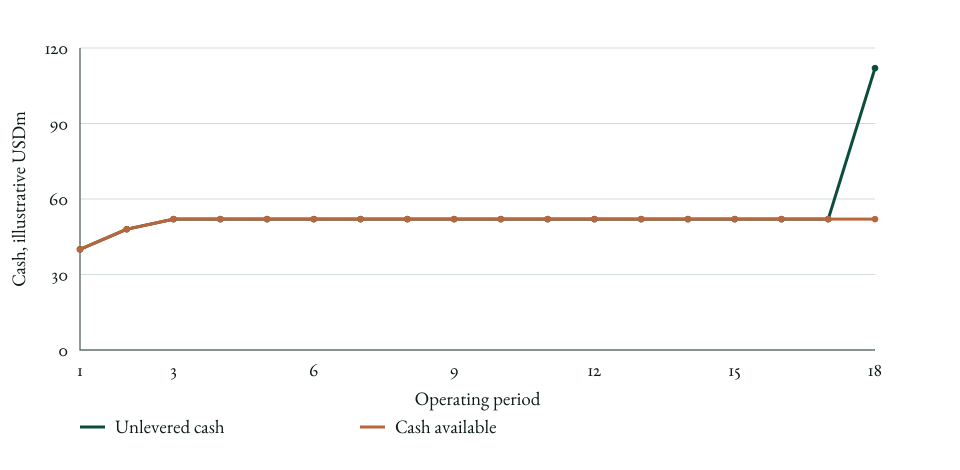
Original deterministic plot of frozen illustrative schedule outputs. Terminal cash is not automatically available for a service test. No actual residual value or operating forecast is asserted.
Restricted cash requires a control-based interpretation. Money held in a maintenance account, debt-service reserve or collection account may be legally or operationally unavailable for ordinary payments. A consolidated balance can therefore mislead the reader about immediate liquidity. The analyst should record the account purpose, permitted uses, access conditions and replenishment obligations. If a reserve can fund debt service during a stress period, that does not automatically make it part of recurring operating cash available. Combining the reserve with operating cash can conceal depletion and make a repeated shortfall appear to be normal coverage.
The financing perimeter can also differ from the accounting group. A sponsor may have cash elsewhere while the project company lacks permission or a binding right to receive it. A consolidated group can be solvent while a ring-fenced asset cannot meet its dated obligation. Conversely, a project may receive support under a properly defined arrangement even when its own operating cash is temporarily insufficient. The analyst should keep operating cash, unrestricted project liquidity and available support distinct. That separation makes the source of repayment visible and prevents a silent change from project reliance to sponsor reliance.
The canonical time-resolution boundary is recorded in the calculation dictionary. Here the distinct diligence question is asset life: identify the acceptance event and operating-right endpoint relied upon by the project cash horizon. If the right ends before the forecast cash, remove or justify that cash before comparing financing alternatives. A payment calendar cannot restore an absent right to operate. This test protects the asset-value perimeter, rather than treating every horizon dispute as a short-term liquidity problem.
An auditable reconciliation should allow the reader to move from operating records to the debt-service perimeter without unexplained residuals. Start with collected operating receipts, deduct required paid operating costs, then identify taxes, working-capital movements and lifecycle expenditure according to the stated definition. Show adjustments separately where an item is excluded or restricted. The aim is not to assert that this ordering is a universal contractual convention. The aim is to make the convention selected for the transaction explicit, so legal documents, financial forecasts and monitoring reports can use the same meaning.
The reconciliation should also reveal where an input is judgement rather than direct measurement. Expected receipts may require an assumption about collections. Maintenance cash may depend on an engineering plan. Tax cash may depend on an interpretation. A well-designed bridge retains these references instead of replacing them with a single unexplained CFADS row. This helps specialists review the part they understand while showing the financing analyst where uncertainty enters. The committee can then condition its decision on the material judgments rather than treating the presence of a named financial metric as evidence that all underlying issues have been resolved.
There is a trade-off between conservatism and usefulness. If every uncertain operating item is deducted at its most adverse value simultaneously, the resulting schedule can cease to describe a coherent operating case. If uncertain expenditure is ignored, the schedule can overstate cash capacity. The practical solution is a documented base perimeter and separate mechanism-specific stresses. A severe combined case can then be examined deliberately, with its joint assumptions visible. The committee should know whether it is viewing ordinary operating expectations, a prudent funding case or an exceptional survival case; each serves a different decision.
Cash leakage deserves attention because its classification can affect both coverage and governance. Management fees, related-party payments, discretionary expansion and distributions may be economically legitimate, yet their timing can compete with required service and lender obligations. The analyst should identify who authorises them and when they can be deferred. A fee that is contractually senior to lenders is different from an optional distribution even if both ultimately reach the sponsor group. Treating all sponsor-directed cash as subordinate can produce an inaccurate financing picture and invite disputes when monitoring begins.
The chapter's practical conclusion is a boundary challenge before a ratio challenge. Ask which cash is available, for what obligation, at what date and under whose control. Then reconcile the answer to the operating mechanism and the agreed financing definition. If the boundary remains unsettled, presenting a coverage ratio creates premature authority. If the boundary is clear, the ratio becomes a useful compressed statement whose underlying conditions can be challenged. The analytical discipline lies in preserving enough information to reverse that compression whenever the financing decision requires it.
Evidence and scope
The IFRS Foundation's cash-flow standard material distinguishes operating, investing and financing cash flows. That reporting distinction supports this paper's separation of cash movement from accrual performance. The standard does not prescribe the project-specific CFADS definition or the contractual payment priority proposed here.
Evidence: IAS 7 Statement of Cash Flows
CFADS boundary reconciliation
Complete this conceptual sheet before entering a cash-available schedule into the app. The columns specify questions and required evidence rather than invented transaction values.
Scroll for all columns. With the table focused, use the left and right arrow keys.
| CFADS boundary reconciliation | |||
|---|---|---|---|
| Boundary item | Required evidence | Treatment question | Challenge consequence |
| Collected receipts | Invoices, acceptance and collections records | Has cash arrived and is it unrestricted? | Revenue without collection cannot fund the current date |
| Operating payments | Service plan and payable schedule | Are required obligations discharged or deferred? | Arrears can create temporary apparent coverage |
| Lifecycle expenditure | Maintenance and replacement plan | What preserves the assumed service envelope? | Omission can change technical viability |
| Taxes and statutory payments | Qualified transaction-specific assessment | Which payments precede service or restrict transfer? | Generic assumptions do not establish actual availability |
| Restricted balances | Account controls and permitted-use terms | Can the balance be applied to this obligation? | A reserve use must remain visible as depletion |
Related measures answer different questions
These conceptual distinctions prevent a profitability, liquidity or account-control measure from silently replacing the defined debt-service cash perimeter.
Scroll for all columns. With the table focused, use the left and right arrow keys.
| Related measures answer different questions | ||
|---|---|---|
| Measure | Useful question | Unanswered question |
| Accrual operating performance | Is activity economically productive under the accounting basis? | When do receipts arrive and required cash payments occur? |
| Operating cash movement | What cash entered or left through operations? | Which lifecycle or financing restrictions still apply? |
| Unrestricted liquidity | What balance can be spent now? | Is that balance recurring or the result of temporary support? |
| Defined cash available | What cash can meet the specified service obligation in the period? | Is the project attractive before financing? |
A simplified cash perimeter may be appropriate
A preliminary screening model can reasonably use a compact operating cash schedule when a detailed accounting build would create false precision. The simplification should identify what is supplied independently and which exclusions could change the decision. It becomes inadequate when the financing conclusion depends on disputed working capital, maintenance, taxes or restricted accounts.
A definition must be transaction specific
This chapter supplies analytical questions, not an accounting opinion or a financing covenant definition. Actual cash availability depends on the operating perimeter, payment calendar, legal arrangements and jurisdiction. The app's supplied CFADS values do not validate those underlying conditions.