
Governance and application
A strongest-counterargument method boundary
The strongest objection to a fixed network
A fixed precedence network assumes the required work and its material relationships can be defined well enough to support a calculation. That assumption can fail during discovery, complex design or adaptive service development. New information may change the objective, reveal tasks or invalidate earlier relationships. In those settings, a complete-looking end-to-end network can create false certainty. The strongest counterargument to this playbook is therefore substantive: dependency visibility does not require pretending that every future dependency is already known.
Adaptive planning can make commitments to learning and decision points rather than to a fully specified delivery sequence. A team may first test whether a problem merits intervention, whether a technical approach is viable or whether a user need is correctly understood. The accepted outcome of that phase is evidence suitable for a decision. Subsequent work depends on what is learned. A static network can represent the bounded phase, but it should not silently extend its confidence to the undefined later undertaking.
Exhibit: evidence before irreversible commitment
Inspect the declared relationships within the captioned scope.
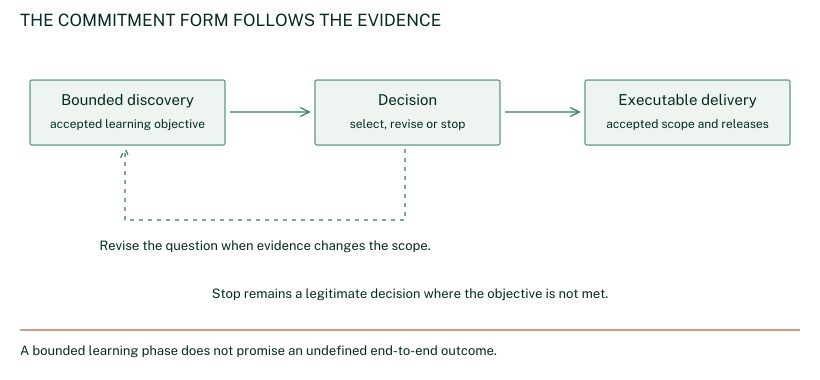
Original planning-method concept. A discovery phase can lead to revision, stopping or executable delivery. The loop represents a governance option rather than a cycle accepted by the acyclic scheduling engine. No duration or probability is inferred. The decision purpose is to preserve a credible commitment while scope remains uncertain.
The control perimeter can be staged. Define the current phase’s accepted evidence, resources and decision authority. Identify the conditional branches that may follow without assigning unsupported detail to each. A later baseline is created when the branch and scope become sufficiently clear. Preserve the earlier phase record so the project can explain why its plan changed. This is controlled adaptation rather than unrestricted movement of goals. The commitment changes because evidence changes under a stated process.
Dependency reasoning still matters in adaptive work. A discovery experiment can require data access, permission or a technical environment. A design decision can require user evidence or safety analysis. An iteration can need a recipient’s acceptance before a broader release. The difference is granularity and scope. The team should expose consequential prerequisites while allowing uncertain implementation work to evolve. Control is weakened by both overplanning unknown work and ignoring known release conditions.
The Delivery atlas is suitable for explicitly entered acyclic scenarios. It does not choose a discovery method, generate missing work or represent a continuously evolving backlog. It can help compare a bounded experiment or a conditional delivery branch once the assumptions are stated. It should not be used to claim that a novel undertaking has become predictable simply because tasks have been assigned ranges. Numerical uncertainty within known scope is different from uncertainty about what scope will be needed.
Use the planning form the evidence can support
Commit to a fixed delivery network when the scope and relationships are sufficiently executable. Use bounded learning and decision commitments when discovery can materially change them.
Commit to evidence and decision cadence
An adaptive phase should have a decision question and evidence boundary. What must be learned to decide whether to proceed, change approach or stop? Who accepts the evidence? What conditions would make the phase insufficient? These questions prevent discovery from becoming indefinite activity. They also prevent a premature delivery promise from forcing the team to ignore findings that would justify a different approach. A bounded evidence commitment can be rigorous without pretending to know the eventual implementation date.
A cadence is useful when it supports timely decisions. Regular reviews can surface new evidence, reconcile priorities and authorise the next bounded work. The cadence should not be mistaken for guaranteed progress. A meeting that occurs on schedule can leave the decision unresolved. The record should show what was accepted, what remains uncertain and what obligation the next iteration undertakes. This preserves accountability while allowing the method to adapt.
Choose the commitment form from the uncertainty
A qualitative planning framework adapts without abandoning accountability.
Scroll for all columns. With the table focused, use the left and right arrow keys.
| Choose the commitment form from the uncertainty | |||
|---|---|---|---|
| Condition | Useful commitment | Control evidence | Avoid |
| Executable scope and stable interfaces | Bounded delivery baseline | Accepted packages and duration bases | Uncontrolled changes hidden as updates |
| Uncertain solution or scope | Evidence phase and decision | Learning objective and accepting authority | Detailed end-to-end precision without basis |
| Adaptive work joins fixed external package | Explicit interface release | Stable information boundary and conditions | Assuming iteration status equals external acceptance |
| Material irreversible decision | Staged gate before commitment | Evidence that can change action | Review only after alternatives expire |
A backlog item should not be treated as equivalent to an accepted package merely because both have an identifier. The item may be a hypothesis, an implementation task or an unresolved requirement. Its status and acceptance boundary should be clear. When adaptive work joins a fixed external interface, the integration manager needs a credible release condition and forecast. The external party may not be able to absorb continuous scope change. The interface must bridge the planning methods rather than force one team’s vocabulary onto the other.
Staged commitments can preserve optionality. Before an irreversible procurement, the team may commit to a feasibility test and a design decision. Before a public service promise, it may require evidence of operating readiness. These gates should follow consequential uncertainty, not a generic bureaucracy. A gate is useful when its result can change action. Repeating the same review after the decision is effectively irreversible provides little protection and can create delay without value.
Stopping can be a successful decision. If discovery shows that the proposed intervention does not meet the objective or is inadmissible, preserving the option to stop protects resources and credibility. A schedule culture that treats every stopped project as failure encourages continuation despite adverse evidence. The charter should state when learning can justify termination or redirection. This keeps the project’s purpose above the appearance of completing its original activity list.
Adaptive language can excuse uncontrolled scope
It can when accepted evidence and decision authority are absent. Controlled adaptation preserves the question, phase boundary, rationale and history of change.
Evidence and scope
GAO agile guidance addresses requirements refinement, validation, traceability and programme monitoring in software.
Evidence: Agile Assessment Guide
Evidence and scope
Government service guidance frames discovery around understanding the problem before committing to a service solution.
Evidence: How the Discovery Phase Works
Fictional case: discovery rejects the original installation concept
A fictional sponsor begins discovery expecting to install a particular equipment system. The accepted evidence shows that the proposed configuration cannot meet the defined operating need without a material redesign. The original delivery chart would have continued toward procurement. A controlled discovery charter instead permits the sponsor to revise or stop. The case illustrates why learning must be allowed to change the plan, rather than being treated as an obstacle to an already promised solution.
The team preserves the original objective and the evidence that contradicts the proposed means. It separates the operating need from the preferred equipment concept. A different solution may meet the need, or the undertaking may no longer be justified. The authority should compare admissible alternatives using the appropriate evidence. The Delivery atlas cannot choose that solution or infer missing tasks. It can model a bounded branch only after the new scope and relationships are sufficiently clear.
Procurement exposure is reviewed before further irreversible action. Any reservation or preliminary instruction has its actual conditions and consequences. The commercial assessment uses those terms rather than a generic assumption that stopping is free or prohibitively expensive. The schedule records the decision boundary and avoids treating a pending redesign as completed design. This preserves truthful readiness while the sponsor decides.
The receiving team identifies unaffected work that could continue, if any. Its scope must be demonstrably independent of the rejected configuration. Activity for its own sake is not progress toward the accepted outcome. The manager should resist retaining tasks merely to make the programme look active. A pause can be a controlled decision when it prevents avoidable rework and preserves options. The record should state what is held, what may proceed and why.
The sponsor communicates the changed commitment honestly. The earlier chart was a conditional concept plan, not an executable promise if its scope was still under discovery. If external reliance occurred beyond that boundary, the consequences need explicit management. A new baseline should not erase the earlier communication. The edition and project history should explain the evidence that changed the decision and the authority's disposition.
The learning review evaluates the discovery phase by whether it produced useful accepted evidence in time to affect action. Rejecting the original concept can be a successful outcome of that phase. This does not imply that all projects should remain adaptive indefinitely. Once the new scope becomes executable, a controlled delivery network may be appropriate. The lesson is to match the commitment form to evidence maturity and allow a legitimate decision to change the work.
A fictional discovery-to-installation boundary
Imagine the sponsor has not yet selected the equipment configuration. The receiving works can be designed only after the relevant interface is known. An end-to-end installation chart could assign a single design duration and show a precise finish, but that would conceal the possibility that discovery selects a different configuration or rejects the concept. The manager instead defines a bounded feasibility phase with accepted evidence and a configuration decision. This qualitative case illustrates a planning choice, not a modelled forecast.
The phase has explicit prerequisites: access to requirements, relevant technical evidence and the decision authority. It has an accepted output: a reasoned configuration recommendation with its limits. The sponsor can then select, revise or stop. Once the selection is sufficiently stable, the team creates an executable supply and receiving network. The earlier discovery record remains available, explaining why the later baseline contains its particular scope and assumptions.
The fictional sponsor receives an early supplier request while equipment configuration remains unresolved. The branch record distinguishes a reservation of a production opportunity from a release of configuration-specific manufacture. Reservation may preserve an option under its actual terms; manufacture consumes that option by committing a design. The sponsor leaves the commercial exposure unresolved until those terms are reviewed and refuses to label discovery complete merely to satisfy the supplier's production form. If the eventual concept uses a different interface, the reservation is reassessed rather than treated as evidence that the selected configuration was known earlier. This is a branching commitment record, not a newly calculated network.
Unaffected work is tested by a change-of-concept counterexample. The receiving team proposes access preparation that remains necessary under the currently admissible equipment concepts. It also proposes foundations whose dimensions depend on the selected interface. The first proposal can be considered independently if its physical and commercial basis holds; the second waits for the configuration decision. The manager records the reason for this split and asks whether a newly admitted concept would invalidate it. This test is stronger than describing preparation as generally low risk. It connects each proposed activity to the uncertainty that could make the work unusable and exposes the specific scope that discovery has not yet released.
The eventual baseline carries a discovery-to-delivery transfer note. Accepted findings settle the selected interface and retire rejected concepts; unresolved supply evidence becomes an estimate-basis obligation; the independent access work is recorded as already performed within its own scope. The planner checks that the new network neither forgets that work nor credits the held foundations as completed. A discovery finding that creates a new test requirement becomes actual baseline scope rather than a generic contingency. The note's contribution is closure by consequence: each finding changes a requirement, activity, estimate or accepted exclusion. Discovery has improved the plan only where this transfer can be traced, not merely because a preceding phase has been called successful.
No method is universally superior
The app models entered DAGs only. The planning recommendation depends on scope maturity, consequence, actual interfaces and organisational authority.