
Mechanisms and worked studies
A change impact decision framework
A change affects more than its task
A proposed change should be described as a change in obligation, method or assumption before its schedule effect is calculated. A task duration revision may reflect added scope, better evidence, altered resources or a recovery method. These causes affect cost, risk, acceptance and responsibility differently. A change record that contains only an old date and a new date cannot support an informed decision. Begin with what changed and why, then trace its consequences through the delivery system.
The dependency closure is the set of successors and interfaces that may be affected. A changed equipment configuration can alter receiving works, assembly procedures, tests and operating documentation. A shortened supply duration can move assembly earlier into a period when inspection resources are unavailable. A new acceptance requirement can invalidate evidence already reported as complete. The change review should therefore inspect both the network closure and the associated package records. The app recalculates task dates, but it cannot discover these wider obligations from a duration edit alone.
Change valuation should include alternatives. Accepting the request unchanged may not be the only response. The team can reject it, defer it, separate its scope, adopt a different method or qualify the delivery promise. Each alternative needs an executable basis and consequence record. A comparison should preserve what is held constant. If one option changes scope, resources and acceptance while another changes only duration, their apparent schedule difference cannot be attributed to a single intervention. The frozen studies use narrowly declared changes to make this distinction inspectable.
Cost and benefit consequences belong to a separate valuation basis. The Delivery atlas provides no cash flow, productivity, delay damages or net present value output. A schedule change can affect those quantities, but the relationship is not a universal multiplier. The review should identify the mechanism and the evidence needed for valuation. A later service start may defer benefits; a faster method may increase resource cost; concurrent work may create rework exposure. These consequences require their own assumptions and appropriate authority.
Some conditions are noncompensable. A change that violates a safety, statutory or contractual release requirement cannot be made acceptable merely by showing a favourable date or financial benefit. The record should distinguish admissibility from preference. First determine which alternatives can lawfully and technically be considered. Then compare their consequences within that admissible set. This prevents the schedule model from becoming a device for balancing away obligations it has no authority to reinterpret.
Exhibit: the closure of an authorised change
Inspect the declared relationships within the captioned scope.
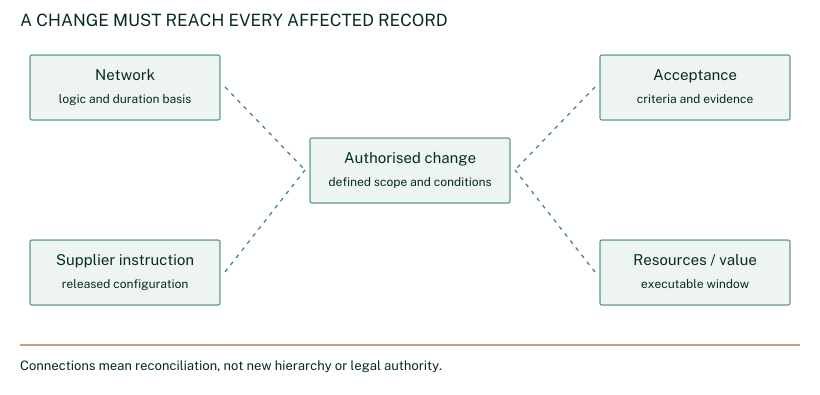
Original proposed reconciliation map. Dotted links mean that the selected change must be checked against affected records. They do not assign hierarchy, legal power or actual agreement. The model computes entered dates while supplier, acceptance, resource and value records retain their separate evidence and authorities.
Approve the complete intervention
Authorise a change only after its causal mechanism, affected obligations, admissibility and material consequences are sufficiently clear. Treat the modelled date as conditional evidence rather than the entire value case.
Control the decision while uncertainty remains
The change record should identify the decision owner and the latest responsible decision point. Some alternatives expire when equipment is released, work becomes irreversible or a resource window closes. A request left unresolved can consume the very option that would have reduced its consequence. The programme should show decision latency where it governs release, and the governance record should state what evidence is needed before the authority can act. Escalation should be tied to an expiring option, not merely a late meeting.
A forecast can incorporate a conditional change scenario before approval. Label it clearly as a scenario and retain the current authorised basis. This allows the authority to see likely consequences without confusing analysis with permission. The programme may need separate scenarios for acceptance, rejection or partial implementation. A single blended duration can obscure the fact that these are mutually exclusive decisions. The small app can reproduce each entered network separately; it does not choose the correct branch or confer change authority.
Illustrative change decision record
A supply acceleration proposal is assessed beyond its local duration.
Scroll for all columns. With the table focused, use the left and right arrow keys.
| Illustrative change decision record | |
|---|---|
| Field or action | Illustrative completed record |
| Input | Proposed change: revised supply duration basis |
| Input | Mechanism evidence: supplier capacity and method confirmation required |
| Input | Network effect: receiving branch becomes binding in the frozen study |
| Input | Other effects: inspection, logistics, cost and quality to be assessed separately |
| Input | Admissibility: actual safety, statutory and contract conditions retained |
| Input | Decision authority: sponsor within delegated change powers |
| Action | Compare executable alternatives with declared constants. |
| Action | Identify the latest responsible decision point. |
| Action | Reconcile all affected configurations and acceptance records after approval. |
A change assessment should state uncertainty in both the proposed intervention and its effects. A supplier’s suggested acceleration may depend on unconfirmed capacity. A revised design may reduce installation time but require additional testing. The record should identify what is known, what is assumed and what evidence would resolve the assumption. When a decision must precede full evidence, the authority can accept a bounded exposure with monitoring and stop conditions. That is a recorded judgment, not a claim that the uncertainty has been eliminated.
Responsibility analysis should remain separate from immediate recovery where necessary. The team may need to protect delivery before contractual allocation is resolved. A without-prejudice operational action can be appropriate under actual agreements, but the legal meaning must come from those agreements and specialist advice. The schedule record should preserve facts, instructions and reservations without inventing legal effect. Mixing every recovery discussion with an unsupported allocation claim can delay action and weaken the evidence needed for a later fair assessment.
After approval, reconcile all affected records. Update the network, scope baseline, acceptance criteria, resource plan, procurement instruction and benefit assumptions where relevant. A change is not fully controlled when only the schedule bar moves. The operator can otherwise continue using an earlier configuration while the supplier acts on the new one. The closure record should show which versions changed, who received them and which previously accepted evidence remains valid. This is practical integration, not administrative completion for its own sake.
Change review can cost more time than the change saves
Use proportionate authority and evidence for low-consequence edits. Material changes still need a clear mechanism and closure because an unreviewed local saving can create a larger integration failure.
Evidence and scope
Public appraisal guidance separates objectives, options, consequences and uncertainty in decision analysis.
Evidence: The Green Book
An illustrative supply acceleration request
In a fictional review, the supplier offers a shorter equipment supply basis. The duration-switch study represents a narrow numerical version: only the supply estimates change. Project completion becomes 17.00 weeks, and receiving works governs the accepted finish under the entered means. This result is useful because it limits the claimed benefit of supply acceleration. It does not establish the price, feasibility or risk of the supplier’s offer. Those require separate evidence outside the model.
The integration manager asks what makes the shorter duration executable. The supplier may propose additional shifts, an alternative production location or a partial release. Each has different implications. Additional shifts require capacity and quality controls. A different location may change inspections and logistics. A partial release may allow bounded work while preserving a later interface condition. The change assessment should record the actual proposed mechanism before treating the shortened task range as credible.
The manager then checks the receiving branch. If it becomes binding, further supply acceleration may not improve the overall finish. The sponsor should avoid paying for a local saving whose integrated benefit is absent unless another justified objective exists. Earlier equipment availability could still reduce another exposure or preserve optionality, but that value should be stated and supported. The network result narrows the schedule claim; it does not make the whole commercial decision automatically favourable or unfavourable.
The fictional review records an intervention comparison rather than another approval checklist. Entry SUPPLY-SHIFT keeps equipment scope intact, changes the production arrangement and requires inspection attendance at the new location. Entry RECEIVING-RELEASE retains the production arrangement but changes which receiving information can be released independently. Entry WAIT retains both arrangements and preserves the existing resource reservations. The manager rejects a combined saving claim because its supporting papers describe different interventions. The supplier offer answers the production question; the receiving sketch answers the information question; neither establishes the operator's test window. The sponsor requests the missing interaction assessment before choosing a combined method.
The resulting fictional disposition has a useful counterfactual. If the supplier's acceleration were available without changing inspection or transport, SUPPLY-SHIFT could be compared directly with WAIT for the supply mechanism. If it instead requires another factory, the inspection and logistics changes enter the same alternative and cannot be held constant in its explanation. The record retains the rejected combined claim beside the separate offers, so a later outcome review can identify which premise was actually secured. Its contribution is an incidence test: follow each proposed saving to the additional obligations it creates, and distinguish an unchanged surrounding system from a surrounding system that must change with it.
No monetary valuation is calculated here
The app computes schedule consequences only. Cost, benefit, damages and legal responsibility require distinct evidence and models.