
Mechanisms and worked studies
A declared weight-shift experiment and reversal-investigation record
Seek the conditions that could overturn the recommendation
Sensitivity should begin with a question capable of changing the recommendation. The analyst asks which reasonable alteration to performance, preference or decision scope could make a different action preferable. A chart of changing scores is useful only if its changes correspond to a decision concern. The purpose is not to decorate the baseline with reassurance. It is to expose the boundary of the recommendation, identify influential assumptions and reveal where further judgement or evidence would matter.
The app provides a specific preference challenge. It changes each normalised criterion weight upward and downward by the fixed percentage-point increment, caps the changed weight at the permitted endpoints and rescales the remaining weights proportionally. The raw performances and candidate universe stay fixed within each challenge. This is a transparent set of individual movements around the baseline. It is not a sample from a population of decision makers, and the fraction retaining the leader is not a probability that the recommendation is correct.
The choice of sensitivity movement matters. A large change can reveal whether a recommendation survives a different priority, but it may be too coarse to locate a nearby reversal boundary. A small change may diagnose local fragility while missing coherent joint changes in several weights. The analyst should describe the app routine exactly and supplement it with separately declared mandate scenarios where relevant. The comparison should not pretend that the selected challenges exhaust all legitimate preferences or all ways the underlying performance evidence could change.
A useful challenge separates the object being varied from the reason for varying it. A readiness weight might change because the committee adopts a different commitment stage. A readiness rating might change because an operating plan is verified. These are different experiments. Altering both simultaneously without a clear scenario narrative makes it hard to identify why the recommendation moves. The team can use a coherent combined scenario when the circumstances require it, but should preserve simpler comparisons that help explain the causal structure of the calculation.
Evidence and scope
Decision alternatives should be examined with explicit uncertainty and deliberation.
An illustrative contest with opposing strengths
Equal supplied weights produce tied leading preference totals for proposals with different profiles. The engine displays tied alternatives in literal text order. It does not establish substantive priority between the tied alternatives. Literal text order compares code units using JavaScript string comparison, independently of browser language; it is a display convention for equal totals. All co-leading alternatives remain substantively tied under the represented preference.
Scroll for all columns. With the table focused, use the left and right arrow keys.
| An illustrative contest with opposing strengths | |||||
|---|---|---|---|---|---|
| Alternative | Cost | Impact | Readiness | Risk | Score |
| Flexible service | 70.00 | 80.00 | 75.00 | 30.00 | 50.00 |
| Operating readiness | 90.00 | 65.00 | 95.00 | 20.00 | 50.00 |
| Balanced capacity | 80.00 | 75.00 | 80.00 | 25.00 | 47.92 |
Canonical close-contest input and output. Capital cost is illustrative USDm; impact, readiness and risk are supplied ratings. Scores are preference points under the frozen vector.
The selected individual preference challenges
The raw candidate performances remain fixed. Each row reports the criterion being changed, the resulting weight, the preferred display entry and the resulting leading score. The full ordering is retained in the frozen output for replication.
Scroll for all columns. With the table focused, use the left and right arrow keys.
| The selected individual preference challenges | ||||
|---|---|---|---|---|
| Changed criterion | Shift in percentage points | Resulting weight | Preferred entry | Leading score |
| Capital cost | -20.00 | 5.00 | Operating readiness | 63.33 |
| Capital cost | 20.00 | 45.00 | Flexible service | 63.33 |
| Strategic impact | -20.00 | 5.00 | Operating readiness | 63.33 |
| Strategic impact | 20.00 | 45.00 | Flexible service | 63.33 |
| Readiness | -20.00 | 5.00 | Flexible service | 63.33 |
| Readiness | 20.00 | 45.00 | Operating readiness | 63.33 |
| Execution risk | -20.00 | 5.00 | Flexible service | 63.33 |
| Execution risk | 20.00 | 45.00 | Operating readiness | 63.33 |
Canonical close-contest sensitivity output. Weight values are percentages; leading scores are preference points. The challenge set is deterministic and does not represent a probability distribution.
Different tradeoffs move the baseline display entry
The illustrative diagnostic selects capital-cost and readiness challenges and shows the position of the original literal text display entry after each movement. The complete table retains every criterion challenge. The base substantive preference is tied; this diagnostic does not turn that display convention into a uniquely preferred option.
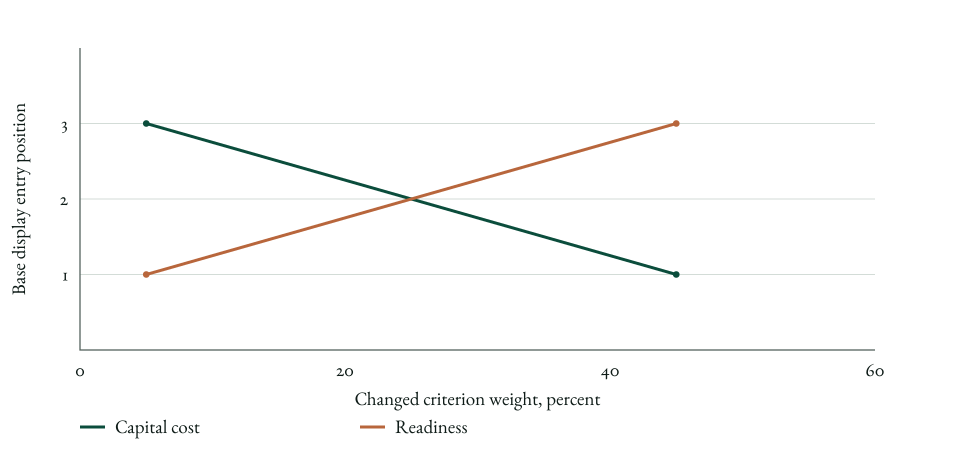
Original deterministic drawing from close-contest canonical output pointers. Lower vertical position is a lower displayed rank. Connectors pair discrete tests only; intermediate positions are not computed and the lines do not estimate a continuous rank curve or reversal boundary. Read the preferred names in the accompanying table.
What the experiment actually establishes
The illustrative base scores for Flexible service and Operating readiness are both 50.00. The app reports a leader-retention fraction of 50.00 percent across its selected individual challenges. Lower emphasis on capital cost produces Operating readiness as the preferred entry, while greater emphasis on capital cost produces Flexible service. This demonstrates dependence on the declared tradeoff. It does not estimate a chance that either intervention will succeed.
The tie provides a useful adversarial case because a stable literal text display must not be mistaken for a robust substantive choice. The engine needs a deterministic ordering to display and export equal totals. The committee needs a decision rule when the represented preference leaves alternatives indifferent. It might request additional evidence, acknowledge that either option is acceptable under the declared model or apply an authorised secondary consideration. It should not manufacture precision by presenting the first displayed name as a uniquely justified winner.
The close contest also shows why the identity of the leader is only part of the sensitivity record. Changes may move the original leader below other candidates, change the margin between challengers or affect the ordering of options relevant to a staged programme. The full ranking is therefore retained. A leader-only percentage compresses these distinctions. If a committee plans to keep a reserve option or investigate a runner-up, its sensitivity question should concern that position as well as the first entry.
A more stable reference can still have important limitations. In the balanced fixture, the preferred entry survives the app's selected individual shifts. That is useful evidence about this particular challenge set. It does not mean that a coherent joint change cannot alter the leader, that changed performance inputs cannot matter or that a different candidate universe preserves the scale. The mandate and evidence scenarios in this paper examine some of those other changes explicitly. They should be read alongside the local weight routine, without collapsing them into a single unexplained confidence label.
A recommendation should identify its important reversal conditions in ordinary language. For the close contest, a committee that values lower cost and stronger represented impact differently from operating readiness and risk can favour a different proposal. This is a tradeoff dispute, not necessarily an estimation failure. If both perspectives are legitimate and the commitment is consequential, the next step may be a facilitated mandate discussion. Gathering more engineering detail will not resolve a disagreement about the authorised preference unless the new detail changes the relevant interpretation.
By contrast, a reversal caused by a disputed raw rating can justify targeted evidence work. The analyst should state which proposition needs resolution, what information could change it and what action would follow either conclusion. That structure connects sensitivity to an investigation plan. It also prevents indiscriminate diligence in which every uncertain attribute receives the same attention. The decision-relevant question is whether plausible revision could alter the choice, commitment conditions or scope of the next action.
Sensitivity scenarios need admissibility checks of their own. A weight vector that removes a mandatory concern may be mathematically valid but institutionally illegitimate. A performance scenario that combines favourable assumptions inconsistent with the engineering design may be impossible. A changed universe containing a proposal outside the decision envelope may answer a different question. The team should distinguish logical model experiments from credible decision scenarios. Both can be educational, but only the latter directly support a commitment discussion under the actual charter.
The team should resist tuning the range of challenges after seeing a preferred outcome. If the report only includes shifts that preserve the sponsor's candidate, the stability display becomes a selection artefact. A predeclared challenge plan can reduce that discretion. It names the kinds of variation, their rationale and the criteria for adding a new challenge when evidence arrives. Unexpected fragility should be retained in the record. A method earns trust by exposing awkward results and explaining their consequence, not by producing reassurance on demand.
Finding no reversal is also a result that needs disciplined interpretation. It may mean the recommendation is stable over a relevant set of changes. It may mean the experiment was too narrow, the tested alternatives are far apart or the changed assumption is not influential. The analyst should say what remained fixed and why the tested movements were relevant. A claim of robustness without that perimeter says little. A bounded statement allows another reviewer to identify a missing challenge and extend the work productively.
The report should keep computation, interpretation and action separate. Computation identifies the ordering under each supplied scenario. Interpretation explains which tradeoff or evidence change produced it. Action decides whether to commit, investigate, redesign or deliberate further. A reversal can lead to different actions depending on whether it arises from legitimate preference disagreement, weak evidence or an invalid option definition. The same movement in a chart does not prescribe the same governance response.
Predeclare the challenge and the consequence
State the baseline recommendation and the uncertainty or preference dispute being tested. Identify what changes and what remains fixed. Check that each decision scenario is credible under the charter, while labelling purely logical experiments separately. Run the canonical comparison, inspect full ordering and ties, then explain the reversal or retention in terms of the changed assumption. Connect that explanation to a specific action: additional evidence, mandate deliberation, redesign or a conditional commitment. Retain inconvenient outcomes and disclose the untested parts of the decision space.
The case for a single stability number
A single leader-retention number can help readers recognise that a recommendation deserves a sensitivity discussion. It becomes misleading when presented as confidence, reliability or likelihood. The repair is to keep the number beside the exact challenge definition and a table showing which scenarios change the preferred entry. For a tied baseline, the display-order convention also needs explicit treatment. The summary remains useful when it directs attention to the detailed explanation rather than replacing it.
Selected shifts do not establish global robustness
The app sensitivity routine is deterministic, local to the supplied vector and limited to individual weight shifts. It does not explore every joint vector, perform probabilistic uncertainty analysis or calculate a reversal boundary analytically. The close-contest fixture is an authored example of conditional preference and tied-score interpretation. It is not a sample of actual investment decisions. A stable leader in the selected tests cannot establish that the full decision is robust to changed eligibility, funding, evidence or interactions.