
Governance and application
A qualitative dependency diagram and incremental-evidence challenge
Several reports may carry the same underlying evidence
Several pieces of evidence do not automatically provide several independent improvements in a decision. Signals may share data, a physical cause, an expert panel or a selection process. Their apparent agreement can therefore reflect the same information repeated through different channels. The binary engine evaluates a single supplied signal against a current prior. It has no joint-signal likelihood model. A report using it should not multiply several instrument claims or add separate information values as though dependence had been resolved.
The prior may already incorporate evidence similar to the proposed signal. If the committee has screened opportunities using an early technical result, a later test evaluated on the same screened population can overlap with what is already known. The correct current prior should condition on the existing information set, and the new likelihood should describe the additional signal in that context. The simple app accepts those numbers but does not derive the bridge. A provenance register should state what evidence has already entered the current belief and why the new instrument adds distinct information.
Shared data can create an especially subtle duplication. A market report and an internal forecast may both depend on the same survey, while a technical assessment and an engineering estimate may both use the same assumptions about operating conditions. Treating their agreement as independent confirmation can overstate confidence. The evidence map should trace inputs rather than count report titles. A committee should ask whether each source provides a new observation, a new model using old observations or a new interpretation of the same underlying evidence.
Shared expert judgement presents a similar issue. Several reports can cite the same specialist or institutional consensus. Their publication by different organisations does not necessarily make them independent evidence of the state. An elicitation process should record who participated, what information participants shared and how judgements were aggregated. The current paper does not estimate correlations between experts or prescribe a universal aggregation rule. It recommends retaining the dependency question so that a numerical prior does not gain authority merely from repeated citation.
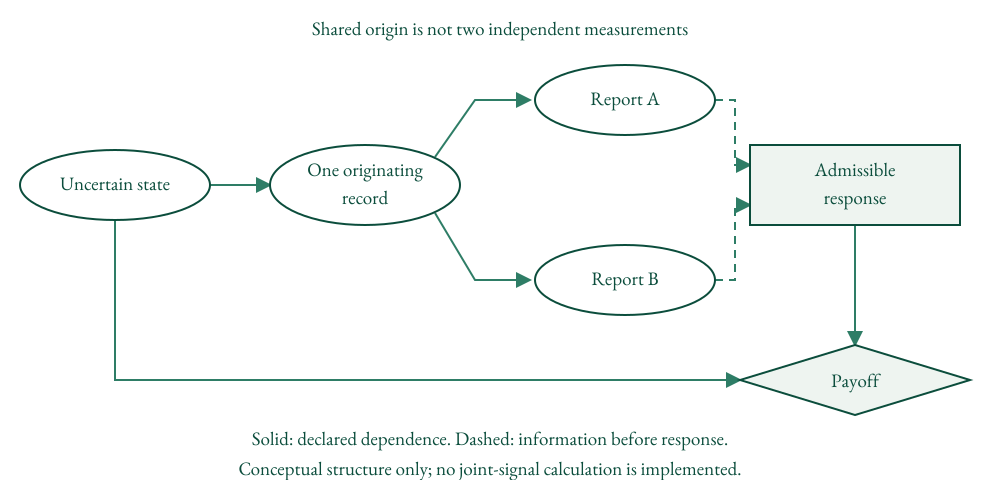
Shared origin is not independent confirmation
Original qualitative influence structure for a duplicated-origin evidence case. The reports share a parent record, so their likelihoods cannot be multiplied as independent new measurements without a justified joint model. Dashed edges identify information available before the response; the payoff depends on the state and chosen action. This diagram does not extend the binary-signal app into a joint or causal inference engine.
Signals can also depend on the state in a way that requires conditional modelling. Two instruments may both respond to an underlying defect or market condition, so their joint likelihood cannot be reconstructed from their individual marginal performance alone. A joint model needs evidence or assumptions about their combined outcomes given each state. The binary app supplies neither a joint table nor a graphical dependency network. A reader who wants to evaluate a sequence or combination of tests should use a method that actually represents those outcomes and preserve the assumptions for reproduction.
The independence assumption is not inherently unacceptable. It can be a useful simplification when supported or when a sensitivity study shows that dependence does not alter the choice. The problem is treating independence as the default merely because it makes arithmetic easier. A decision package should state why the assumption is reasonable for the intended use and how the recommendation changes if it fails. If those checks have not been performed, the report should identify the missing analysis rather than present an independent-combination result as established evidence.
Adding separate information values can double count response benefits. If either of two signals alone would cause the committee to choose the same improved action, the second may have little incremental value after the first is known. The value of a signal should be evaluated against the best current action using the current information set. Once another signal has updated that set, the benchmark and branch probabilities can change. A sum of standalone EVSIs calculated from the same original prior does not generally represent the value of a research package.
The order of evidence acquisition can matter. An inexpensive early signal may determine whether an expensive study is still worthwhile. A costly signal may become redundant after an external result arrives. A later test may target a subgroup defined by an earlier result, changing its use population. These are sequential decisions with conditional acquisition costs and response options. The simple fixed-signal engine cannot calculate an adaptive programme from an action label. It can support explicitly revised snapshots, but a series of snapshots is not automatically a complete dynamic optimisation.
The charter should also distinguish repeated measurement from independent state evidence. Repeating an instrument can improve knowledge of measurement variability under appropriate conditions, but it may not resolve a shared systematic bias or an omitted state. A report that reduces a random error metric can still leave the decision uncertainty unchanged. The metrology account and the commercial state account need a supported bridge. This is why a precise measurement, a well-reproduced computation and a well-calibrated success probability remain different evidence objects.
An adverse result can reveal a dependency the initial model missed. If several supposedly independent signals fail together, the institution should investigate their shared mechanism before simply requesting another of the same kind. The paper makes no empirical assertion about any actual instrument. It identifies a plausible failure that should have an escalation rule. The evidence map should be revised with the new information, and the decision model should be rerun only when its updated assumptions and scope are sufficiently defined.
Source independence and method diversity are also different. A new analytical method can interrogate the same data and expose a modelling weakness without supplying an independent observation of the state. That can be valuable for assurance. It should be described as a robustness or method challenge rather than counted as another independent confirmation. Conversely, a new observation can add information even when processed through the same model. The committee needs the evidence object's origin and role, not merely a tally of approaches or publications.
The practical dependency map should connect the current prior, proposed signal, validation evidence and action payoff estimates. A study might share assumptions with the payoffs as well as the state model. If a favourable instrument result is used to justify a larger payoff that already assumed that result, the appraisal can count the same improvement in both probability and consequence. The author should trace the bridge and retain a consistent revised fixture. A narrative statement that inputs are conservative does not replace this coherence check.
A duplicate-evidence walkthrough can expose the dependency before any joint calculation is attempted. In a hypothetical packet, the prior already reflects an engineering assessment and a proposed second report summarises that same assessment through another publisher. A new document has arrived, but the underlying state evidence has not necessarily changed. Mark the shared assessment at both uses and ask what additional observation the second report supplies. If it supplies only interpretation, treat the task as interpretation rather than another independent likelihood update. If it supplies new observations with shared measurement error, a joint account may be required. Counting publishers or methods alone cannot determine which branch applies.
The order of acquisition should be assessed through the decision remaining after the earlier result. A hypothetical first report may make the same feasible action best across all outcomes of a later instrument, leaving little action value for the later commission even if that instrument remains accurate. Another first result may move the institution near an active switch and make the later distinction useful. These conditional branches explain why standalone values should not be added. The single-signal studies illustrate the action-change mechanism, while a numerical package value would require the joint and sequential method absent from the app. The dependency map should identify that missing object rather than supply invented combined probabilities.
Evidence and scope
NIST structures risk assessment through preparation, conduct and maintenance within organisational risk management.
Evidence: Guide for Conducting Risk Assessments
Completed illustrative evidence dependency map
No joint likelihoods are invented. Unresolved relationships remain visible.
Scroll for all columns. With the table focused, use the left and right arrow keys.
| Completed illustrative evidence dependency map | |||
|---|---|---|---|
| Evidence object | Possible shared input | Question before combining | Current treatment |
| Current prior | Existing technical screen | Is the new signal already partly known? | Declared pre-signal information set |
| Instrument likelihoods | Validation population | Does selection alter intended-use performance? | Fixed illustrative assumptions |
| Second proposed test | Same underlying condition | What are joint outcomes given each state? | Outside single-signal model |
| Expert judgement | Shared reports or panel | Is agreement independent evidence? | Elicitation provenance required |
| Payoff matrix | Same favourable operating assumption | Is benefit counted in both likelihood and payoff? | Perimeter coherence review |
| Repeated measurement | Shared systematic bias | What uncertainty does repetition resolve? | Measurement bridge unresolved |
Commission incremental evidence against the current information set
Trace underlying data and assumptions before counting report agreement. Keep a new observation distinct from a new method applied to old data. Do not add standalone signal values or combine marginal likelihoods without an appropriate dependency account. Use a joint or sequential model when those relationships determine the purchase, and preserve the single-signal result as a scoped illustration.
- Map evidence already embedded in the prior.
- Identify shared data, causes and expert inputs.
- Review marginal versus joint performance.
- Reassess incremental value after other evidence arrives.
A qualitative dependency review can be enough for screening
Not every decision needs a large joint model. A qualitative map can identify major overlaps, remove redundant commissions and show that remaining uncertainty is unlikely to change a bounded screening choice. The report should state that limited purpose. When a consequential recommendation relies on the exact benefit of several correlated signals, a qualitative map alone cannot establish the combined value.
No joint or adaptive signal computation is implemented
The engine evaluates a single binary signal with fixed likelihoods. It does not estimate correlations, calculate a joint likelihood table, optimise a test sequence or integrate repeated measurement uncertainty. The dependency worksheet identifies required evidence and method boundaries; it supplies no new quantitative result.